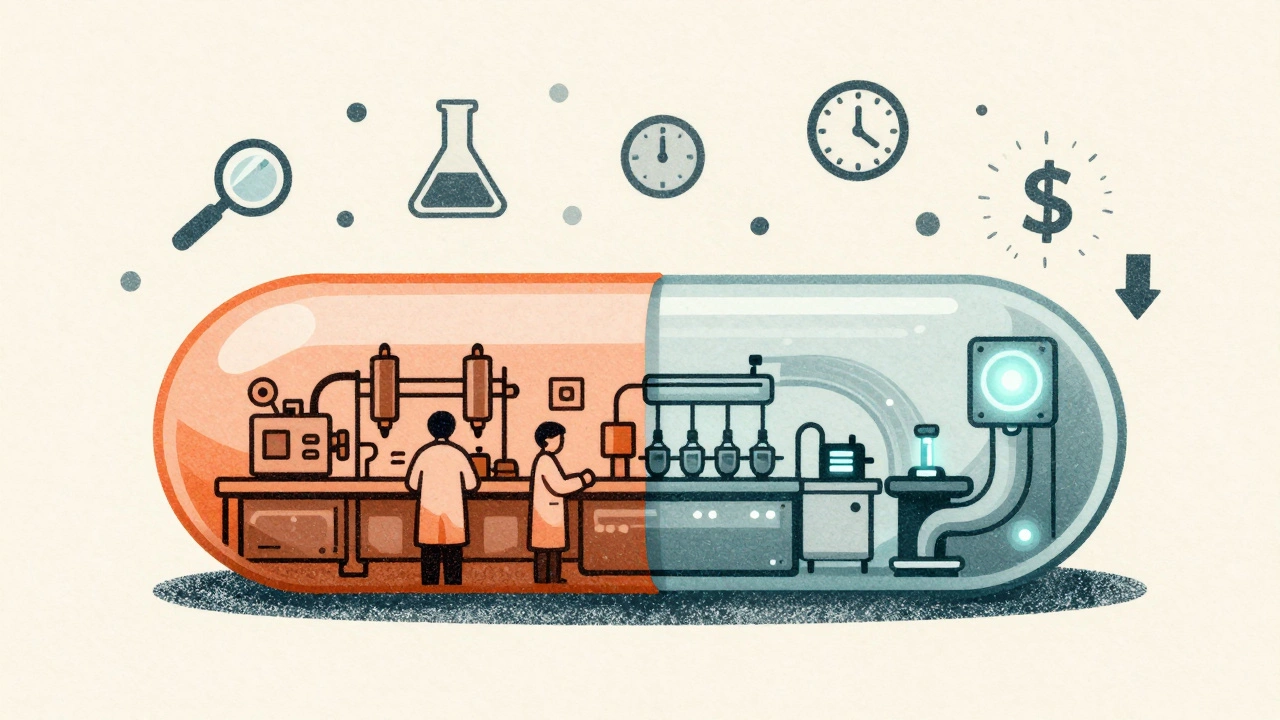
When a generic drug hits the market, it’s not the end of the story. Even after FDA approval, manufacturers can’t just keep making it the same way forever. A small tweak in the production line - a new machine, a different supplier, a bigger batch size - can trigger a full regulatory re-evaluation. For generic drug makers, these changes aren’t just technical decisions. They’re legal, financial, and strategic moves with serious consequences.
What kind of manufacturing changes force the FDA to step back in?
The FDA doesn’t treat every change the same. It uses a risk-based system to decide whether a change needs full review or can be made quietly. There are three main categories: Prior Approval Supplements (PAS), Changes Being Effected (CBE), and Annual Reports (AR).
Prior Approval Supplements (PAS) are the big ones. You can’t make the change until the FDA says yes. These are required for:
- Switching to a completely new manufacturing process
- Changing the drug substance synthesis route (how the active ingredient is made)
- Transferring production to a new facility
- Significant scale-up or scale-down of batch size
- Adding new specifications for impurities or potency
For example, if a company wants to increase tablet production from 1 million to 5 million per month, that’s not just a bigger machine - it’s a PAS. The FDA needs proof the drug still dissolves the same way, stays stable, and matches the brand-name version. One case from 2022 showed a 30% batch size increase took 14 months to get approved because the FDA demanded six months of stability data and full process validation.
Changes Being Effected (CBE) let manufacturers make changes right away - but they still have to tell the FDA. This applies to minor changes like swapping out a non-critical component, updating packaging, or adjusting in-process controls. You submit the notice within 30 days (CBE-30) or immediately (CBE-0) if it’s a safety improvement.
Annual Reports (AR) are for the smallest tweaks - things like updating a label, changing a supplier for a non-critical excipient, or minor equipment maintenance. You just report it once a year.
The line between CBE and PAS is where most companies struggle. A 2023 survey found that 78.4% of generic manufacturers had trouble deciding which category their change belonged to. One quality manager on Reddit described waiting 18 months for approval on a tablet press upgrade - even though the final product tested identical to before. The FDA didn’t reject it; they just kept asking for more data.
Why does the FDA care so much?
Generic drugs are supposed to be identical to the brand-name version - same active ingredient, same dose, same effect. That’s the whole point. The FDA doesn’t require new clinical trials for generics, but it does demand that any change doesn’t break that equivalence.
That means every change must be backed by science:
- Comparative analytical testing to prove chemical identity and purity
- Stability studies showing the drug won’t degrade faster
- Bioequivalence studies if the change could affect how the body absorbs the drug
For complex generics - like inhalers, injectables, or peptide drugs - the bar is even higher. The FDA requires that any new impurity in a peptide drug must be under 0.5%, and you have to prove it doesn’t affect safety. That’s not just paperwork. It’s lab work, validation, and often months of testing.
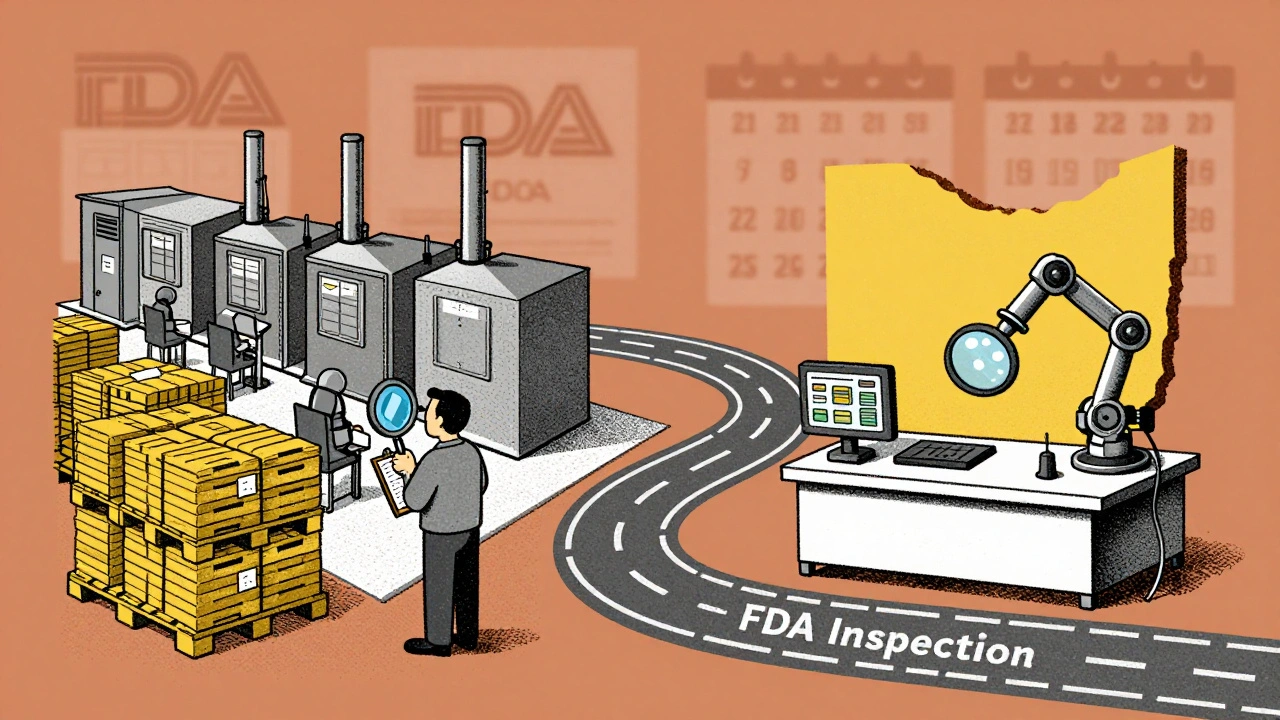
And it’s not just about the drug itself. The FDA also checks the facility. If you move production from a plant in India to one in Ohio, expect an inspection. The agency doesn’t just review documents - they send teams to see how things are done on the floor.
The hidden cost of change
It’s not just time. It’s money.
According to 2023 industry data, a single PAS submission costs an average of $287,500. That includes consulting, testing, documentation, and FDA user fees. For a low-margin generic drug selling for pennies per pill, that’s a hard sell to executives.
That’s why many companies avoid improvements. A quality professional from a mid-sized generic maker told me: “We had a chance to switch to continuous manufacturing - it’s faster, cleaner, more consistent. But the PAS process was too risky. We’d lose market share while waiting for approval. So we stuck with the old way.”
Meanwhile, the FDA’s review times are long. PAS submissions take an average of 10 months. Complex ones? Up to 14. And 68.4% of PAS submissions get a “complete response letter” - meaning the FDA asks for more data, more studies, more explanations. It’s not a rejection. It’s a delay. And delays mean lost sales.
What’s changing? New paths to faster approval
There’s good news. The FDA is trying to fix this.
In September 2023, they launched the ANDA Prioritization Pilot Program. If you make your generic drug in the U.S. - from the active ingredient to the final pill - and test it here too, your review time drops from 30 months to as little as 8 months. That’s not a typo. Eight months.
This isn’t just about speed. It’s about incentives. The FDA wants to bring manufacturing back to the U.S. Commissioner Robert Califf said the goal is to spur $4.2 billion in new domestic investment by 2027. Companies like Teva are already using this. Their amlodipine (a blood pressure drug) went from traditional batch manufacturing to continuous manufacturing in 2022. With pre-submission meetings and full transparency, their PAS was approved in just 8 months.
Another new tool is the PreCheck program, announced in February 2024. It’s a two-phase review for high-priority facilities. Instead of waiting 18 months for a facility transfer, you could get approved in 9.
And in 2024, the FDA released draft guidance for complex generics that could reduce PAS submissions by up to 35% for minor changes. If this becomes final, it means more room to improve without hitting the regulatory wall.
How can manufacturers avoid the bottleneck?
The smartest companies don’t wait for change to happen. They plan for it from day one.
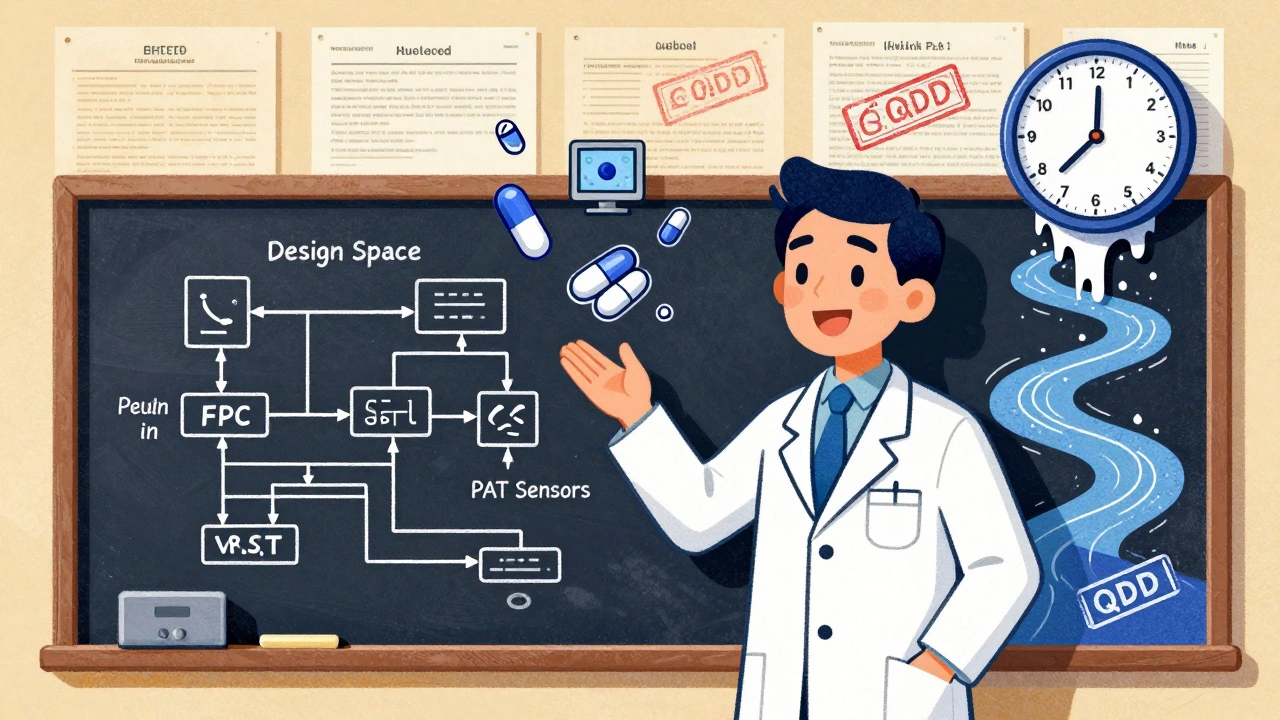
Quality by Design (QbD) is the game-changer. Instead of building a process that works just for the initial approval, QbD builds in flexibility. You map out the “design space” - the range of conditions where the drug still performs the same. If you know your tablet’s hardness can vary between 6 and 10 kg without affecting dissolution, you don’t need a PAS when you tweak the press.
Companies using QbD during ANDA development report up to 40% fewer post-approval changes. Sandoz and Mylan cut their PAS approval times by over 30% by doing this.
Another tactic? Process Analytical Technology (PAT). These are real-time sensors that monitor the manufacturing process. If you can measure moisture, particle size, or blend uniformity as the batch runs, you catch problems early. Manufacturers using PAT saw 32.6% fewer PAS submissions over five years.
And don’t underestimate pre-submission meetings. The FDA’s own guidance says to schedule 3-5 of them for complex changes. It’s not a formality. It’s a chance to get feedback before you spend $200,000 on a submission that gets rejected.
What’s next?
The next big shift is coming with GDUFA IV, the next round of user fee negotiations set for 2025. Industry groups are pushing for standardized rules for classifying changes. Right now, one FDA division might call a change a PAS, while another calls it a CBE. That inconsistency causes delays and confusion.
By 2026, experts predict 37.5% of new generic approvals will qualify for expedited pathways. That means more U.S.-made drugs, faster approvals, and fewer supply chain surprises.
But the real winner? Manufacturers who treat change not as a problem to avoid, but as a design challenge to solve. The ones who invest in QbD, PAT, and early FDA dialogue aren’t just surviving - they’re gaining market share. Because in the world of generics, the fastest way to win isn’t the lowest price. It’s the most predictable path to approval.
What triggers a full FDA re-evaluation for a generic drug after approval?
A full re-evaluation - usually through a Prior Approval Supplement (PAS) - is triggered by major manufacturing changes that could affect the drug’s safety, identity, strength, quality, or purity. This includes switching the production process, changing the active ingredient’s synthesis route, moving manufacturing to a new facility, significantly scaling up or down batch size, or adding new impurity limits. The FDA requires scientific proof that the modified product remains bioequivalent to the brand-name drug.
Can I make a small change to my generic drug without FDA approval?
Yes, but only if it falls under the Changes Being Effected (CBE) or Annual Report (AR) categories. Minor changes like updating packaging, switching a non-critical excipient supplier, or adjusting in-process controls can be made with a CBE-30 (notice within 30 days) or CBE-0 (immediate notice). For very low-risk changes, like label updates, you can report them in your annual report. But if you’re unsure, it’s safer to assume it needs a PAS - the FDA doesn’t reward guessing.
How long does it take the FDA to approve a manufacturing change?
Review times vary by submission type. Prior Approval Supplements (PAS) take an average of 10 months, but complex changes can stretch to 14 months or more. CBE-30 submissions are reviewed in about 3 months, while CBE-0 submissions are reviewed within 9 months. Under the new ANDA Prioritization Pilot Program, manufacturers with U.S.-based production can get PAS approval in as little as 8 months.
Why are PAS submissions so expensive and slow?
PAS submissions require extensive documentation: analytical data, stability studies, bioequivalence results, facility validation, and sometimes even new clinical data. The average cost is $287,500 per submission. The FDA reviews these thoroughly because even small changes can affect how the body absorbs the drug. Many PAS submissions (68.4%) get a complete response letter, requiring more data - which adds months to the timeline. The system was built for safety, not speed, and low profit margins make many companies avoid it altogether.
Are there ways to reduce the need for PAS submissions?
Yes. Using Quality by Design (QbD) during initial development lets you define a safe operating range for your process - so minor changes don’t trigger a PAS. Implementing Process Analytical Technology (PAT) for real-time monitoring reduces variability and surprises. Pre-submission meetings with the FDA help clarify expectations. Companies using these strategies report 30-40% fewer PAS submissions. The new draft guidance for complex generics could also reduce PAS requirements by up to 35% for minor changes.
Roger Leiton
December 3, 2025 AT 02:37
Man, I had no idea a simple batch size increase could take 14 months to get approved 😳
My cousin works at a generic pharma co and they just shelved a continuous manufacturing upgrade because of this. The cost alone is insane.
Also, why does the FDA need six months of stability data for a 30% increase? That’s like asking for a decade of weather forecasts after one rainstorm 🤦♂️
Laura Baur
December 4, 2025 AT 16:25
Let us not mince words: the FDA’s regulatory framework is a monument to institutional inertia masquerading as safety. The notion that a 30% increase in batch size necessitates a full re-validation of bioequivalence is not science-it is bureaucratic fetishism.
One must ask: if the chemical identity, dissolution profile, and impurity thresholds remain identical, what precisely is being safeguarded? The answer, of course, is not public health-it is the myth of absolute reproducibility in an inherently variable physical world.
Quality by Design is not a tool; it is a philosophical rupture from the 1980s paradigm of end-product testing. Yet even this is insufficient, for the FDA still treats process parameters as sacred rather than probabilistic.
And let us not forget the grotesque economic distortion: a $287,500 fee to change a machine setting. This is not regulation-it is rent-seeking disguised as public service.
The ANDA Prioritization Pilot is a step toward sanity, but until the agency embraces risk-based, data-driven decision-making over procedural dogma, we are merely rearranging deck chairs on the Titanic.
And yes, I have read the GDUFA IV draft. The language is still vague. Vagueness is the last refuge of the unaccountable.
Jack Dao
December 5, 2025 AT 18:26
Wow, so you’re telling me the FDA cares more about paperwork than actual patient access? 😒
Meanwhile, people in rural towns can’t get their blood pressure meds because some bureaucrat needs 14 more months of data on a tablet press.
Real talk: if you’re making the same damn pill, why are we treating it like a nuclear launch code?
Also, why is Teva getting VIP treatment? Is it because they’re big and have lobbyists? 🤔
dave nevogt
December 7, 2025 AT 00:03
There’s something deeply human in how we treat manufacturing changes like moral transgressions rather than engineering adjustments.
We demand perfection from machines, but we’ve built a system that punishes evolution. The FDA’s fear isn’t of bad drugs-it’s of uncertainty.
Every PAS submission is a confession of doubt: ‘We don’t trust our own process enough to let it adapt.’
QbD and PAT aren’t just tools-they’re cultural shifts. They say: ‘We understand variability. We don’t fear it. We map it.’
But the system doesn’t reward understanding. It rewards compliance.
And so we get 14-month reviews for changes that don’t alter a single molecule’s behavior.
It’s not about safety. It’s about control.
And control, in the end, is the only thing more expensive than innovation.
Arun kumar
December 8, 2025 AT 20:12
bro in india we just change supplier and no one care 😅
but i know here its diffrent
still $287k for a machine upgrade? that’s more than my yearly salary 😂
Zed theMartian
December 9, 2025 AT 22:56
Oh, so now the FDA is a venture capital fund disguised as a regulatory body?
‘Oh, you made your drug in America? Here’s a gold star and a 3-month approval!’
What’s next? Tax breaks for companies that use American-made packaging tape?
This isn’t innovation-it’s nationalism dressed in lab coats.
And let’s be real: if this pilot actually works, it’ll be because Teva bribed someone. Not because ‘science’ changed.
Also, ‘continuous manufacturing’? That’s just fancy talk for ‘we finally automated the 1980s.’
Stop pretending this is progress. It’s PR.
Ella van Rij
December 10, 2025 AT 07:38
So the FDA takes 14 months to approve a tablet press upgrade... but somehow my Amazon package arrives in 2 days? 🤔
Also, ‘pre-submission meetings’? So I pay $287k to get feedback... then pay another $287k to fix it? Brilliant.
At this point, I’m just waiting for the FDA to start charging me for breathing near the manufacturing floor.
Also, QbD? Sounds like a new yoga trend. 🧘♀️
ATUL BHARDWAJ
December 10, 2025 AT 20:07
Change is hard. FDA is slow. But safety first.
Simple.
Steve World Shopping
December 11, 2025 AT 08:09
The regulatory architecture is fundamentally misaligned with the velocity of modern pharmaceutical engineering. The PAS framework is a legacy artifact predicated on analog-era assumptions of process homogeneity, which are now rendered obsolete by stochastic manufacturing paradigms enabled by PAT and digital twins.
The current compliance burden is not a feature-it is a systemic pathology. The 68.4% complete response rate is not inefficiency-it is epistemic resistance to adaptive systems.
Until the FDA transitions from artifact-based validation to process-centric risk modeling, we are merely optimizing the wrong variable.
And let’s be clear: the $287,500 cost is not excessive-it is the market-clearing price for institutional entropy.
Rebecca M.
December 12, 2025 AT 18:53
Oh, so now the FDA is the villain in a corporate drama? How original.
Meanwhile, real people are running out of meds because some CEO decided ‘it’s cheaper to wait than to innovate.’
And you call that ‘strategic’? Nah. That’s cowardice with a PowerPoint.
I hope your shareholders are proud.
Lynn Steiner
December 14, 2025 AT 03:55
They’re letting Teva skip the line because they’re American? 😭
What about the little guys? The ones who actually care about patients? Not profits?
This isn’t fairness. This is capitalism wearing a white coat.
I’m so mad I could cry. 💔
Alicia Marks
December 15, 2025 AT 23:54
Small changes, big impact. Keep pushing for QbD and PAT-your patients will thank you. 💪