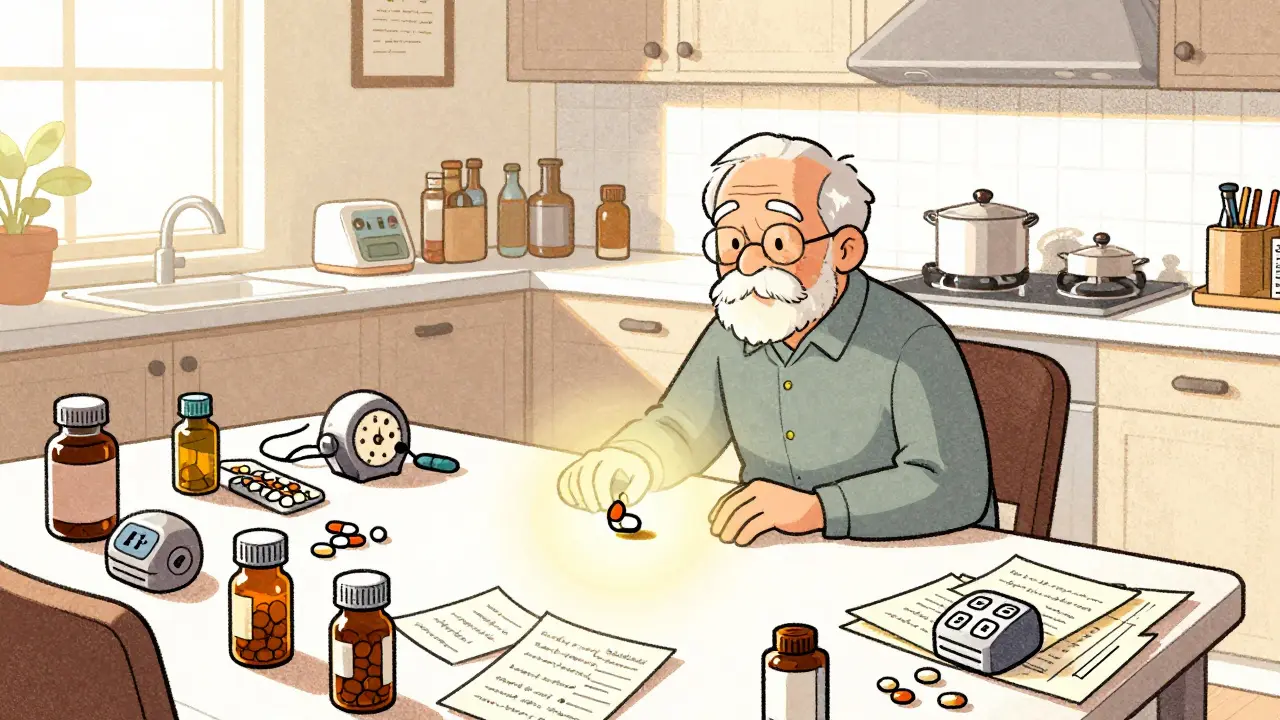
For many older adults, taking medication isn’t just a chore-it’s a full-time job. Imagine waking up at 6 a.m. for one pill, another at 8 a.m., then three more at noon, 4 p.m., and 8 p.m. Add in creams, inhalers, eye drops, and injections, and you’ve got a daily schedule that’s hard to follow, let alone remember. This isn’t rare. In the U.S., nearly 4 in 10 adults over 65 take five or more medications daily. In the U.K., the numbers are similar. And it’s not just about quantity-timing matters. Some pills must be taken on an empty stomach. Others need to be spaced hours apart. Miss one, and the whole system starts to unravel.
Why Complexity Leads to Mistakes
When medication regimens get too complicated, people stop taking them. Not because they don’t care, but because it’s overwhelming. A 2020 study in the Journal of the American Geriatrics Society found that older adults with six or more daily doses were twice as likely to miss doses compared to those with three or fewer. And it’s not just about forgetting. Confusion over what to take, when, and why leads to dangerous errors-taking double doses, skipping critical medications, or mixing pills that shouldn’t be taken together.
One real example: a 78-year-old woman in Sheffield was taking three separate pills for high blood pressure, each with different instructions. One had to be taken at bedtime, another at breakfast, and the third at lunch. She started mixing them up after her daughter moved away. Within weeks, she ended up in the hospital with dangerously low blood pressure. Her pharmacist later found she’d been taking the wrong pill at the wrong time for months.
These mistakes aren’t about memory loss alone. They’re about system failure. The body doesn’t care if your pill organizer has 14 compartments. What matters is whether the regimen fits into your life, not the other way around.
The Three Ways to Simplify
Simplifying medication regimens isn’t about cutting pills-it’s about smarter design. There are three proven methods, used together or separately:
- Once-daily dosing - Switching from multiple daily doses to a single daily dose whenever possible. For example, some blood pressure medications now come in long-acting forms that last 24 hours. That means instead of taking two pills at 8 a.m. and 8 p.m., you take one at 8 a.m.
- Fixed-dose combinations - Combining two or more drugs into a single pill. If someone takes a statin and a blood pressure pill separately, they might be able to switch to a combo pill like amlodipine/atorvastatin. This cuts pill count and reduces confusion.
- Combining both - The most powerful approach. A 2020 systematic review found that when both strategies are used together, adherence improves significantly-especially for diabetes, heart failure, and psychiatric medications.
But here’s the catch: not all medications can be simplified. Statins work best at night. Levothyroxine (for thyroid) must be taken on an empty stomach, at least 30 minutes before food. Insulin timing is tied to meals. These aren’t just preferences-they’re biological rules. Simplification has to respect them.
The MRS GRACE Tool: A Step-by-Step Framework
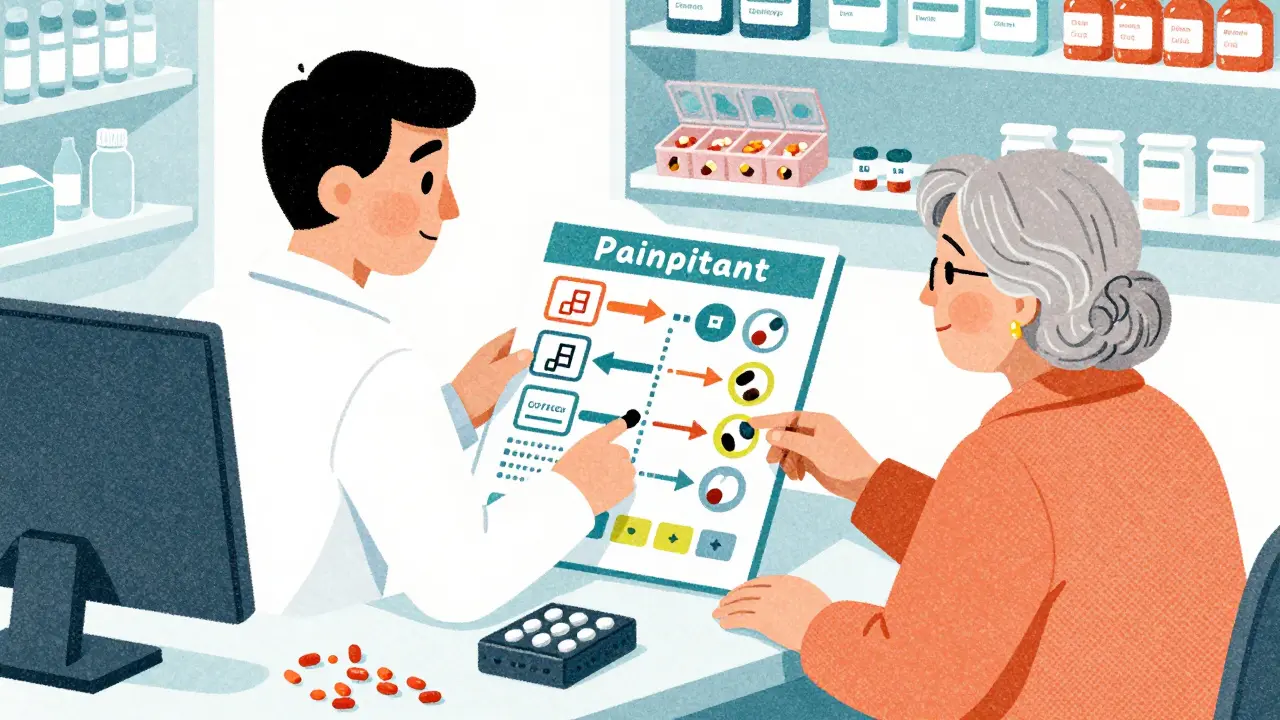
There’s a proven method used in aged care homes across Australia and now being adopted in the U.K. called the MRS GRACE Medication Regimen Simplification Guide for Residential Aged Care. It’s not a magic bullet, but it’s a clear, five-question checklist that helps pharmacists and GPs spot where simplification is possible.
Here’s how it works:
- What’s the current dosing schedule? Count how many times a day each medication is taken. If someone has five or more daily doses, simplification is almost always possible.
- Are there alternatives? Is there a long-acting version? A once-daily form? A combination pill? This step requires checking drug databases and formularies.
- Is timing critical? Some drugs need to be taken at specific times-for example, prednisone in the morning to mimic natural cortisol rhythms. If timing matters, don’t change it.
- Can any meds be stopped? This is called deprescribing. A 2021 study found that 37% of older adults were taking at least one medication with no clear benefit. Removing those first reduces complexity before even changing dosing.
- What does the person prefer? A 75-year-old man might hate taking pills in the morning because he’s not awake yet. If he’s fine taking his blood pressure pill at lunch, that’s better than forcing him to wake up early.
Pharmacists using MRS GRACE were able to simplify regimens for 58-60% of residents in a 2020 trial. And here’s the kicker: when simplification happened, medication errors dropped by 30% in one aged care facility.
What Works Best-And What Doesn’t
Not all medications respond the same way to simplification.
- Works well: Blood pressure meds (like lisinopril, amlodipine), cholesterol drugs (atorvastatin), some diabetes pills (metformin ER), and antipsychotics (risperidone long-acting injections).
- Works with caution: Insulin can be simplified using once-daily long-acting types, but mealtime doses still need precision. Antibiotics must be taken at exact intervals-no shortcuts.
- Hard to simplify: Levothyroxine (must be taken alone, on empty stomach), warfarin (needs frequent monitoring), and oral bisphosphonates (must be taken upright with water, 30 minutes before food).
Surprisingly, a 2019 German study found that simplifying insulin regimens led to better blood sugar control-not just because people took it more often, but because they understood it better. One patient switched from three daily injections to one long-acting shot and stopped worrying about missing meals. His HbA1c dropped by 1.2%.
But here’s the hard truth: improving adherence doesn’t always mean better health. A 2020 review of 12 studies found that while 83% of simplification efforts improved adherence, only 54% led to measurable clinical improvements. Why? Because sometimes, the medication itself isn’t helping. Or the body’s changed. Or the condition has stabilized. That’s why simplification must go hand-in-hand with deprescribing.
The Role of the Patient (and Their Family)
Too often, simplification is done to older adults, not with them. But the best results come when they’re involved.
Dr. Amy Theresa Page, lead author of the MRS GRACE validation study, says: "Simplification should always involve a discussion with the patient and their carer to elucidate their preferences and perspectives." That means asking:
- "When do you usually take your pills?"
- "What’s the hardest part about your current routine?"
- "Would you rather take fewer pills at a time you’re already awake, or one pill in the morning even if it’s less "perfect"?"
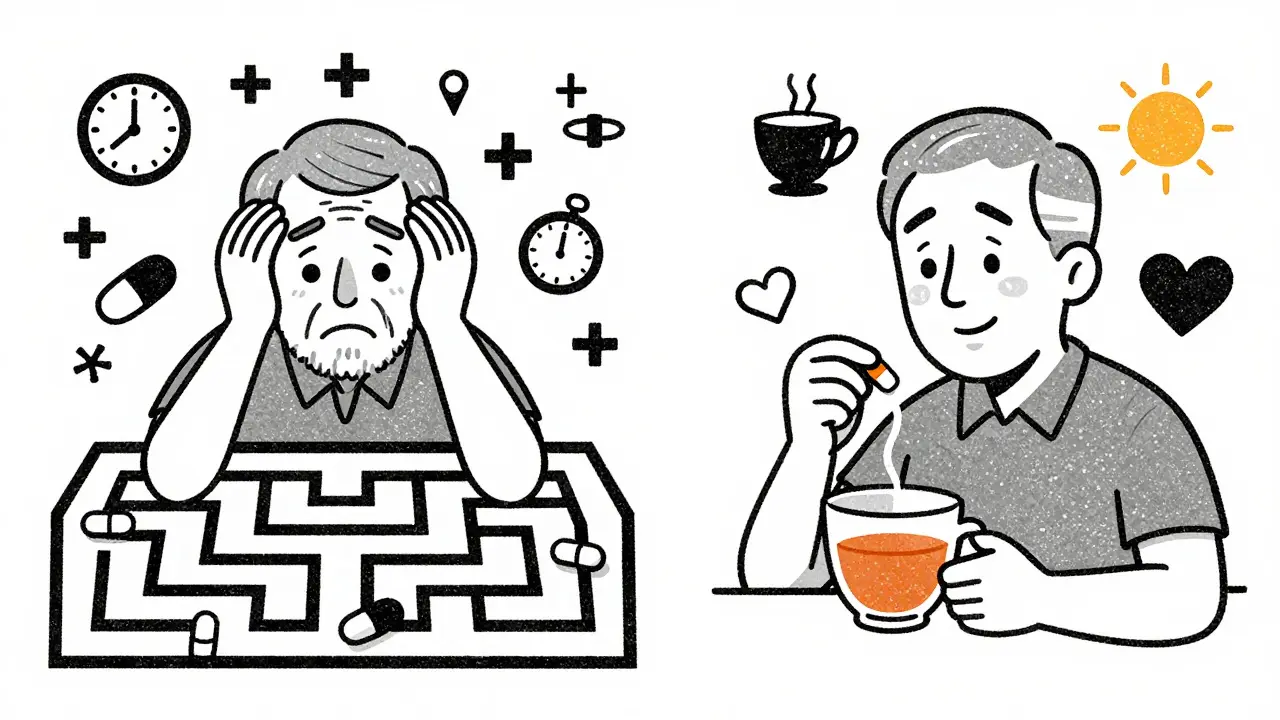
One 82-year-old man in Manchester switched from four daily pills to two-because he could take them right after his morning cup of tea. He’d been missing doses because he was too tired to sit at the kitchen table at 7 a.m. Now, he takes them with his tea, and his blood pressure is stable.
Family members can help, too. A 2020 study found that when nurses scheduled medication administration to match home visits, adherence jumped. If a daughter visits every Tuesday, make sure her dad’s meds are ready to take then. Simple. Human. Effective.
Barriers to Adoption
Despite the evidence, simplification isn’t routine. Why?
- Time - A full medication review with simplification takes 45-60 minutes. Most GPs have 10-minute slots.
- Training - Only 35% of pharmacy schools in the U.K. and U.S. teach formal medication simplification. Many prescribers don’t know how to spot opportunities.
- Systems - Electronic health records rarely flag high pill burdens. Epic Systems added a complexity scoring tool in 2022, but most clinics still don’t use it.
- Reimbursement - Pharmacists who do these reviews aren’t paid for the time. In Germany, pharmacists get reimbursed. In the U.K., they don’t.
And then there’s the mindset: "If it’s not broken, don’t fix it." But for many older adults, their medication routine is broken-not because it’s ineffective, but because it’s unsustainable.
What You Can Do Right Now
If you or a loved one is managing multiple medications, here’s how to start:
- Make a full list. Write down every pill, patch, spray, and injection-including vitamins and supplements. Include dose and timing.
- Check for duplicates. Is someone taking both a statin and a fish oil supplement? Are there two blood pressure pills with the same active ingredient?
- Ask your pharmacist. Bring the list to your local pharmacy. Ask: "Can any of these be switched to once-daily? Or combined?" Pharmacists are trained to spot this.
- Ask about deprescribing. "Are all these medications still necessary?" Sometimes, stopping a drug is the best simplification.
- Align with daily life. Can meds be taken with meals? With a morning walk? With TV time? Structure matters more than timing.
There’s no rush. But if you’re taking more than four medications daily, it’s worth a conversation. You don’t need to be a medical expert. You just need to ask the right questions.
What’s Next?
The future of medication management isn’t in fancier pill boxes. It’s in smarter systems. The University of Sydney is running a large trial (2022-2024) to see if using MRS GRACE reduces medication errors in care homes. Early results show promise. In the U.S., Medicare Advantage plans are starting to pay pharmacists for medication reviews. In the U.K., the NHS is piloting similar programs in Sheffield and Manchester.
But change won’t come from technology alone. It’ll come from asking: "Does this make life easier?" Not: "Is this the textbook way?"
trudale hampton
March 22, 2026 AT 22:36
I've seen this firsthand with my dad. He was taking 12 different pills a day, some at weird times. We sat down with his pharmacist and cut it down to 4. One in the morning with coffee, one at lunch, one at dinner, and one at bedtime. No more confusion. His blood pressure's better, and he actually remembers to take them now. Sometimes less really is more.
Shaun Wakashige
March 24, 2026 AT 21:03
lol just give em a pill dispenser and call it a day 😅
Jackie Tucker
March 26, 2026 AT 07:35
Ah yes, the classic "simplify" solution. How quaint. You're treating symptoms while ignoring the systemic rot of overprescribing in geriatric care. We don't need a fancy checklist-we need to stop treating aging like a bug to be fixed with pharmaceutical bandaids. The real simplification? Letting people die without 17 pills.
Thomas Jensen
March 27, 2026 AT 15:19
You know who benefits from all this? Big Pharma. They create 3 pills, then sell you a combo pack for 3x the price. They don't care if you live or die-just that you keep buying. I saw my neighbor's meds bill go up after they "simplified" his regimen. Coincidence? I think not.
matthew runcie
March 28, 2026 AT 09:08
My mom went from 8 meds to 3. Just by asking the right questions. She’s sleeping better, not dizzy anymore. Took us 6 months, but it was worth it. You don’t need a PhD to ask, "Is this still helping?"
shannon kozee
March 29, 2026 AT 12:40
Pharmacists are your best friend here. Bring the whole bag to them. They can spot duplicates, interactions, and options you didn’t know existed. And yes, deprescribing is real. It’s not giving up-it’s stopping the unnecessary.
Paul Cuccurullo
March 30, 2026 AT 12:26
There is something profoundly beautiful about a life reduced to the essentials. Not just in medication-but in meaning. When we strip away the clutter of unnecessary pills, we return to the rhythm of the body, the quiet dignity of natural cycles. This isn't just medicine. It's a return to grace.
Solomon Kindie
April 1, 2026 AT 07:26
mrs grace? sounds like some corporate buzzword made by a guy who never met an old person. most of these "simplifications" just move the problem from the patient to the nurse or family. and dont even get me started on the insulin thing. its not about being perfect its about being alive and not having to be a pharmacist to survive