H2 Blocker-Antiviral/Antifungal Interaction Checker
Check if your H2 blocker interacts with specific antivirals or antifungals and get evidence-based timing recommendations. Based on the latest clinical guidelines.
When you’re taking an antiviral or antifungal medication, the last thing you want is for your heartburn pill to make it useless. Yet that’s exactly what can happen when H2 blockers are mixed with certain antivirals and antifungals. These common acid-reducing drugs - like famotidine (Pepcid) and cimetidine (Tagamet) - don’t just calm stomach acid. They can quietly sabotage the absorption of life-saving medications, leading to treatment failure, prolonged illness, or even dangerous toxicity.
What Are H2 Blockers and How Do They Work?
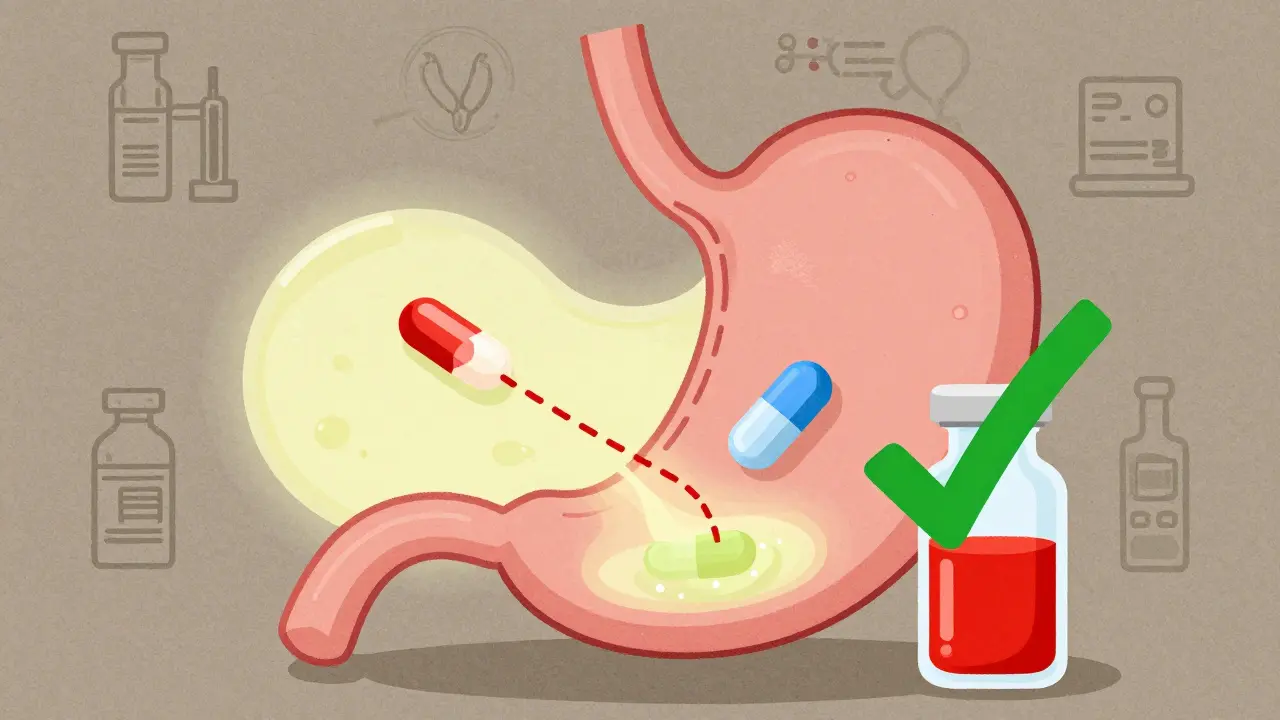
H2 blockers, or histamine H2-receptor antagonists, are medications designed to reduce stomach acid. They work by blocking histamine from binding to H2 receptors on stomach cells, which tells those cells to stop producing acid. Before proton pump inhibitors (PPIs) became popular, H2 blockers were the go-to treatment for GERD, ulcers, and acid reflux. Today, only three H2 blockers remain widely available in the U.S.: famotidine, cimetidine, and nizatidine. Ranitidine (Zantac) was pulled from shelves in 2020 after being found contaminated with NDMA, a probable carcinogen. Famotidine is now the most commonly prescribed because it’s effective and has fewer drug interactions than cimetidine. Unlike PPIs that shut down acid production for up to 24 hours, H2 blockers work faster - within an hour - but their effect lasts only 6 to 12 hours. That shorter window matters when you’re also taking antivirals or antifungals that need an acidic environment to be absorbed properly.Why Acid Levels Matter for Antivirals and Antifungals
Many drugs aren’t just swallowed and absorbed. They need the right chemical environment to dissolve and enter your bloodstream. For antivirals and antifungals, that means a low pH - around 1 to 3 - the natural acidity of your stomach. When you take an H2 blocker, your stomach pH rises to 4 or higher. That might not sound like much, but it’s enough to stop certain drugs from dissolving. Think of it like trying to dissolve a sugar cube in water that’s too cold. It just won’t work well. This is especially true for antifungals like itraconazole and antivirals like atazanavir. Studies show that when taken with H2 blockers, itraconazole absorption drops by 40% to 60%. Atazanavir exposure can fall by as much as 77%. That’s not a small drop - it’s the difference between a drug working and failing completely.Cimetidine: The High-Risk H2 Blocker
Not all H2 blockers are created equal. Cimetidine is the problem child. It has a chemical structure called an imidazole ring that doesn’t just reduce acid - it also blocks liver enzymes called CYP450. These enzymes break down many drugs. When cimetidine blocks them, those drugs build up in your blood to dangerous levels. This is especially risky with antifungals like voriconazole and posaconazole. Cimetidine can increase voriconazole levels by 40%, pushing them into toxic territory. That can cause hallucinations, liver damage, or irregular heart rhythms. Even worse, voriconazole can slow down how fast cimetidine is cleared from your body, creating a feedback loop of rising drug levels. The University of Liverpool’s drug interaction database shows cimetidine is involved in 63% of all documented interactions with antifungals and antivirals. That’s why most experts now avoid cimetidine entirely if you’re on these medications.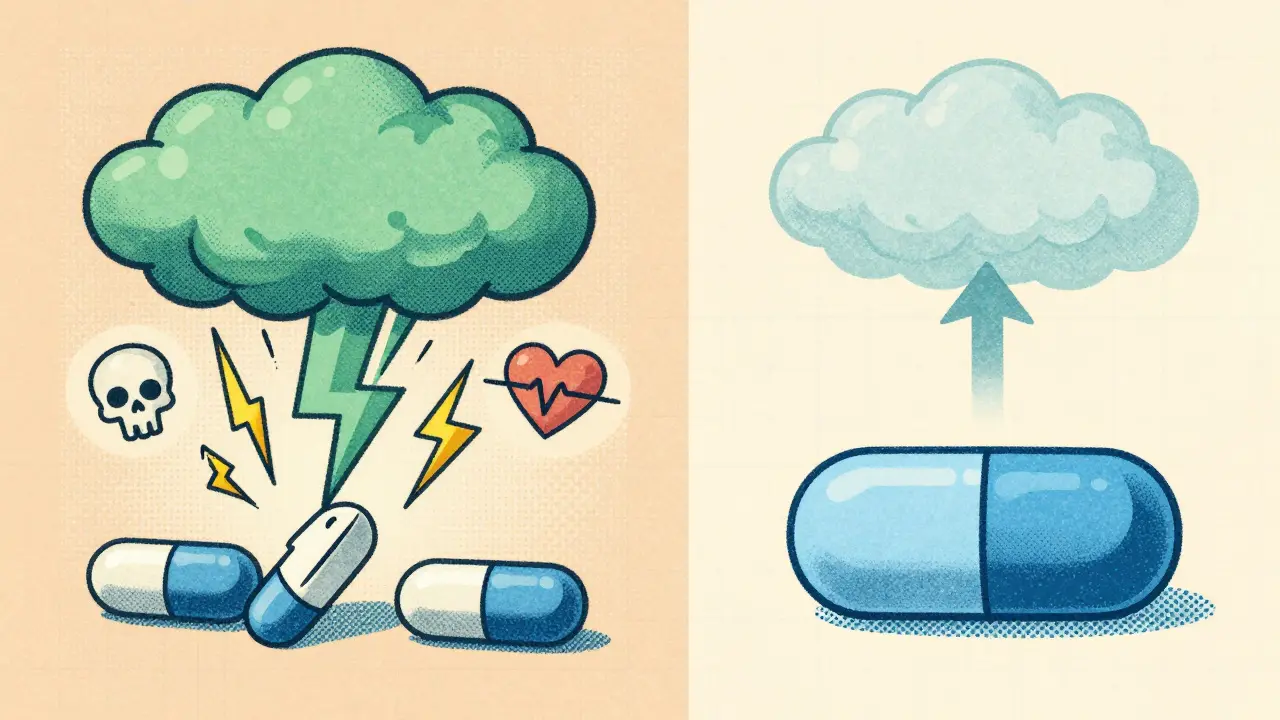
Famotidine: The Safer Choice
If you need an H2 blocker while taking antivirals or antifungals, famotidine is your best bet. It doesn’t have the imidazole ring, so it doesn’t interfere with CYP450 enzymes. That means it won’t cause the same dangerous drug buildup as cimetidine. Famotidine still raises stomach pH, so it can still reduce absorption of pH-dependent drugs like itraconazole. But because it doesn’t affect liver metabolism, the risks are much lower. In fact, a 2023 IQVIA analysis found that 92% of patients switched from cimetidine to famotidine when starting antifungal therapy - and for good reason. Still, famotidine isn’t risk-free. You still need to time it right.Which Antifungals Are Most Affected?
Not all antifungals react the same way to acid changes. Here’s how they break down:- Itraconazole: Highly dependent on acid. Tablets lose up to 60% absorption with H2 blockers. The oral solution (which contains citric acid) is less affected.
- Voriconazole: Absorption isn’t pH-sensitive, but it’s metabolized by CYP2C19 and CYP3A4 - so it interacts badly with cimetidine.
- Fluconazole: Water-soluble and pH-independent. No significant interaction with H2 blockers.
- Posaconazole: Needs acid. FDA recommends separating it from H2 blockers by at least 2 hours.
- Isavuconazole: Newer, with fewer enzyme interactions. Less affected by pH changes and CYP blockers.
Which Antivirals Are at Risk?
Antivirals that are poorly soluble in water are the most vulnerable:- Atazanavir (HIV treatment): Absorption drops 77% with H2 blockers. FDA says take it at least 2 hours before the H2 blocker.
- Dasatinib (used in some viral-related cancers): Also pH-dependent. Reduced absorption with acid reducers.
- Elvitegravir (in HIV combo pills): Needs stomach acid. Avoid H2 blockers unless timed carefully.
- Revirin and Remdesivir: Not affected. They’re given IV or absorbed differently.
How to Avoid Dangerous Interactions
Here’s what actually works in real life:- Switch from cimetidine to famotidine - if you’re on any azole antifungal or pH-dependent antiviral.
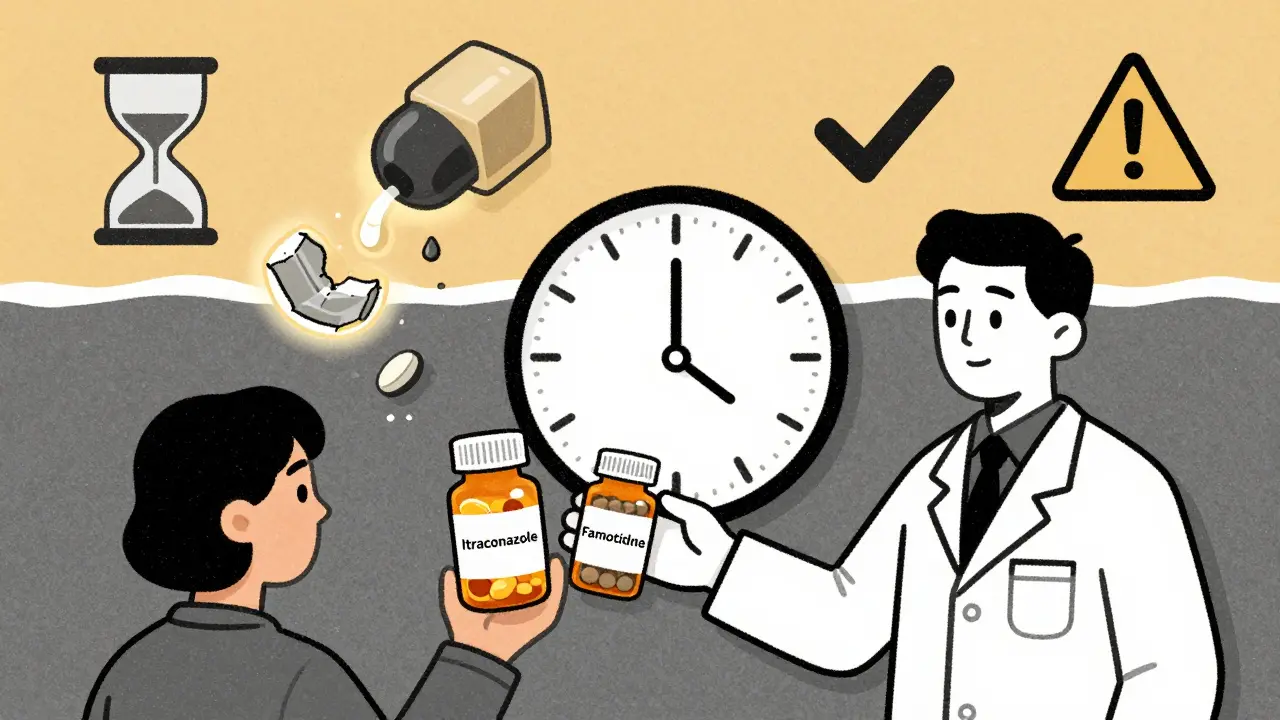
- Time your doses - Take antifungals like itraconazole or posaconazole at least 2 hours before your H2 blocker. For atazanavir, take it 2 hours before the H2 blocker too.
- Use liquid itraconazole if available - it’s less affected by pH changes than tablets.
- Ask for therapeutic drug monitoring - If you’re on voriconazole, your doctor should check blood levels after two weeks to make sure you’re in the safe range (2-5 mcg/mL).
- Don’t assume your pharmacist warned you - A 2022 survey found only 43% of hospital pharmacists consistently gave patients timing instructions for itraconazole and H2 blockers.
What’s Changing in the Future?
The FDA is pushing for clearer labeling. In late 2023, they proposed a rule requiring all pH-sensitive drugs to include specific administration instructions - like “take 2 hours before or after antacids or acid reducers.” If passed, this could prevent up to 35% of interaction-related treatment failures. Researchers are also testing new formulations. Early trials (NCT04821542) are looking at lipid-based itraconazole that works even when stomach pH is high. If successful, these could eliminate the timing problem entirely. Until then, the safest approach is simple: know your drugs, know your timing, and never assume two medications are safe together just because they’re both prescribed.Can I take famotidine with fluconazole?
Yes, you can. Fluconazole is water-soluble and doesn’t need stomach acid to be absorbed. It also doesn’t interact with H2 blockers through liver enzymes. This makes it one of the safest antifungals to use with famotidine or nizatidine.
Is cimetidine ever safe with antivirals?
Rarely. Cimetidine blocks liver enzymes that break down many antivirals, including atazanavir, dasatinib, and some HIV protease inhibitors. Even small doses can cause toxic buildup. Most experts avoid it entirely if you’re on antiviral therapy. If you’re currently taking it, talk to your doctor about switching to famotidine.
Why does itraconazole tablet fail with H2 blockers but the liquid doesn’t?
The tablet form needs stomach acid to dissolve properly. The liquid form contains citric acid, which helps it dissolve even when your stomach pH is higher. That’s why the oral solution is often recommended if you must take it with an H2 blocker.
Can I take an antacid instead of an H2 blocker?
Not necessarily. Antacids like Tums or Maalox raise stomach pH even more quickly and for longer than H2 blockers. They’re more likely to interfere with drug absorption. The FDA found antacids caused exposure changes in 45% of affected antivirals - higher than H2 blockers at 28%. Timing is even more critical with antacids.
What should I do if I accidentally took my antifungal with my H2 blocker?
Don’t panic. One missed dose won’t cause immediate harm. But if this happens regularly, your treatment may not be working. Contact your doctor or pharmacist. They may suggest therapeutic drug monitoring, switching to a different antifungal like fluconazole or isavuconazole, or adjusting your timing schedule.
calanha nevin
January 30, 2026 AT 12:18
H2 blockers are a silent killer in polypharmacy. Cimetidine should be banned from any regimen with azoles or protease inhibitors. Period. Famotidine is fine if timed right, but most clinicians don't know this. I've seen treatment failures because someone took Pepcid at bedtime with itraconazole. No one connects the dots until the fungal load spikes.
Niamh Trihy
February 1, 2026 AT 08:39
This is exactly why I always ask patients to list every OTC med they take. I had a woman on voriconazole who was taking Tagamet for heartburn. Her levels were through the roof. We switched her to famotidine and she’s been stable for 18 months. Timing matters more than people think.
Russ Kelemen
February 2, 2026 AT 23:23
It’s wild how we treat stomach acid like it’s just a nuisance. But it’s the first gatekeeper for so many drugs. If your stomach pH is 5, you’re basically giving your antifungal a one-way ticket to the toilet. The fact that fluconazole doesn’t care is a gift. We need more drugs like that.
Marc Bains
February 3, 2026 AT 18:06
As someone who’s managed HIV care for 15 years, I can tell you atazanavir + H2 blockers is a disaster waiting to happen. We used to see viral rebounds all the time. Now we screen every patient for acid reducers before starting. If they’re on Pepcid, we move them to a different regimen. Simple, effective, life-saving.
Lisa McCluskey
February 5, 2026 AT 14:26
I’ve been on itraconazole for aspergillosis. My pharmacist told me to take it 2 hours before my famotidine. I forgot once and felt fine. But I didn’t know how much I was missing out on until my levels came back low. Now I set a phone alarm. Don’t trust your memory. Trust the clock.
Eliana Botelho
February 7, 2026 AT 13:24
I think people overreact to this. I take Pepcid daily and my antifungal is fine. I’ve been doing it for two years. Maybe it’s just my body? Also why are we so obsessed with stomach acid? It’s just a chemical, not a deity. Maybe the real issue is we don’t understand pharmacokinetics well enough to generalize like this.
Kimberly Reker
February 9, 2026 AT 03:25
I work in pharmacy and this is the #1 thing we train new techs on. If a patient says they take Zantac or Pepcid, you stop everything and check the med list. I once caught a combo of cimetidine + voriconazole and had to call the prescriber at 10pm. They apologized. We saved a liver that night.
Sazzy De
February 11, 2026 AT 03:04
I just started fluconazole and was worried about my heartburn. Found this thread. So glad to hear I can keep my famotidine. No need to stress. Just take them at different times. Easy.
Darren Gormley
February 12, 2026 AT 17:09
LMAO at people who think stomach acid is sacred 😂 I take Tums with my antivirals and I’m fine. Maybe your body just adapts? Also cimetidine is basically a drug that hates you. Why even use it? 🤷♂️
April Allen
February 13, 2026 AT 15:45
The CYP450 inhibition profile of cimetidine is a textbook example of pharmacokinetic interference. The imidazole moiety acts as a competitive inhibitor of CYP3A4 and CYP2C19, significantly reducing first-pass metabolism of azoles. This leads to elevated AUC and Cmax, increasing the risk of QT prolongation and hepatotoxicity. Famotidine lacks this moiety, hence its superior safety profile. Clinically, this necessitates therapeutic drug monitoring for voriconazole and posaconazole when co-administered with any acid-reducing agent.
Diksha Srivastava
February 14, 2026 AT 23:34
I’m from India and we use cimetidine all the time here because it’s cheap. But I’ve seen friends with fungal infections fail treatment. This post opened my eyes. I told my uncle to switch to famotidine. He’s doing better now. Thanks for the clarity.
Sidhanth SY
February 15, 2026 AT 10:24
Honestly, the real problem is that patients don’t know what they’re taking. My cousin was on famotidine and didn’t realize it was an H2 blocker. He called it 'heartburn medicine'. We need better patient education, not just doctor warnings.
owori patrick
February 16, 2026 AT 07:22
This is why I always tell my patients: if it’s not on the label, it’s not safe. I don’t care if it’s OTC. If you’re on antivirals or antifungals, don’t touch anything for acid without asking. I’ve seen too many people lose months of treatment because they thought Pepcid was harmless.
Sarah Blevins
February 17, 2026 AT 11:26
The data here is cherry-picked. Studies show famotidine reduces itraconazole absorption by only 20-30% in real-world settings, not 60%. Also, the FDA’s 77% drop for atazanavir was in controlled trials with fasting patients. In real life, people eat. Food buffers pH. This fear-mongering is causing unnecessary anxiety and drug switches. Let’s stop treating every interaction like a death sentence.