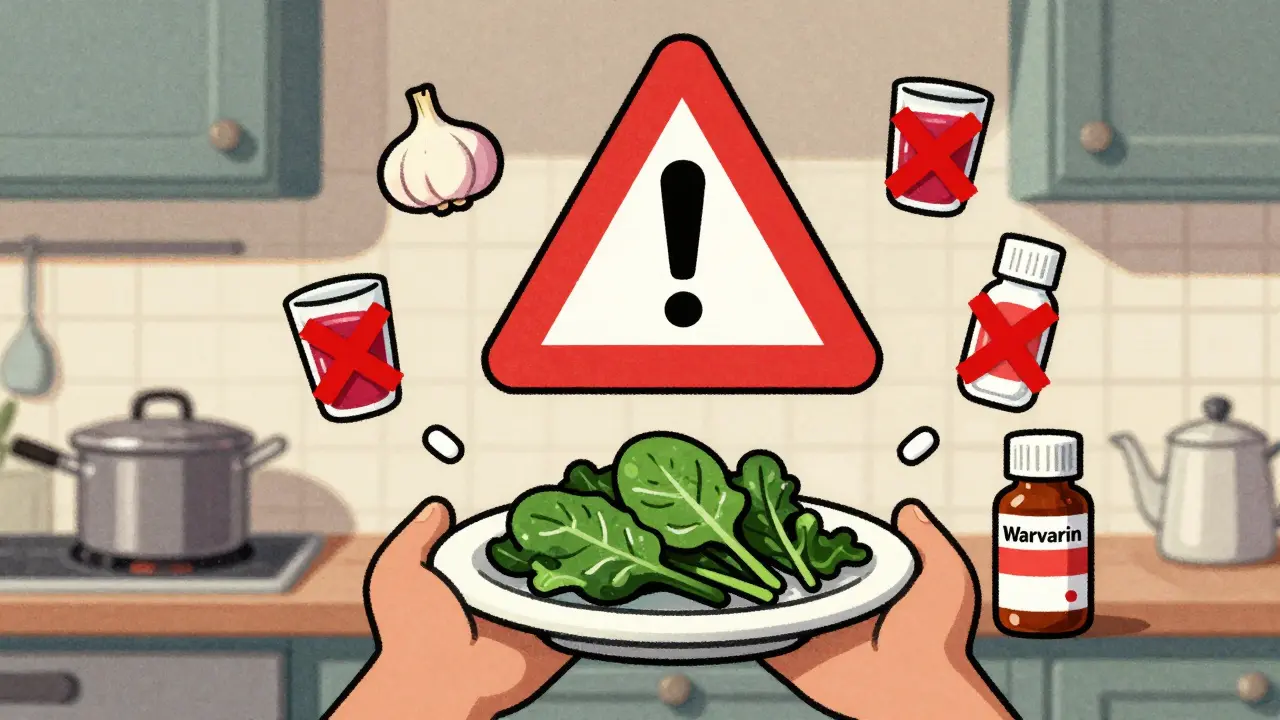
Warfarin saves lives. But it’s also one of the most dangerous medications if you don’t know what to avoid. A simple change in your diet, a new supplement, or even an over-the-counter painkiller can send your INR soaring-or crashing. And when that happens, you’re at risk of a stroke, a bleed, or worse.
Why Warfarin Is So Tricky
Warfarin works by blocking vitamin K, which your body needs to make blood clotting proteins. That’s why it prevents dangerous clots in people with atrial fibrillation, artificial heart valves, or deep vein thrombosis. But here’s the catch: your body needs vitamin K for other things too-bone health, cell function, even wound healing. So if you eat too much or too little vitamin K, your warfarin dose stops working right.
And it’s not just food. Warfarin is broken down by liver enzymes-CYP2C9 and CYP3A4-that also handle hundreds of other drugs. If something else blocks or speeds up those enzymes, your warfarin level jumps or drops fast. That’s why a single antibiotic can send you to the ER.
Most people on warfarin need their INR checked every 4 weeks. But if your INR is below 2.0, you’re not protected enough. Above 3.0, you’re bleeding risk skyrockets. And it doesn’t take much to push you out of range.
Foods That Mess With Warfarin
The biggest food culprit? Vitamin K. Not because it’s bad-but because it directly fights warfarin’s effect.
You don’t need to avoid vitamin K. You need to keep it consistent. A sudden spike in vitamin K can drop your INR by 0.5 to 1.5 points in just a few days. A sudden drop can make your INR spike dangerously high.
Here’s what’s high in vitamin K:
- 1 cup cooked spinach: 1,062 mcg
- 1 cup cooked kale: 1,062 mcg
- 1 cup cooked broccoli: 220 mcg
- 1 cup cooked Brussels sprouts: 219 mcg
- 1 cup raw lettuce: 100 mcg
- 1 tablespoon soybean oil: 25 mcg
The NHS recommends keeping your daily vitamin K intake between 60-80 mcg. That means if you normally eat a salad with spinach every day, don’t suddenly switch to kale. If you usually skip greens, don’t start eating two cups of broccoli every night.
Some people even stabilize their INR by eating the same amount of vitamin K at the same time every day. One Reddit user with over 400 upvotes says they eat exactly 1 cup of spinach at 6 p.m. daily-and their INR hasn’t budged in two years.
Other foods to watch:
- Green tea: Contains vitamin K and may reduce warfarin’s effect. One patient saw their INR drop from 2.8 to 1.9 after drinking 3 cups a day.
- Cranberry juice: Linked to INR spikes in case reports. Not everyone reacts, but it’s not worth the risk.
- Alcohol: More than 1-2 drinks a day triples your bleeding risk. Binge drinking can cause sudden INR spikes.
Supplements That Can Kill You (Literally)
People think supplements are safe. They’re not. Many interact with warfarin-and most patients don’t even tell their doctors they’re taking them.
Here are the worst offenders:
- Garlic supplements: Can increase bleeding risk. One study found INR rose by 1.2 in patients taking 800 mg daily.
- Ginkgo biloba: Thins blood. Multiple case reports show serious bleeds after combining it with warfarin.
- Ginseng: May reduce warfarin’s effect. One patient’s INR dropped from 3.1 to 1.8 after starting ginseng.
- St. John’s Wort: Speeds up warfarin metabolism. INR can drop 30-50% within days.
- Vitamin E: High doses (over 400 IU) increase bleeding risk.
- Coenzyme Q10: Structurally similar to vitamin K. May reduce warfarin’s effect.
- Calcium and magnesium supplements: Can interfere with absorption if taken at the same time. Take them 4-6 hours apart.
And don’t forget herbal teas. Chamomile, dong quai, and feverfew all have anticoagulant effects. If you’re on warfarin, skip them.
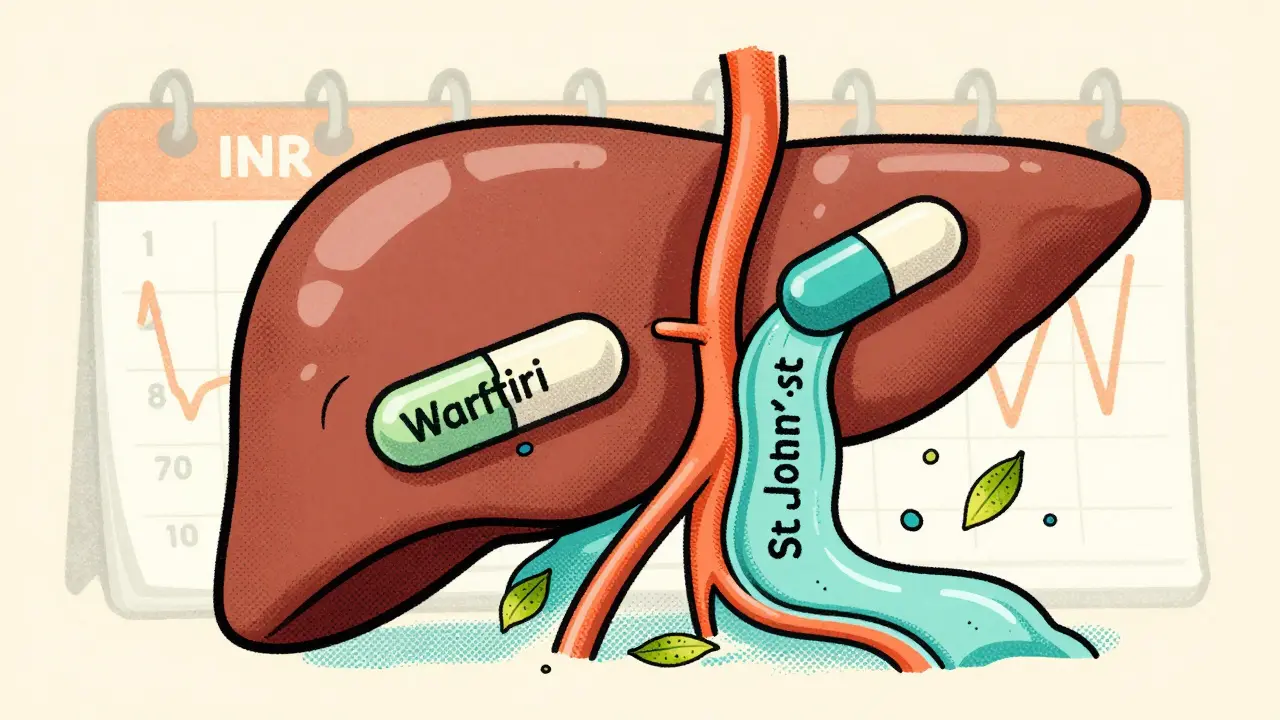
Prescription Drugs That Change Everything
Over 300 drugs interact with warfarin. That’s 10 times more than newer anticoagulants like Eliquis or Xarelto. Here are the most dangerous ones:
Strongly Increase Warfarin Effect (High Bleeding Risk)
- Antibiotics: Especially trimethoprim-sulfamethoxazole (Bactrim) and fluconazole (Diflucan). One patient’s INR jumped from 2.4 to 5.1 after taking Bactrim for a UTI. That’s a 112% increase.
- Amiodarone: Used for heart rhythm problems. Can increase warfarin levels by 30-50%. Dose reductions of 30-50% are often needed.
- NSAIDs: Ibuprofen, naproxen, diclofenac. These irritate your stomach lining and thin blood. Combining them with warfarin increases GI bleeding risk by 4.5 times.
- SSRIs: Fluoxetine, sertraline. Can increase bleeding risk by affecting platelets.
- Statins: Especially atorvastatin and fluvastatin. May increase warfarin levels.
Strongly Decrease Warfarin Effect (Higher Clot Risk)
- Barbiturates: Used for seizures or anxiety. Speed up warfarin breakdown.
- Rifampin: Antibiotic for TB. Can cut warfarin levels in half.
- Carbamazepine: For epilepsy and nerve pain. Reduces warfarin’s effect by 40-60%.
Even some heart meds like metoprolol or amlodipine can have mild effects. The key? Always tell your doctor every new prescription-even if it’s for acne or a fungal infection.
What About DOACs? Are They Better?
Direct oral anticoagulants (DOACs) like apixaban, rivaroxaban, and dabigatran are replacing warfarin for many people. They don’t need regular blood tests. They have fewer food interactions. And they’re less likely to interact with other drugs.
But they’re not perfect.
- They cost $6,500 a year. Warfarin is $80.
- They can’t be used if you have mechanical heart valves.
- They’re risky if you have severe kidney disease.
- There’s no easy way to reverse them in an emergency.
Warfarin’s advantage? Vitamin K and prothrombin complex concentrate can reverse it in minutes. That’s why it’s still first-line for people with antiphospholipid syndrome or mechanical valves.
And while DOACs are easier, they’re not magic. If you’re on warfarin, you’re not stuck with it forever. Talk to your doctor about switching-if your situation allows it.

How to Stay Safe
Managing warfarin isn’t about fear. It’s about awareness.
- Keep a food journal. Track your vitamin K intake for a week. Find your baseline. Stick to it.
- Never start or stop a supplement without checking with your anticoagulation clinic.
- Always tell every doctor you’re on warfarin-even dentists and ER staff.
- Use the American Society of Hematology’s interaction checker. It lists 297 interactions with severity ratings.
- Get genetic testing. The FDA approved a test (Warfarin GenAssist) that checks your CYP2C9 and VKORC1 genes. It can predict up to 50% of your ideal dose.
Most people stabilize within 4-6 weeks. Once you’re steady, life gets easier. But one slip-up can undo months of progress.
Signs You’re Bleeding
Know these red flags:
- Bleeding gums when brushing teeth
- Nosebleeds that won’t stop
- Unusual bruising
- Red or dark urine
- Black, tarry stools
- Severe headache or dizziness
- Unexplained swelling or pain
If you see any of these, call your doctor or go to the ER. Don’t wait.
Final Thought
Warfarin isn’t going away. Even as DOACs rise, it’s still the only option for millions. It’s cheap. It’s reversible. But it demands respect.
Don’t treat it like a regular pill. Treat it like a loaded gun-because in some ways, it is.
Consistency is your best friend. Communication is your safety net. And knowledge? That’s your life insurance.
Can I eat leafy greens while on warfarin?
Yes-but keep your intake consistent. Eating 1 cup of spinach every day is fine. Switching from spinach to kale every other day is not. Your INR stays stable when your vitamin K levels stay stable. The goal isn’t to avoid vitamin K, but to avoid sudden changes.
Is it safe to take ibuprofen with warfarin?
No. Ibuprofen and other NSAIDs increase your risk of stomach bleeding when combined with warfarin. Use acetaminophen (Tylenol) instead for pain relief. Always check with your doctor before taking any new painkiller.
How long does it take for warfarin interactions to show up?
It varies. Some drugs, like fluconazole or Bactrim, can raise your INR within 48 hours. Vitamin K changes usually show up in 3-5 days. Alcohol can cause spikes after just one heavy night. Always monitor your INR closely after starting or stopping anything new.
Can I drink alcohol while on warfarin?
Limit it to 1-2 drinks per day. More than that increases bleeding risk by 3.2 times. Binge drinking can cause dangerous INR spikes. If you drink regularly, tell your doctor. They may need to check your INR more often.
Do I need to stop warfarin before surgery?
Sometimes-but never on your own. Your doctor will decide based on your risk of clotting versus bleeding. For minor procedures, you may keep taking it. For major surgery, you might stop 5 days ahead and use heparin as a bridge. Always follow your care team’s instructions.
Is there a test to know my ideal warfarin dose?
Yes. The FDA-approved Warfarin GenAssist test checks your CYP2C9 and VKORC1 genes. These genes control how your body processes warfarin. The test can predict 30-50% of your dose needs and reduce the time to reach a stable INR by over two weeks. Ask your doctor if it’s right for you.
Abby Polhill
December 24, 2025 AT 22:37
Warfarin is such a finicky beast. I’ve been on it for 7 years and the only thing that keeps me alive is consistency. Same spinach serving, same time, same damn day. One week I ate kale instead and my INR dropped like a rock. Docs don’t always stress how sensitive this is. It’s not just about avoiding things-it’s about ritualizing your intake. I even track it in a Notion doc now. No jokes, no exceptions.
Lindsey Kidd
December 25, 2025 AT 03:13
Just wanted to say THANK YOU for this post 🙏 I was about to start ginkgo for my memory… yikes. I canceled it. Also, I now know why my INR spiked after that cranberry smoothie. 🤦♀️ Vitamin K consistency = my new religion. 🌿
Austin LeBlanc
December 25, 2025 AT 05:45
Everyone’s acting like this is rocket science. It’s not. If you can’t handle a daily spinach routine, maybe you shouldn’t be on warfarin. I’ve seen people take 12 supplements, drink green tea like it’s water, and then panic when they bleed. You’re not special. Your body doesn’t get a pass. Stop blaming the drug. Take responsibility.
niharika hardikar
December 27, 2025 AT 01:38
It is imperative to underscore that the pharmacokinetic variability inherent in warfarin metabolism necessitates rigorous patient education. The CYP2C9 and VKORC1 polymorphisms are not trivial considerations-they are clinically significant determinants of therapeutic efficacy. Furthermore, the concomitant use of NSAIDs with anticoagulants constitutes a Class I contraindication per ACC/AHA guidelines. Compliance is non-negotiable.
Rachel Cericola
December 28, 2025 AT 11:03
Let me tell you something real: warfarin isn’t the enemy. The enemy is the myth that ‘natural’ means safe. I’m a nurse in anticoagulation clinic and I’ve seen too many patients come in with bleeding ulcers because they thought ‘garlic pills are just herbs’ or ‘turmeric is anti-inflammatory, not anticoagulant.’ No. It’s not. Ginkgo? Ginseng? St. John’s Wort? These aren’t ‘supplements’-they’re unregulated pharmaceuticals with zero oversight. And yes, your ‘organic green juice’ with 3 cups of kale? That’s a blood thinner. You don’t get to pick and choose when your meds matter. If you’re on warfarin, you’re in a partnership with your INR. Treat it like a relationship. Communication. Consistency. No surprises. And if you’re thinking of switching to a DOAC? Talk to your hematologist. Cost isn’t the only factor. If you have a mechanical valve or antiphospholipid syndrome, warfarin is still the gold standard. Don’t let marketing fool you. Your life depends on knowing the difference.
Blow Job
December 28, 2025 AT 13:44
This is actually one of the most helpful posts I’ve read on here. I was scared to even eat broccoli after my first INR spike. Now I know it’s not about avoiding greens-it’s about keeping it steady. I started eating one cup of spinach every night at 7pm. Two months in, my INR’s been 2.3 the whole time. I’m not a genius. I just followed the rules. Thank you for writing this.
Christine Détraz
December 29, 2025 AT 14:09
My dad’s been on warfarin for 12 years. He drinks one beer a night, eats the same salad every day, and never takes anything without asking his clinic. He’s the calmest guy I know. No drama. No panic. Just routine. I think that’s the secret. It’s not about being perfect-it’s about being predictable. Your body likes a schedule. Even if it’s just a daily spinach habit. That’s peace of mind.
Isaac Bonillo Alcaina
December 31, 2025 AT 04:44
Wow. So many people here acting like they’re experts. You all think you know what’s safe? Let me guess-you’ve never had a GI bleed from NSAIDs and warfarin. You’ve never had to go to the ER because your INR was 7.2. You’re lucky. I’ve been there. And I’m telling you: if you’re not checking your INR every 2 weeks when you start something new, you’re playing Russian roulette. Stop being casual about this. This isn’t a lifestyle tweak. It’s a survival protocol.
Joe Jeter
January 1, 2026 AT 03:46
Everyone’s obsessed with vitamin K. But what about the fact that warfarin’s mechanism is literally ancient? It was originally a rat poison. And now we’re feeding it to humans and calling it medicine? The whole system is a gamble. DOACs are better. They’re not perfect, but they’re not medieval. Why are we still clinging to this 1940s relic? Because Big Pharma doesn’t make enough off it. That’s the real story.
Sidra Khan
January 2, 2026 AT 00:49
Yeah but like… do we really need 15 paragraphs on spinach? I skimmed. I got the gist. Don’t eat kale randomly. Don’t take garlic pills. Use Tylenol. Got it. Also, why is this post so long? I’m not a med student.
siddharth tiwari
January 3, 2026 AT 17:54
you know what they dont tell u? the gov is using warfarin to control the population. why? because if u eat the wrong food u bleed. they want u scared. also the vitamin k thing? fake. its the glyphosate in the spinach. its not the veg. its the poison. u need to drink alkaline water and avoid all american food. my cousin died from warfarin. they lied. i know.
Adarsh Dubey
January 4, 2026 AT 12:40
Good breakdown. I’m from India and we have a lot of people here on warfarin who think curry leaves or neem tea are ‘safe.’ They’re not. Same rules apply. Vitamin K is everywhere-in turmeric, in mustard oil, in fenugreek seeds. Consistency matters more than avoidance. Also, if you’re on warfarin, don’t assume your local doctor knows the interactions. Many don’t. Get a specialist. Or at least use the ASH interaction checker. It’s free.
Bartholomew Henry Allen
January 5, 2026 AT 07:16
Warfarin is the only anticoagulant that respects American discipline. DOACs are for weaklings who cant handle routine. Eat your spinach. Take your pill. Check your INR. No excuses. No whining. No supplements. No alcohol beyond two drinks. This is not a suggestion. This is a requirement for survival. Period.