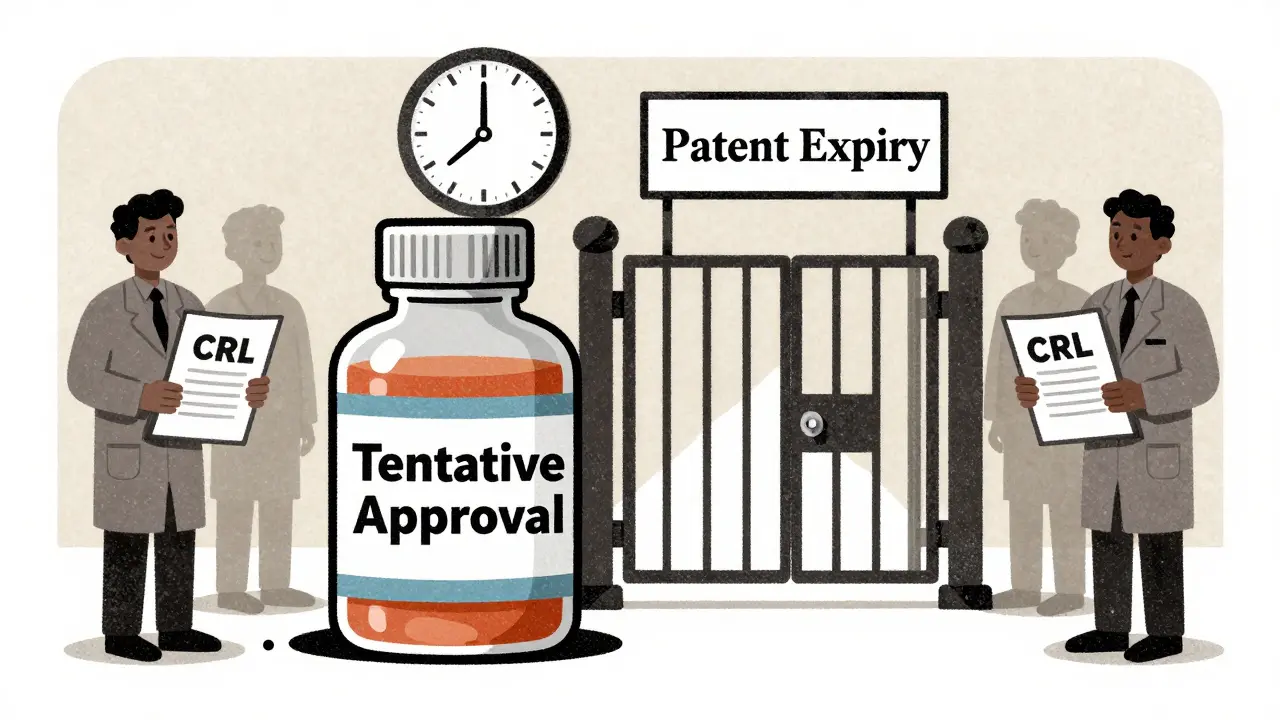
When a generic drug gets tentative approval from the FDA, it doesn’t mean it’s ready to hit pharmacy shelves. It means the agency has checked every scientific box - safety, effectiveness, manufacturing quality - but can’t let it sell yet. Why? Because a brand-name drug still holds patents or exclusivity rights. Tentative approval is like getting your driver’s license before your car is allowed on the road. You’re qualified. But someone else owns the road right now.
Why Tentative Approval Exists
Tentative approval was created by the Hatch-Waxman Act of 1984 to speed up access to cheaper generic drugs. Before this law, generic makers had to wait until patents expired before even starting their applications. Now, they can apply years in advance. The FDA reviews the application fully, just like a final approval. If everything checks out, they give tentative approval. This lets companies finish packaging, labeling, and scaling up production while they wait for the patent clock to run out. The goal? Launch the generic the day the patent expires - no delays, no gaps.But in practice, that rarely happens. Even after tentative approval, most generics sit idle for months - sometimes years - before they’re actually sold. Why?
Review Cycles: The Bureaucratic Bottleneck
The biggest internal reason for delays? The FDA keeps asking for more information. Generic drug applications are complex. A single application can have hundreds of pages on chemistry, manufacturing, and testing. If one section is incomplete or unclear, the FDA sends back a Complete Response Letter (CRL). The applicant has to fix it, resubmit, and wait for another round of review.Before 2012, it took nearly four review cycles on average just to get tentative approval. Even after the FDA launched GDUFA (Generic Drug User Fee Amendments) to speed things up, the average was still 3.2 cycles in 2022. That’s over two years of back-and-forth before the drug even gets tentative approval - let alone final approval.
Common reasons for these cycles:
- Missing or weak chemistry and manufacturing data (35% of all deficiencies)
- Inadequate bioequivalence studies (28%) - proving the generic works the same way as the brand
- Poor validation of testing methods (22%) - if the lab can’t prove its measurements are accurate, the FDA won’t accept the results
- Stability data gaps (43% of 2022 deficiencies) - showing the drug won’t break down over time
- Insufficient info on packaging (31%) - like whether the bottle protects the drug from moisture or light
Complex drugs - think inhalers, creams, injectables - take even longer. They need 2.3 times more review cycles than simple pills. And if the applicant takes more than six months to respond to a CRL - which happens often - the clock keeps ticking.
Manufacturing Problems: The Hidden Roadblock
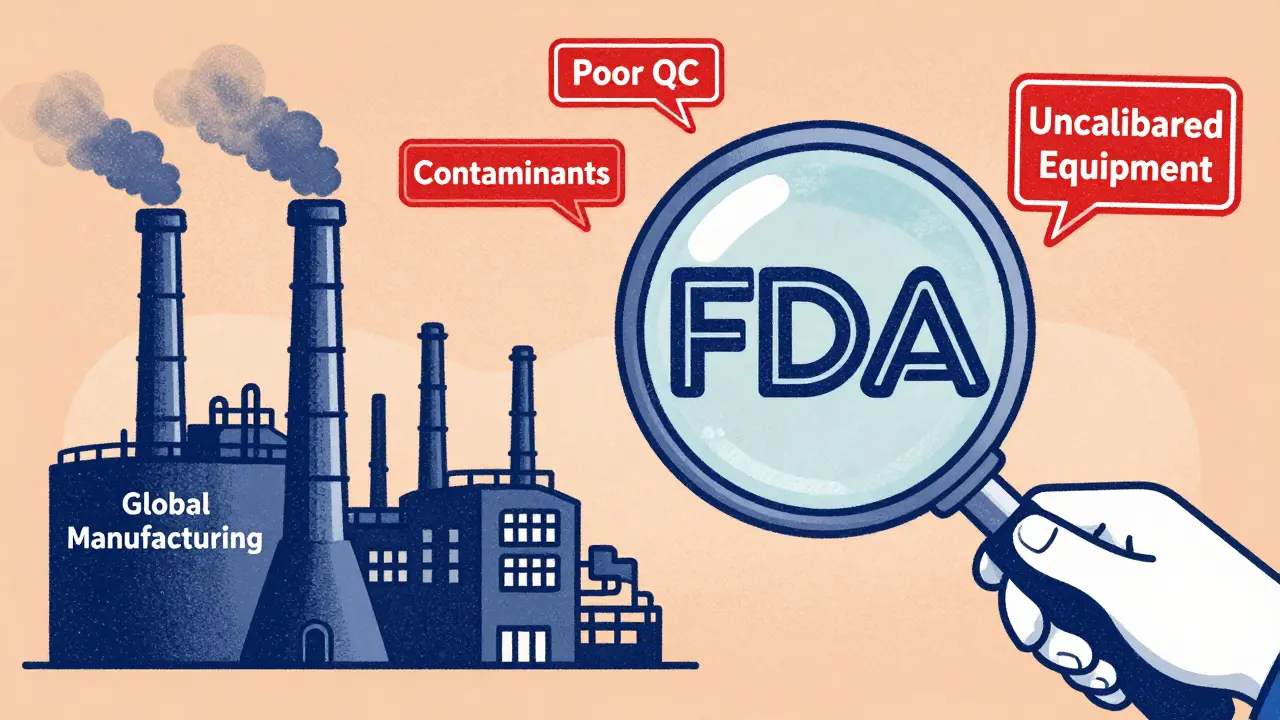
Even if the science is perfect, the factory might not be. The FDA inspects every manufacturing site - in the U.S. and overseas. If the facility has issues, the application stalls.In 2022, 41% of all complete response letters came from inspection problems. The most common red flags:
- Weak quality control systems (63% of facility-related CRLs)
- Failure to monitor environment for contaminants (29%)
- Equipment not properly tested or calibrated (24%)
Many generic manufacturers operate in countries with less oversight. The FDA can’t inspect every plant every year. So when they do go, they find gaps. And if a plant fails inspection, the entire application is put on hold - even if the drug itself is flawless. Fixing a manufacturing issue can take months. And if the company doesn’t fix it right the first time? They’re back in review cycle #4.
Patent Litigation: The Legal Lock
This is where things get messy. Even if the FDA gives tentative approval, a brand-name company can sue the generic maker for patent infringement. Under the Hatch-Waxman Act, this triggers a 30-month legal freeze. The FDA can’t give final approval until the court case is settled - no matter how strong the generic’s case is.Between 2010 and 2016, 68% of tentatively approved generics were held up by lawsuits. Some of these lawsuits are legitimate. Others? They’re tactics.
Brand companies use what’s called “citizen petitions” - formal requests asking the FDA to delay approval on technical grounds. Between 2013 and 2015, 67 petitions were filed. Only three were approved. But they still delayed launch by an average of seven months. The FDA itself found that 72% of these petitions were based on weak or unsupported science.
Another trick? “Product hopping.” A brand company makes a tiny change - like switching from a pill to a liquid - and gets a new patent. This resets the clock. A 2018 FTC study found this happened in 17% of top-selling drugs.
Then there’s “pay-for-delay.” Sometimes, the brand company pays the generic maker to stay off the market. Between 2009 and 2014, this happened 987 times. The FTC called it “anti-competitive.” Courts have cracked down, but it still happens.
Market Economics: Why Some Generics Never Launch
Even after patents expire and lawsuits end, some generics never appear. Why? Because it doesn’t make financial sense.Drugpatentwatch found that 30% of tentatively approved generics never launch. For drugs with annual U.S. sales under $50 million, that number jumps to 47%. If the market is too small, the cost of manufacturing, distribution, and compliance eats up the profit.
It’s worse for complex generics. Inhalers, topical creams, injectables - they’re expensive to make. A 2019 JAMA study showed that 62% of these products had launch delays over 12 months, even after approval. Manufacturers wait for the right moment - when competitors have entered, prices have dropped, and there’s still enough margin to make it worthwhile.
And sometimes, the market is already crowded. If only one generic enters, prices stay high. Other companies wait. Why spend millions to enter a market where the profit is thin? So the brand drug stays dominant longer than it should.

What’s Being Done to Fix It
The FDA knows the system is slow. They’ve tried to fix it.The Competitive Generic Therapy (CGT) pathway gives priority review to drugs with little or no generic competition. Since 2017, 78% of CGT applications got tentative approval in under eight months - compared to 18 months normally.
In 2022, the FDA picked 102 high-priority tentative approvals - mostly for drugs with zero generics on the market. Sixty-seven percent of those got final approval within 12 months. That’s more than double the normal rate.
GDUFA III (2023-2027) sets new goals: hit 70% first-cycle approval rates by 2027 (up from 28% in 2022), cut review times for priority drugs to eight months, and reduce the average number of cycles to 2.5.
But progress is slow. The median time from tentative approval to market launch in 2022 was still 16.5 months - barely better than in 2016. The FDA admits that patent games, complex products, and resource limits will keep delays going through at least 2025.
What This Means for Patients
Every month a generic is delayed costs the U.S. healthcare system millions. The Congressional Budget Office estimated patent delays added $9.8 billion to drug spending in 2018. By 2027, that number could hit $12.4 billion.Patients pay more. Insurers pay more. Taxpayers pay more. And it’s not just about money. For people who need daily medication - like blood pressure pills, diabetes drugs, or asthma inhalers - delays mean longer waits for affordable options.
Tentative approval was meant to be a shortcut. But between legal games, manufacturing hiccups, and economic disincentives, it’s become another long road. The FDA is trying. But until patent abuse is curbed and manufacturing standards are enforced globally, patients will keep waiting.
What is the difference between tentative approval and final approval for generics?
Tentative approval means the FDA has found the generic drug meets all scientific and manufacturing standards - but it can’t be sold yet because a patent or exclusivity on the brand-name version is still active. Final approval means the legal barriers are gone, and the drug can be marketed and sold immediately. Tentative approval is a green light for readiness; final approval is the green light to sell.
How long does it usually take from tentative approval to market launch?
The median time from tentative approval to market launch is about 16.5 months. Some launch quickly after patent expiration; others wait over two years. Delays happen due to patent lawsuits, manufacturing issues, or because the company decides it’s not profitable to launch yet. About 22% of tentatively approved generics never make it to market at all.
Can a generic drug be sold before its patent expires if it has tentative approval?
No. Tentative approval does not allow marketing. The FDA is legally blocked from granting final approval until all patents and exclusivities expire. Even if the drug is ready, it can’t be sold until the legal barriers are removed. Selling before then would be illegal.
Why do complex generics like inhalers or creams take longer to get approved?
Complex generics require more testing, more precise manufacturing, and harder-to-measure bioequivalence. For example, an inhaler must deliver the exact same dose to the lungs as the brand drug - which is harder to prove than a pill dissolving in the stomach. These drugs average 3.7 review cycles compared to 2.9 for simple pills. That adds up to 14 months longer on average.
What is the Competitive Generic Therapy (CGT) pathway?
The CGT pathway is a fast-track option for generic drugs that have little or no competition. If the FDA designates an application as CGT, it gets priority review - meaning faster feedback, fewer delays, and a goal of tentative approval within eight months. Since 2017, 78% of CGT applications met that target. It’s one of the few tools the FDA has to force faster access for drugs stuck in approval limbo.
Do citizen petitions really delay generic drugs?
Yes. Brand-name companies file citizen petitions asking the FDA to delay approval, often claiming the generic’s testing methods aren’t valid. Between 2013 and 2015, 67 petitions were filed. Only three were granted. But even rejected petitions delayed launches by an average of 7.2 months. The FDA says 72% of these petitions were scientifically unsupported - but they still work as legal delays.
Gregory Parschauer
January 14, 2026 AT 06:15
The FDA is basically a glorified paper-pushing machine that lets Big Pharma dictate the timeline for life-saving drugs. Tentative approval? More like tentative hope. We’re talking about people who can’t afford $500 pills for diabetes, and instead they get bureaucratic purgatory. This isn’t regulation-it’s corporate protectionism dressed in lab coats. The fact that 30% of generics never launch? That’s murder by paperwork.
mike swinchoski
January 15, 2026 AT 04:45
People don’t get it. The FDA isn’t the problem. The companies are. They file fake petitions, pay off lawyers, and delay generics just to keep prices high. It’s not about safety-it’s about profit. And the worst part? We all pay for it.
Lethabo Phalafala
January 15, 2026 AT 17:22
I come from a country where people wait six months just to get basic antibiotics, and here we are, with the most advanced regulatory system on earth, and we’re still holding back affordable medicine because some CEO wants another quarter of profits? This isn’t capitalism-it’s cruelty with a flowchart. I’ve seen grandparents ration insulin because the generic they were promised never came. Don’t tell me this is about safety. It’s about who gets to live and who gets to wait.
Lance Nickie
January 16, 2026 AT 15:08
generic drugs r just as good. stop overthinking it. the fda is just scared to move fast.
vishnu priyanka
January 17, 2026 AT 09:56
In India, we make half the world’s generics-and we don’t have 30-month lawsuits slowing us down. We don’t need to wait for patents to expire to start making pills. We just make them. The FDA’s system feels like a 1980s mainframe trying to run TikTok. You’ve got the tech, but the mindset is stuck in the analog era. And don’t even get me started on how they inspect plants in Bangladesh or Vietnam once every five years. It’s not a regulatory gap-it’s a global hypocrisy.
Robin Williams
January 18, 2026 AT 08:43
Think about it-every time a generic is delayed, someone’s life gets a little harder. Not just financially. Mentally. Emotionally. You think a diabetic doesn’t feel the weight of waiting for cheaper insulin? It’s not a statistic. It’s a person skipping doses because they can’t afford the brand. The system doesn’t just slow things down-it steals hope, one month at a time. And the worst part? We’re all complicit. We keep buying the expensive stuff because we don’t know better. Or because we’re too tired to fight.
Scottie Baker
January 19, 2026 AT 03:42
Let me be real-this whole system is rigged. Pay-for-delay? Citizen petitions? These aren’t loopholes, they’re weapons. And guess who gets hurt? The sick. The poor. The elderly. I’ve seen my mom skip her blood pressure med because the generic was ‘delayed.’ She didn’t know it had tentative approval for two years. Two years. Meanwhile, the brand company made $200 million off that same pill. This isn’t healthcare. It’s a casino where the house always wins.
Anny Kaettano
January 20, 2026 AT 01:23
For anyone who thinks this is just about bureaucracy: this is a public health emergency. The CGT pathway is a start, but it’s a Band-Aid on a hemorrhage. We need mandatory transparency in patent litigation, real penalties for frivolous citizen petitions, and global harmonization of manufacturing standards. The FDA can’t do it alone. Congress has to stop taking pharma money and start listening to patients. And manufacturers? If you’re sitting on a tentatively approved drug for 18 months because the market’s ‘not profitable enough’-you’re part of the problem. We need to treat medicine like a human right, not a balance sheet.
Kimberly Mitchell
January 20, 2026 AT 04:21
It’s not the FDA’s fault. It’s the applicants. If you can’t submit a complete application on the first try, you shouldn’t be in this game. Stop blaming the regulators for your incompetence. And don’t act like every delay is a conspiracy-sometimes, it’s just sloppy science.
Angel Molano
January 21, 2026 AT 13:03
Patent abuse is theft. Pay-for-delay is bribery. And the FDA letting it happen? That’s complicity. End it now.