Most people think of aging as something that happens after retirement. But your body starts changing much sooner. By your late 30s, you begin losing muscle mass every year without even knowing it. This slow decline isn't just about looking different in the mirror; it is about function. If you ignore it, simple tasks like carrying groceries or climbing stairs become dangerous struggles. Understanding Sarcopenia is the first step toward stopping this process before it limits your independence.
This isn't inevitable. Science shows we can reverse the damage, but only if we start early enough. You have to understand what is happening inside your muscles, how to measure your risk, and exactly how to move to fix it. Here is what you need to know to protect your strength and stay active.
What Exactly Is Sarcopenia?
Sarcopenia is the progressive, age-related decline in skeletal muscle mass, strength, and physical function.
It was formally recognized as a medical condition in 1989, but the definition has sharpened significantly over the decades. Unlike general weight loss or muscle atrophy caused by injury, this condition is specific to the aging process. It begins as early as the fourth decade of life. Studies indicate that between ages 65 and 80, the loss accelerates dramatically. Typical individuals lose 1-2% of muscle mass annually. That sounds small until you realize that over 20 years, nearly half of your functional muscle tissue could be gone.
Medical experts now rely on specific thresholds to diagnose the condition. The European Working Group on Sarcopenia in Older People (EWGSOP) updated their guidelines recently to include both mass and function. A clinician looks for:
- Handgrip strength: Below 27kg for men or 16kg for women.
- Gait speed: Walking slower than 0.8 meters per second.
- Appendicular lean mass: Measured via DXA scan, below 7.0kg/m² for men or 5.5kg/m² for women.
Current prevalence estimates show approximately 10% of adults over 60 are affected. That number jumps to 50% among those over 80. In the United States alone, this costs healthcare systems $18.5 billion annually. It is a silent epidemic that impacts millions of households globally.
The Physiology Behind Muscle Loss
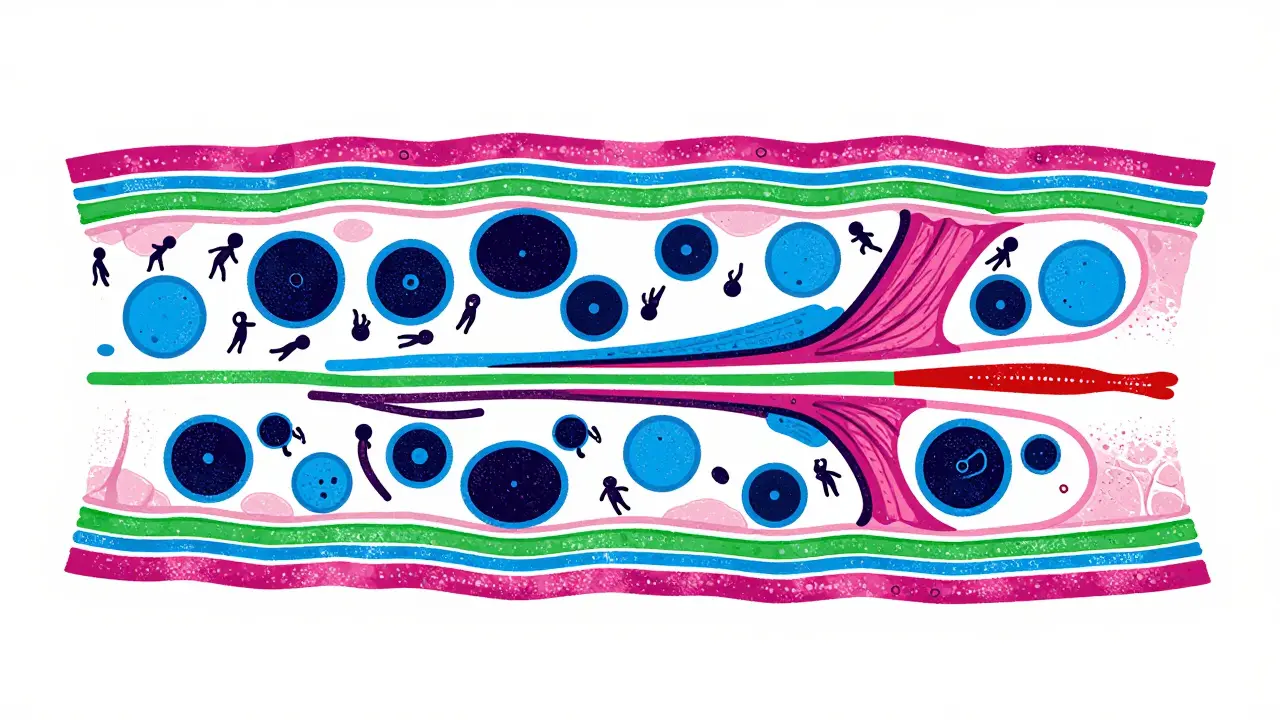
To fix the problem, you must understand the machinery. Inside your skeletal muscle, specialized cells called satellite cells act as repair workers. In your youth, they regenerate damaged tissue effortlessly. However, research shows a 50-60% reduction in regenerative capacity by age 70. Another critical factor involves the communication system. You lose motor neurons at a rate of 3-5% per year after age 60. These neurons control muscle contraction.
When a neuron dies, the muscle fibers it once controlled go unused. They atrophy, meaning they shrink and weaken. Specifically, type II muscle fibers take the hardest hit. These are your fast-twitch fibers responsible for quick, powerful movements. By age 80, you may have lost 30-40% of these specific fibers. This explains why falling becomes a risk; you lose the ability to generate rapid power to catch yourself.
Beyond structure, molecular changes occur too. Your mitochondrial function drops, producing 15-20% less ATP energy. You also face increased inflammation, with levels of certain markers rising by 30-50%. These biological signals tell your body to stop building muscle and start breaking it down. Without intervention, this cycle creates a downward spiral of frailty.
Why Strength Training Is the Only Cure
While supplements help, nothing replaces mechanical tension on the muscle. Expert consensus identifies strength training as the most effective intervention available. Dr. Jeremy D. Walston noted in a 2012 review that resistance exercise increases muscle mass by 1-2kg and strength by 25-30% in older adults within 12-16 weeks. That improvement restores significant daily capability.
Progressive resistance training works because it forces your body to adapt. When you lift something heavy enough, you signal your nervous system to recruit more motor neurons. You stimulate satellite cells to wake up and repair tissue. According to data from the American College of Sports Medicine, performing this twice weekly improves gait speed by 0.1-0.2m/s and reduces fall risk by 30-40%.
The mechanism is straightforward: stress leads to adaptation. If the stress is too low, no change occurs. If it is too high, injury occurs. You need that middle ground where you challenge your muscles without destroying them. This specific application of load is why walking alone won't solve sarcopenia. You must apply external resistance to trigger hypertrophy and neural recovery.
Designing a Safe Exercise Protocol
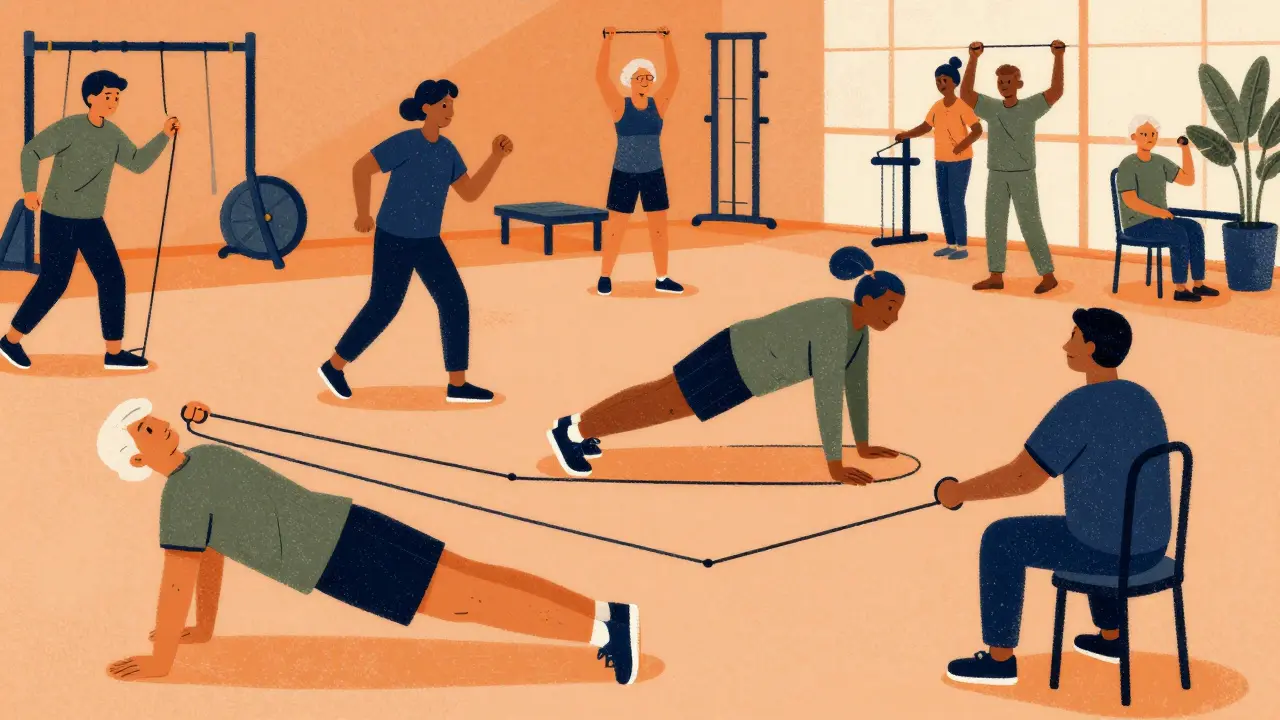
Starting strong requires a plan tailored to your baseline capabilities. The CDC recommends beginning with bodyweight exercises if you are new to lifting. Chair squats and wall push-ups allow you to practice movement patterns safely. From there, progress to resistance bands, then eventually to weight machines. A typical 12-week progression looks like this:
- Weeks 1-4: Bodyweight movements, 2 days per week, focusing on form.
- Weeks 5-8: Resistance bands at 50-60% of your maximum effort, 10-15 repetitions.
- Weeks 9-12: Weight machines at 60-70% intensity, 8-12 repetitions.
The optimal parameters for long-term success involve hitting major muscle groups with 2-3 sessions per week. Aim for 1-3 sets per exercise. Crucially, leave 48 hours of recovery between sessions targeting the same muscles. Without rest, your tissues cannot rebuild stronger.
| Modality | Primary Benefit | Risk Level |
|---|---|---|
| Bodyweight | Balance & Coordination | Low |
| Resistance Bands | Joint Safety & Variable Tension | Low-Moderate |
| Weight Machines | Precise Load Control | Moderate |
Some users report difficulty finding age-appropriate programming. Specialized senior training programs exist, often costing between $50-$75 per month, but home setups work well too. The key is consistency. User surveys show that those who engage in twice-weekly strength training maintain independence in daily activities at a much higher rate than non-exercisers.
Nutrition and Recovery Factors
Exercise breaks muscle down; food builds it back up. Older adults often struggle with protein intake because digestion slows and appetite decreases. To combat this, aim for 20-30 grams of high-quality protein within 45 minutes post-exercise. This window matters for activating the mTOR pathway, which drives protein synthesis.
Sleep is another pillar. During deep sleep, growth hormone peaks, aiding tissue repair. If you are not sleeping well, your gains will suffer regardless of how hard you train. Hydration also plays a role, as dehydration can lead to cramping and reduced performance during workouts. Treat nutrition with the same discipline as your lifting schedule.
Overcoming Common Barriers
Adherence is the biggest hurdle. About 40% of older adults drop out due to joint pain. Others quit because the exertion feels overwhelming. If you experience pain, modify the range of motion rather than stopping completely. Using machines that limit movement by 20-30 degrees can reduce joint strain while still loading the muscle.
Social support boosts persistence significantly. Joining exercise groups increases adherence by 35-40%. Many local centers offer classes specifically designed for mobility issues. Even having a partner checks in on you can make a difference. Remember, the goal is longevity, not winning a competition. Listening to your body prevents setbacks and keeps you moving forward.
Can I reverse sarcopenia naturally?
Yes. While some age-related decline is normal, resistance training combined with adequate protein intake can significantly improve muscle mass and strength, effectively reversing many symptoms of sarcopenia.
How much weight should I lift?
Start light and focus on form. As you build confidence, aim for a weight where the last 2 reps feel challenging. Typically, 60-80% of your maximum capacity works best for building strength in older adults.
Is protein powder necessary for seniors?
Not strictly necessary, but helpful. If you struggle to eat enough meat, fish, or dairy to reach 20-30g of protein per meal, supplements can help bridge the gap efficiently.
Does sarcopenia affect men and women differently?
Women generally lose muscle mass faster after menopause due to hormonal changes, making strength training critically important for female bone density and metabolic health alongside muscle preservation.
At what age should I start strength training?
Ideally in your 40s. Muscle loss begins earlier than you think, so preventative training should start mid-life to preserve reserve capacity for later decades.
Addressing muscle loss is about preserving your freedom. Every rep you add to your routine is an investment in staying independent longer. By understanding the biology and committing to a structured plan, you can change the narrative of aging from decline to maintenance. The tools are right here in your reach.
Calvin H
March 31, 2026 AT 21:36
Yeah sure, just lift weights until you snap a spine because apparently gravity became your personal enemy.
Ruth Wambui
April 2, 2026 AT 05:10
The big pharma cabal loves selling pills instead of fixing the root cause naturally. They want us dependent on their industrial shenanigans forever.
Brian Yap
April 3, 2026 AT 10:02
G'day everyone! Just remember to stay positive and move your body slowly :)
Kendell Callaway Mooney
April 4, 2026 AT 16:01
Start with bands. Do not jump into heavy machines immediately. Form comes first always.
Katie Riston
April 6, 2026 AT 02:24
We often discuss aging as a linear slide toward oblivion. This perspective misses the nuance of human adaptability. Muscle tissue is not merely meat attached to bone. It is the physical manifestation of our past choices. When we neglect movement, we silence our bodies. Silence eventually leads to structural failure. The fear of falling is understandable. Yet fearing gravity prevents us from mastering balance. Resistance training offers a dialogue with our physiology. We ask for load and the body answers with strength. This cycle repeats throughout the lifespan. Older adults possess a unique capacity for repair. It requires patience more than brute force. Consistency becomes the primary metric of success. Ultimately, the goal is maintaining autonomy.
Jonathan Sanders
April 6, 2026 AT 12:55
My back hurts just reading this guide honestly. I feel completely drained thinking about having to do anything physical.
Carolyn Kask
April 8, 2026 AT 11:24
Americans are the only ones doing it right with gyms here. The rest of the world lacks the proper grit and discipline. You should try harder to match our national standards.
Jonathan Alexander
April 9, 2026 AT 00:30
I am literally terrified about losing my ability to walk up stairs. It feels so heavy in my chest thinking about the decline. My existence feels fragile right now.
Charles Rogers
April 10, 2026 AT 17:59
Weak people ignore discipline then cry when they get old. You choose the path of comfort and suffer the consequences. It is entirely self inflicted misery. Stop making excuses and move.
Cameron Redic
April 11, 2026 AT 15:40
Data suggests compliance rates are abysmal anyway. Most individuals quit before any meaningful change occurs. It is a waste of resources to push this narrative. The system is rigged against participation.
emma ruth rodriguez
April 11, 2026 AT 20:54
Exercise is vital for health outcomes; furthermore, diet plays a crucial role! One must prioritize protein intake; subsequently, sleep patterns require optimization too.