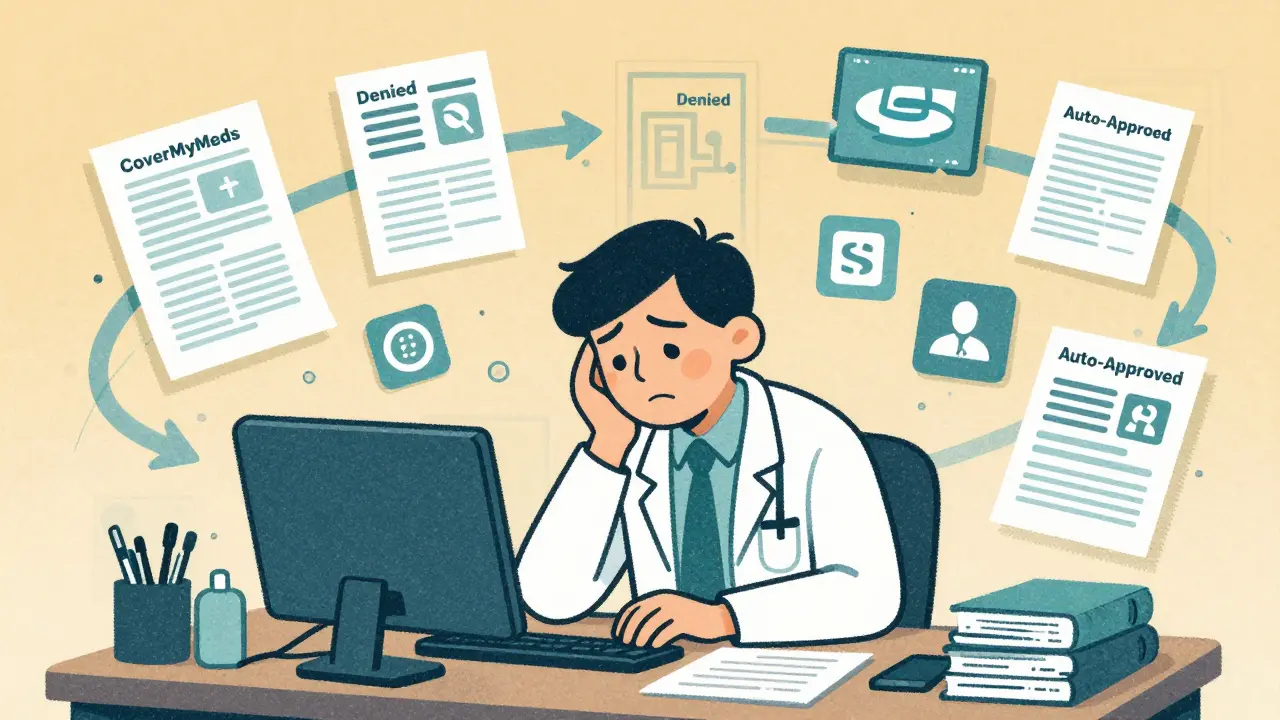
Getting a generic medication approved through prior authorization isn’t just paperwork-it’s a daily obstacle for providers trying to get patients the drugs they need, when they need them. Even though generics cost less and work just as well as brand-name drugs, insurance companies still demand proof before covering them. For many doctors, nurses, and medical assistants, the process feels like navigating a maze with shifting walls. One day, a request gets auto-approved. The next, it’s denied because a form was missing a single lab result.
Why Do Insurers Require Prior Authorization for Generics?
It’s not about distrust in generics. It’s about control. Insurance companies and pharmacy benefit managers (PBMs) use prior authorization to manage how and when drugs are prescribed. For generics, this usually happens in three cases: when there are multiple versions on the formulary and the plan prefers one over another, when the prescribed quantity exceeds the plan’s limit (like asking for 90 pills instead of 30), or when the medication is being used beyond a set duration-like prescribing a proton pump inhibitor for more than eight weeks without documentation.
According to the Academy of Managed Care Pharmacy, 28% of all prior authorization requests involve generic drugs. That’s not because they’re risky-it’s because they’re common. When a patient has been on omeprazole for years, or needs a specific generic version because they had a reaction to another, providers have to prove why the standard option won’t work.
The Centers for Medicare & Medicaid Services estimates that prior authorization saves $23.8 billion a year in unnecessary spending, with $4.2 billion of that tied to generic medications. That sounds good on paper. But for providers, the cost isn’t just financial-it’s time. Physicians spend an average of 16.1 hours a week on prior authorizations. That’s nearly two full workdays lost to bureaucracy instead of patient care.
How the Process Actually Works (Step by Step)
There’s no single system. Every insurer, Medicaid plan, or Medicare Part D provider has its own rules. But the core steps are mostly the same.
- Identify the requirement. Check the payer’s formulary. If the generic you want isn’t pre-approved, you’ll need prior authorization. Some plans list this directly in their online portals; others require calling customer service.
- Gather documentation. You can’t just say, “My patient needs this.” You need proof. That means clinic notes, lab results, diagnostic reports, or even prior treatment failures. For example, if a patient can’t tolerate metformin due to GI issues, you need to document that. If you’re requesting a 90-day supply, you need to show the patient has been stable on the medication for at least 30 days.
- Submit electronically. Over 78% of commercial insurers and 63% of Medicare Part D plans now require electronic submissions through platforms like CoverMyMeds or Surescripts. Fax is fading fast-only 22% still accept it. Phone requests? Just 5%.
- Wait for a decision. For urgent cases (like a patient without medication and at risk of hospitalization), Medicaid must respond within 24 hours. For standard requests, commercial insurers typically take 5-10 business days. Medicare Advantage plans, as of January 2024, must respond within 72 hours for non-urgent cases.
- Handle denials. If denied, you get a reason. Common ones: missing documentation (42%), failure to show medical necessity (38%), or not trying the preferred generic first (20%). You can appeal, but that adds another 7-14 days.
Auto-approval is becoming more common. Judi Health reports that 41% of generic prior authorization requests are approved automatically when the quantity is within limits and the patient has a history of use. Express Scripts saw a 40% increase in auto-approvals for generics in 2023. That’s progress-but only if your system is set up right.
What Makes Generic Prior Authorization Different From Brand-Name
Generics don’t get the same scrutiny as brand-name drugs, and that’s a good thing. Approval times for generics are typically faster: 1-3 business days versus 3-7 for brand-name drugs. Why? Because generics are proven. They’ve gone through FDA approval. They’ve been on the market. They’re cheaper. Insurers know they’re safe.
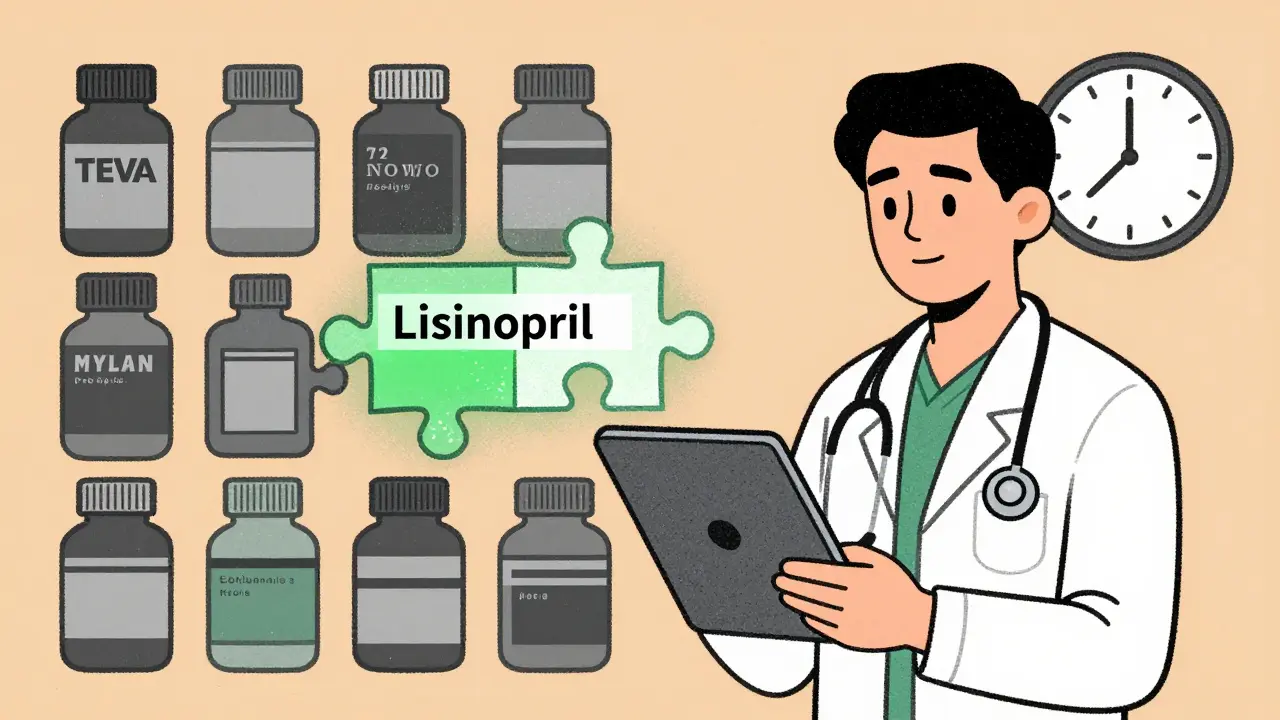
But here’s the twist: some PBMs now restrict which manufacturer’s generic they’ll cover. If your patient has been taking the Teva version of lisinopril, but the plan only covers the Mylan version, you might need prior authorization just to switch manufacturers-even though both are the same drug. Dr. Paul Fischer of GoodRx says this is becoming more common. Providers have to document why the patient can’t switch: allergies, GI intolerance, or even packaging issues (like a pill that’s too big to swallow).
Medicaid programs are also more likely to require prior authorization for generics than Medicare or commercial plans. Sixty-seven percent of Medicaid fee-for-service plans require it for certain generics, compared to 89% of Medicare Part D and 93% of commercial plans. That’s because Medicaid formularies are tightly managed to control state budgets.
What Providers Are Doing Right (And What’s Still Going Wrong)
Successful providers aren’t waiting until the last minute. They’ve built systems.
Dr. Michael Chen, a gastroenterologist, shared on Reddit how he secured approval for omeprazole 40mg daily for 12 weeks for a patient with Barrett’s esophagus. He didn’t just write a note. He attached the endoscopy report showing intestinal metaplasia. The request went through CoverMyMeds and was approved in two business days.
That’s the model. Document. Submit. Follow up.
But others aren’t so lucky. Dr. Lisa Rodriguez, on Sermo, had a request denied for generic sitagliptin after a patient had GI issues with metformin. The insurer demanded proof of three failed medications-even though the American Diabetes Association says metformin intolerance is enough to switch. That’s where the system breaks down: when insurers ignore clinical guidelines.
According to MGMA, 68% of practices get approval for generics in 1-3 days when documentation is complete. But if the payer asks for more info? That timeline jumps to 7-14 days. And 83% of pharmacists say patients can’t afford to pay out-of-pocket during that wait. That’s not just inconvenient-it’s dangerous.
How to Streamline the Process
You can’t eliminate prior authorization. But you can make it less painful.
- Use templates. Create standardized templates for common scenarios: diabetes meds, PPIs, SSRIs, antihypertensives. Capital Rx found that providers using templates see 32% faster approval times.
- Build payer-specific checklists. Every insurer has different rules. Keep a running list: “For Blue Cross, you need the last three HbA1c values. For United, you need a signed patient consent form.”
- Train a dedicated staff member. MGMA says 78% of routine prior authorizations are handled by medical assistants under physician supervision. That’s not a waste of time-it’s smart delegation.
- Use electronic systems. Don’t fax. Don’t call. Use CoverMyMeds, Surescripts, or your EHR’s built-in PA tool. Electronic submissions are 35-50% faster than fax.
- Track everything. Use a simple spreadsheet or software to log submission dates, expected response times, and outcomes. If a payer consistently delays, document it. That data can help when lobbying for change.
The Future: AI, Automation, and Reform
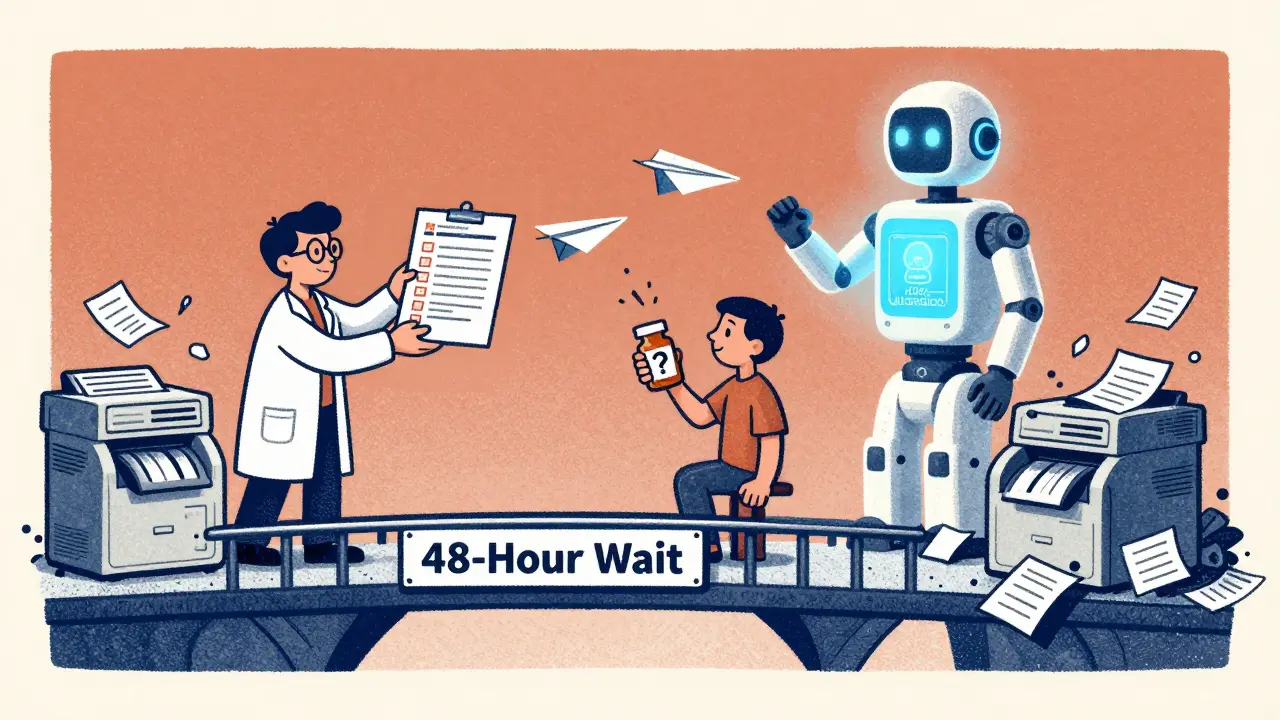
The system is changing. By 2026, McKinsey predicts 75% of prior authorization decisions for generics will be made by AI-assisted systems. That means faster approvals, fewer human errors, and less back-and-forth.
CMS rolled out new rules in July 2024 requiring Medicaid managed care plans to use standardized electronic transactions. That should cut processing times by 25%. The Improving Seniors’ Timely Access to Care Act of 2023 already forced Medicare Advantage plans to speed up responses.
The American Medical Association is pushing for state laws to eliminate prior authorization for generics that have been on the market for five or more years and have multiple manufacturers. That’s reasonable. If a drug has been safely used for over half a decade with dozens of suppliers, why does it still need approval?
But the Congressional Budget Office warns: if we don’t streamline, provider administrative costs will hit $1.2 billion extra by 2026. That’s money taken from clinics, not from drug prices.
Bottom Line: It’s Still a Battle, But You Can Win
Prior authorization for generics isn’t going away. But it doesn’t have to be a nightmare. The key is preparation, documentation, and using technology. Know your payer’s rules. Document like your license depends on it-because it does. Submit electronically. Track every request. And don’t accept denials without appeal.
Generics are the backbone of affordable care. If we let bureaucracy block access to them, we’re not saving money-we’re costing patients their health.
Why do insurers require prior authorization for generic medications if they’re cheaper and just as effective?
Insurers use prior authorization to control how medications are prescribed, even for generics. It’s not about safety-it’s about cost management. They restrict use when multiple generics exist, when doses exceed limits, or when drugs are used longer than standard guidelines. The goal is to prevent overuse and steer patients toward the most cost-effective option, even if it’s not always the best fit for the individual.
How long does it usually take to get prior authorization approved for a generic drug?
For urgent cases, Medicaid must respond within 24 hours. For standard requests, commercial insurers typically take 5-10 business days, while Medicare Advantage plans must respond within 72 hours as of 2024. Generic approvals are often faster than brand-name-usually 1-3 days-if documentation is complete and submitted electronically. If additional info is requested, it can stretch to 7-14 days.
What documentation is needed to get prior authorization for a generic medication?
You need clinical evidence showing medical necessity. This includes clinic notes, lab results, diagnostic reports (like endoscopies or MRIs), and proof of prior treatment failures. For example, if a patient had a bad reaction to one generic version, you must document that. If requesting a 90-day supply, you need proof the patient has been stable on the medication for at least 30 days.
Can patients get their generic medication while waiting for prior authorization approval?
Sometimes, but not always. Many patients can’t afford to pay out-of-pocket during the wait-83% of pharmacists report this happens regularly. Some providers give short-term bridge prescriptions, but that’s not a long-term fix. In urgent cases, providers can request expedited review, which may speed up approval.
Why are some generic medications denied even when the patient has a documented intolerance to the preferred option?
Some insurers ignore clinical guidelines and require providers to try multiple alternatives-even when guidelines say one failure is enough. For example, the American Diabetes Association says metformin intolerance is sufficient to switch to another drug, but some plans still demand proof of three failed medications. These are policy failures, not medical ones, and they often require formal appeals to correct.
Is there a way to reduce the time spent on prior authorization requests?
Yes. Use electronic submission tools like CoverMyMeds or Surescripts. Create standardized templates for common medications. Train a medical assistant to handle routine requests. Keep payer-specific checklists. Providers who use these strategies report 30-40% faster approval times and fewer denials.
Tiffany Wagner
January 23, 2026 AT 13:12
Just had a patient go without their generic lisinopril for 10 days because the system kept rejecting it for 'missing lab' even though they've been on it for 5 years
They showed up to the clinic dizzy and confused
Why are we still doing this in 2024
Chloe Hadland
January 24, 2026 AT 05:11
i feel you
my clinic started using covermymeds last year and it cut our PA time in half
but the one time it glitched and we lost a whole week
still better than faxing though
Amelia Williams
January 25, 2026 AT 23:21
My favorite part is when they deny a generic because 'preferred alternative not tried' but the preferred one is literally the same active ingredient just different manufacturer
and the patient has a documented allergy to the other one
so we're supposed to make them suffer through a reaction just so some algorithm can check a box
it's not healthcare it's a video game with real lives at stake
venkatesh karumanchi
January 26, 2026 AT 15:39
India has no prior auth for generics
you walk in, you get the pill, you leave
no forms, no calls, no waiting
we still have the same efficacy
why is America so obsessed with bureaucracy over access
Darren Links
January 27, 2026 AT 07:15
Let me get this straight
we're spending billions to save billions
but the people doing the actual work-the nurses, the MAs, the docs-are the ones paying the real cost
in time
in burnout
in lost patient trust
and we call this fiscal responsibility
what a joke
Kevin Waters
January 28, 2026 AT 19:22
Just want to add: if you're still faxing, stop.
Even if your EHR doesn't integrate with CoverMyMeds, use Surescripts.
It's 2024.
And if your clinic doesn't have a dedicated PA person, push for it.
One MA handling 10-15 PAs a day saves 20+ hours per provider weekly.
It's not extra work-it's efficiency
Kat Peterson
January 30, 2026 AT 02:17
OMG I just cried reading this
my best friend is a nurse and she literally has panic attacks before submitting PAs
and then when they get denied she has to call the patient and say 'sorry your meds are on hold for 2 weeks'
and the patient says 'but I can't afford to pay for it' and then she cries in the bathroom
WE ARE BROKEN
Jamie Hooper
January 30, 2026 AT 07:05
they say AI will fix this by 2026
but last time they said that about electronic records
now we got 47 different portals and still have to call for every little thing
imagine if the AI just said 'nah mate, this is fine' and moved on
that’s all we want
Husain Atther
February 1, 2026 AT 04:33
As someone from India working in U.S. healthcare, I find this system both fascinating and deeply troubling. The intent of prior authorization may be cost containment, but the execution is antithetical to patient-centered care. In my home country, access is prioritized over administrative control. Perhaps we can learn from systems that value time as a medical resource.
Izzy Hadala
February 1, 2026 AT 07:24
According to the American Medical Association’s 2023 Administrative Burden Survey, 94% of physicians report that prior authorization requirements have increased over the past five years, with 87% stating that these requirements have negatively impacted clinical decision-making. Furthermore, 62% of respondents indicated that prior authorization has led to delays in care that resulted in adverse clinical outcomes. These findings are statistically significant (p < 0.01) and warrant immediate regulatory intervention.
siva lingam
February 2, 2026 AT 05:30
so you're telling me the same pill
same chemical
same FDA stamp
but you need a PhD in insurance jargon to get it
brilliant
next they'll make us file a notarized affidavit to buy aspirin
blackbelt security
February 3, 2026 AT 04:22
Stop waiting for the system to fix itself.
Start documenting everything.
Use templates.
Train your MA.
Track every denial.
Then send that data to your state med assoc.
They need numbers to change policy.
Don’t just complain-arm yourself with data.
Patrick Gornik
February 4, 2026 AT 20:31
We’ve conflated cost-efficiency with moral superiority. The PBM’s algorithm doesn’t care about your patient’s dignity, only their formulary tier. Prior authorization is capitalism’s last stand against empathy-a bureaucratic ritual designed to make you feel powerless so you’ll stop asking for the obvious. Generics aren’t risky. The system is. And until we dismantle the profit-driven architecture of healthcare administration, we’re just rearranging deck chairs on the Titanic while patients drown in denial letters.
Tommy Sandri
February 5, 2026 AT 08:09
It is noteworthy that the regulatory frameworks governing prior authorization vary significantly across payer types. Medicaid programs, as noted, exhibit higher rates of prior authorization mandates for generic medications due to state budgetary constraints. This suggests a structural disparity in access to essential therapeutics based on socioeconomic status and insurance type, which may constitute a form of institutional inequity requiring policy-level remediation.
Karen Conlin
February 5, 2026 AT 14:25
My clinic started a 'PA Champion' program last year-we trained one MA to handle all prior auths, built a shared Google Sheet with payer rules, and made templates for every common med.
Approval time dropped from 7 days to 2.
Denials dropped by 60%.
Staff morale improved.
Patients stopped calling in tears.
This isn’t magic. It’s just doing the work.
If you’re still doing it solo, you’re not just overworked-you’re doing it wrong.
You don’t need more time.
You need a system.
And you deserve one.