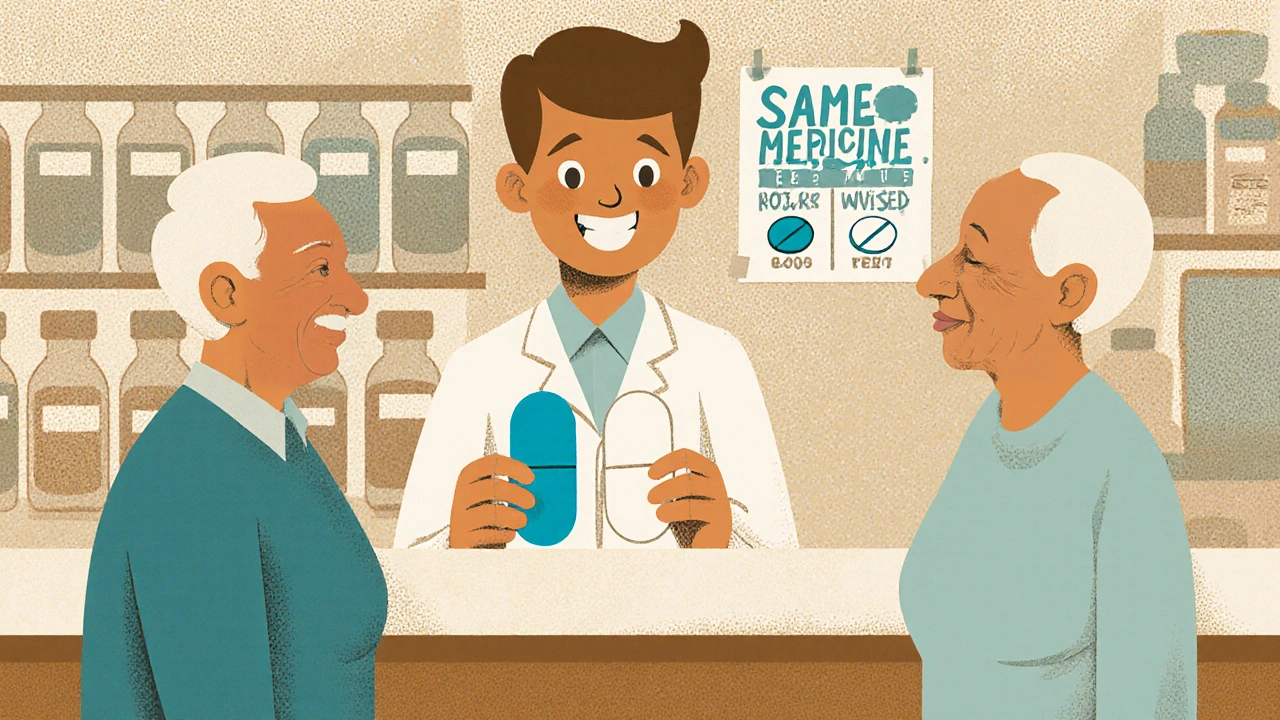
When a patient picks up their prescription and sees a pill that looks nothing like the one they’ve been taking, it’s natural to pause. Generic medications are just as safe and effective as brand-name drugs-but that’s not always how patients feel. In fact, nearly one in four patients express hesitation about switching to generics, according to a 2021 study in the Journal of the American Pharmacists Association. Many think the pills are weaker, made in shoddy factories, or just a cheap substitute. And if you’ve ever heard a patient say, “My old pill worked fine-why did they change it?”, you know this isn’t just a minor issue. It’s a barrier to adherence, safety, and savings.
Why Patients Doubt Generics (And Why It’s Not About Cost)
Most people assume patients resist generics because they’re cheaper. But that’s not the real problem. The real issue is trust. A 2019 University of Michigan study found that 78% of patients worry about changes in pill appearance-color, shape, size, even the imprint. One patient on Reddit described it perfectly: “My blue oval became a white rectangle. I thought I was getting a different drug.” That’s not irrational-it’s human. Then there’s misinformation. The FDA requires generics to be bioequivalent-meaning they deliver 80% to 125% of the same active ingredient as the brand-name version. Yet, 43% of patients believe generics contain only 80% of the active ingredient, as if that’s a deficit, not a range. And only 32% of patients know the FDA even has strict standards for generics, according to 2022 data from the National Community Pharmacists Association. Even worse, some providers accidentally make it worse. Saying “It’s the same drug, just cheaper” sounds practical, but it triggers distrust. A 2023 review in U.S. Pharmacist showed that approach dropped acceptance rates to just 31%. Patients hear “cheaper” and think “lower quality.”What Actually Works: The Science of Trust-Based Communication
The good news? We know exactly what works. It’s not about reciting FDA guidelines. It’s about connection. One of the most powerful tools is the ‘Ask-Tell-Ask’ method. It’s simple:- Ask: “What are your thoughts about switching to this generic version?”
- Tell: “This generic has the same active ingredient, and the FDA requires it to work just like the brand. It’s tested to make sure your body gets the same amount of medicine.”
- Ask again: “Can you tell me back what you understand about how this works?”
Timing Matters More Than You Think
When you talk about generics makes a huge difference. The FDA’s 2022 report found that 89% of patients accept generics when they hear about the switch at the time of prescribing-before they even get to the pharmacy. Only 63% accept it when they’re handed the pill at the counter. Why? Because once a patient sees the pill, their brain locks into the visual mismatch. The doubt has already taken root. If the prescriber explains it upfront-“We’re switching you to this generic because it’s just as effective and saves you money”-the patient enters the pharmacy already open to it. And if you’re the pharmacist? Don’t wait for them to ask. Proactively explaining the switch before a concern arises leads to 82% acceptance, compared to just 47% when you’re reacting to a complaint. That’s the difference between being a trusted advisor and a transaction clerk.Use Visuals, Not Just Words
A 2022 Healthcare Hotline survey found that 68% of patients would feel more confident about generics if they could see a side-by-side comparison of the brand and generic pills. And 41% specifically asked for before-and-after images. The FDA now offers free digital tools-3D pill comparators, videos showing how bioequivalence is tested-that you can show on a tablet in your pharmacy. A pilot at 15 CVS locations in 2023 saw a 29% increase in acceptance after using these tools. You don’t need fancy tech. Even a printed image taped to the counter helps. Show them the pills. Say: “This is the brand. This is the generic. Same active ingredient. Same effect. Just no marketing costs.”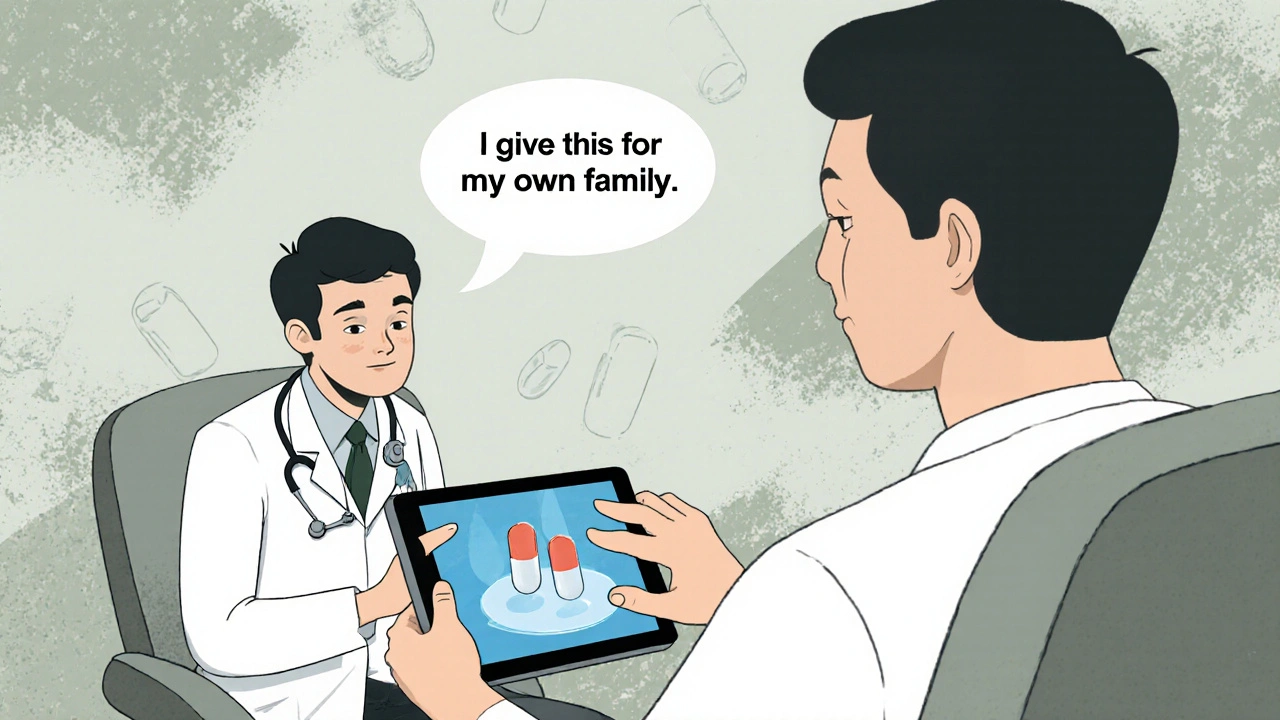
Don’t Say ‘Cheaper.’ Say ‘Same Medicine, Less Noise’
Language changes everything. Saying “It’s cheaper” only increases acceptance by 7%. But saying “This medication contains exactly the same active ingredient, but without the brand name marketing costs” lifts acceptance by 29%. Why? Because you’re not talking about price-you’re talking about value. You’re separating the medicine from the packaging. Patients understand that a car with no fancy leather seats still drives the same. They just need to hear it that way. And never, ever say, “It’s the same thing.” That’s dismissive. It tells patients their concerns aren’t valid. Instead, validate first: “I get why you’d be concerned-the pill looks different. That’s normal with generics.”Teamwork Gets Better Results
The best outcomes don’t come from one person. They come from a team. The American Medical Association found that when both the prescriber and pharmacist communicate clearly about generics, acceptance hits 85%. When only the pharmacist talks? It’s 67%. When only the doctor talks? 59%. That means if you’re a pharmacist and you see a brand-name prescription come in, don’t just dispense it. Flag it. Talk to the prescriber. Ask: “Would you be open to a quick note explaining why this generic is appropriate?” Many doctors will say yes-especially if you give them a template. Electronic health records now support automated prompts. When a doctor writes a brand-name prescription, a pop-up can say: “Consider generic alternative. Patient may benefit from cost savings and equivalent efficacy.” It’s small, but it nudges the conversation in the right direction.What Doesn’t Work-and Why
Some strategies backfire. Overemphasizing cost? It can reduce trust by 22%, according to a 2021 JAMA Internal Medicine study. Patients start wondering if the provider is pushing generics for profit, not care. Ignoring emotional concerns? Big mistake. A patient who stopped taking warfarin after switching to a generic without explanation ended up hospitalized for a blood clot. That’s not just a medical error-it’s a communication failure. And dismissing fears with, “Don’t worry, it’s fine,” shuts down dialogue. Patients stop asking questions. And if they’re not asking, they’re probably not taking the pill.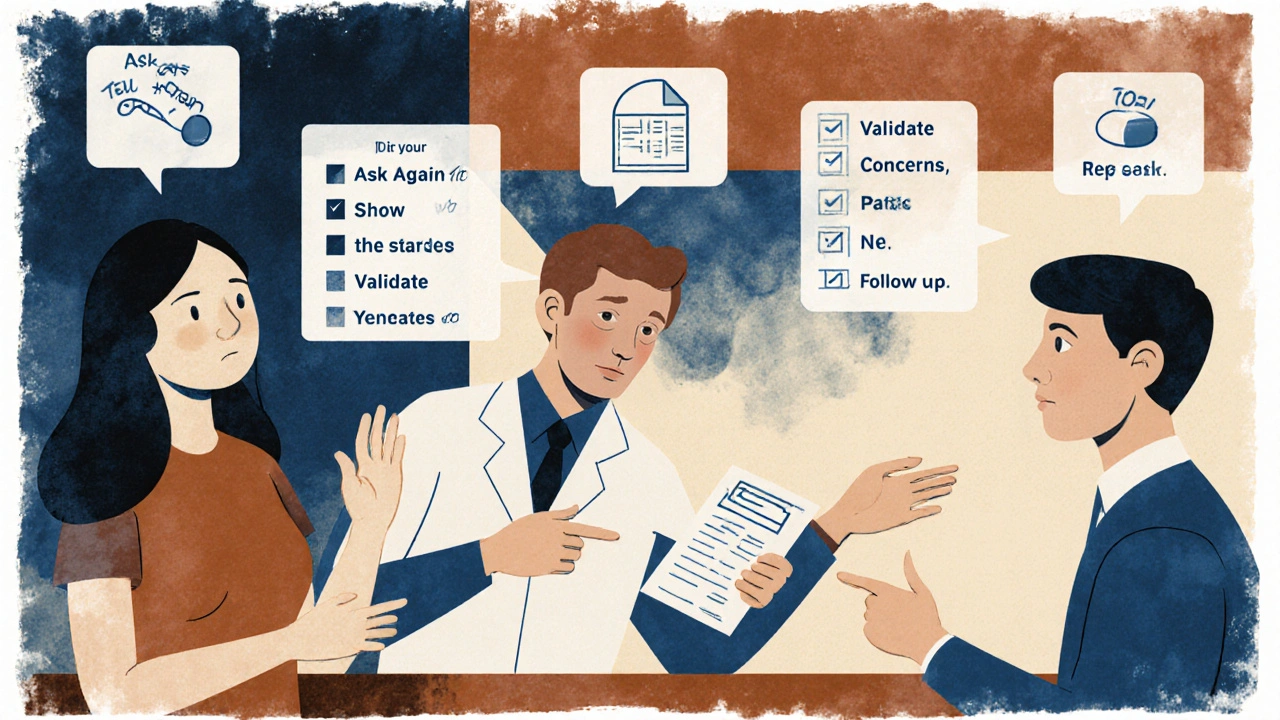
Real Talk: What Patients Are Really Saying
On forums like Reddit’s r/pharmacy, patients consistently mention three things:- They don’t trust pills that look different.
- They’re afraid the generic won’t work as well.
- They feel like they’re being treated like a number.
Training Is the Missing Piece
Most pharmacists didn’t learn how to have these conversations in school. They learned how to count pills. The American College of Clinical Pharmacy says effective training needs 4 to 6 hours of role-playing-practicing how to respond to 12 common objections like “I’ve been on this brand for 10 years,” or “My doctor said this one was better.” But here’s the catch: 67% of independent pharmacies don’t have time for extended counseling. That’s where reimbursement changes help. Medicare Part D now pays for 10-minute Medication Therapy Management sessions specifically for addressing concerns like this. Use them.The Bigger Picture: Why This Matters
Generics make up 90.9% of all prescriptions in the U.S.-but only 22.9% of drug spending. That’s $313 billion saved every year. Yet patient hesitation costs the system $8.2 billion annually in unnecessary brand-name fills. And it’s getting worse. The 2024 Medicare Star Ratings now include “generic substitution acceptance rate” as a quality metric. Pharmacies and providers will be scored on how well they help patients accept generics. The future? Personalized communication. The NIH is funding a $2.3 million study to test AI-driven tools that tailor messages based on a patient’s beliefs, age, and health history. But right now, the best tool you have is you.What You Can Do Today
You don’t need new software. You don’t need a big budget. You need these five actions:- Ask first. Don’t assume they know or agree. Ask what they think.
- Validate. Say: “It’s normal to feel unsure when the pill looks different.”
- Endorse. Say: “I give this to my own family because it’s just as safe.”
- Show. Use a pill comparison image-even a printed one.
- Follow up. Ask: “How’s it going after a week?”
Why do patients think generics are less effective?
Patients often believe generics are weaker because of misleading marketing, changes in pill appearance, or misinformation online. Some think generics contain only 80% of the active ingredient, when in reality, the FDA requires them to deliver between 80% and 125%-the same range as brand-name drugs. The difference is not in strength, but in packaging, color, and marketing costs.
Is it safe to switch from a brand-name drug to a generic?
Yes. The FDA requires all generic drugs to meet the same strict standards as brand-name drugs for dosage, safety, strength, route of administration, and performance. Generics must prove bioequivalence-meaning they work the same way in the body. Millions of patients switch safely every day. The only exceptions are narrow therapeutic index drugs like warfarin or levothyroxine, where close monitoring is needed-but even then, generics are safe with proper management.
What’s the best way to explain generics to an older patient?
Older patients are more likely to express hesitation-38% of those over 65 do, compared to 22% of younger adults. Use simple language and visuals. Show them the brand and generic side by side. Say: “This is the same medicine your doctor prescribed, just without the fancy packaging. It’s tested to work the same way. Many people my age take this exact same pill.” Personal endorsement helps: “I give this to my mother, and she’s been on it for two years.”
Can I be sued if a patient has a bad reaction to a generic?
No, as long as you followed proper procedures. Generic drugs are FDA-approved and legally interchangeable. The key is documentation. If you discussed the switch, explained bioequivalence, and documented the conversation, you’re protected. The FDA now requires standardized documentation for all generic substitution discussions as of January 2024. Always record what you said and how the patient responded.
How do I handle a patient who says, ‘The generic doesn’t work for me’?
Don’t dismiss it. Ask: “When did you notice a difference?” Sometimes, it’s not the drug-it’s the pill size, timing, or other medications changing. Other times, it’s the placebo effect: they expect it to feel different. Try switching back to the brand temporarily to rule out an issue. If the problem disappears, it’s likely perception. If it persists, consult the prescriber. Never assume it’s just in their head.
Are there tools I can use in my pharmacy to help patients understand generics?
Yes. The FDA offers free resources: pill comparison charts, videos showing how generics are tested, and digital tools you can show on a tablet. Many manufacturers also provide printed materials. Even a simple printed image of the brand and generic side by side with the note “Same active ingredient” can reduce confusion. The Kaiser Permanente model showed that using visuals increased acceptance by 27%.
Peter Lubem Ause
November 30, 2025 AT 03:17
Man, this post hit home. I’ve been a pharmacist for 12 years and I’ve seen patients cry because their blue pill turned white. It’s not about money-it’s about losing something familiar. I started using the ‘Ask-Tell-Ask’ method after reading this, and damn, acceptance rates jumped. One elderly lady told me, ‘I thought I was getting poisoned,’ and I just nodded and said, ‘I get that.’ Then I showed her the FDA chart. She left with the generic and a hug. That’s the stuff that matters.
And yeah, never say ‘cheaper.’ Say ‘same medicine, less marketing noise.’ That line alone saved my job last month when a guy threatened to go to the CEO. He walked out saying, ‘Well, when you put it like that…’
linda wood
November 30, 2025 AT 21:05
So let me get this straight-we’re spending millions on studies to prove that a pill that looks different isn’t poison? And we still have to ‘validate’ people’s fear like they’re five-year-olds who think the dark is full of monsters?
Also, ‘I prescribe this to my own family’? Cute. But if I told my grandma that, she’d ask if the generic was made in the same factory as the brand. And then I’d have to explain why the FDA doesn’t care about that. Spoiler: it’s because bioequivalence doesn’t care where the pill is made, just what’s in it.
Meanwhile, the real problem is that no one tells patients the brand-name drug they’ve been on for 10 years was probably made in China too. But hey, at least it had a logo.
Also, why is the FDA’s 80-125% range treated like a loophole? That’s a 45% swing. That’s not ‘same,’ that’s ‘maybe.’
Just saying.
Also also-why do we keep pretending this is about trust and not about corporate greed disguised as cost-saving? The brand-name makers spent $2 billion marketing that blue pill. Now they’re mad we’re not paying for it anymore. That’s the real story.
LINDA PUSPITASARI
December 2, 2025 AT 03:26
OMG YES THIS!! 😭 I had a patient last week who refused her generic blood pressure med because it was ‘too small’ and ‘looked like a baby pill’ 🤦♀️ I showed her the side-by-side pic from the FDA site and she just stared at it for like 2 minutes and said ‘huh… so it’s the same stuff?’
Then I said ‘yep, same as your husband’s, and he’s been on it for 5 years and his BP is perfect’ and she took it. 🙌
Also the ‘I give this to my own family’ thing? GAME CHANGER. My mom takes the same generic statin I give my patients. She’s 78 and still hikes every weekend. I tell that story ALL THE TIME. It works. People need to see you believe in it.
Also please use the pill comparators!! The free ones from FDA are so simple to print. I taped one to my counter and now 80% of patients ask about it before I even mention it. Magic. 🧙♀️
gerardo beaudoin
December 2, 2025 AT 05:08
Yeah, I’ve been doing this for a while and the key is just talking to people like humans. Not robots. Not salespeople. Just… humans.
One guy came in yelling about his generic Adderall not working. I didn’t argue. I said, ‘Okay, tell me what’s different.’ He said, ‘It doesn’t make me feel as sharp.’ I said, ‘What time do you take it?’ He said, ‘Same time.’ I said, ‘Did you eat breakfast?’ He paused. ‘No.’
Turns out he was taking it on an empty stomach. Generic or brand, it wouldn’t have worked. We fixed that. He came back and thanked me.
It’s not about the pill. It’s about the story they’re telling themselves. You just gotta help them rewrite it.
Joy Aniekwe
December 3, 2025 AT 18:26
Oh wow. So now we’re treating adults like toddlers who need a cartoon to understand that a pill isn’t a magic spell?
Let me guess-the next step is handing out coloring books with ‘Generic Pills Are Just As Good’ stickers?
And let’s not forget the real issue: the FDA’s 80–125% range. That’s not ‘same.’ That’s ‘wildly inconsistent.’
But hey, if you want to keep people compliant, just keep telling them it’s fine while ignoring the fact that the system is designed to make them feel like they’re being scammed.
And ‘I prescribe this to my family’? Cute. But if your family’s on a $200/month brand-name drug, you’re not being honest. You’re being performative.
Also, why are we still pretending this isn’t about profit? The brand-name companies spent $3 billion to make people think their blue pill was sacred. Now they’re mad we’re exposing the lie.
It’s not about trust. It’s about control.
Latika Gupta
December 3, 2025 AT 19:41
I’m just wondering… do you think patients who don’t accept generics are also the ones who avoid flu shots because they ‘don’t work’? Like… is this part of a bigger pattern of distrust in medicine? I’ve noticed a lot of my patients who refuse generics also refuse vaccines and say ‘natural remedies’ work better… I’m just curious if there’s a connection.
Also, I saw a patient yesterday who said her generic thyroid med made her ‘feel weird’-but she was on a new brand last year too. Maybe it’s not the pill… maybe it’s something else? I don’t know. Just thinking out loud.
Monica Lindsey
December 5, 2025 AT 15:54
Pathetic.
You’re giving patients a PowerPoint on pill shapes and calling it ‘medicine.’
They don’t need visuals. They need accountability.
Who approved this? Who signed off on letting a 125% variability in bioequivalence be ‘acceptable’?
And why are pharmacists the ones cleaning up the mess instead of the FDA?
Stop treating symptoms. Fix the system.
Or don’t. Just keep handing out stickers.
jamie sigler
December 5, 2025 AT 18:46
So… we’re spending 20 minutes explaining a pill to someone who just wants to get their meds and go?
And now we’re supposed to ‘endorse’ it like we’re a TikTok influencer?
‘I give this to my family’-sure, if your family has health insurance and doesn’t have to choose between insulin and rent.
Meanwhile, the guy who can’t afford the brand? He’s not asking for a lecture. He’s asking for a pill that doesn’t cost his rent.
Stop pretending this is about trust. It’s about money.
And we’re just the middlemen selling hope.
Bernie Terrien
December 6, 2025 AT 07:46
Let’s be real: this whole thing is a corporate PR stunt wrapped in a lab coat.
Generics aren’t ‘just as good’-they’re cheaper. Period.
And yes, 90% of them work fine. But that 10%? The one that makes your BP spike or your depression come back? That’s the one that gets buried in the data.
And now we’re supposed to smile and hand out color-coded pill charts like we’re running a kindergarten?
Meanwhile, the FDA lets a drug swing 45% in potency and calls it ‘bioequivalent.’ That’s not science. That’s math with blindfolds.
Don’t give me ‘trust.’ Give me consistency.
And stop pretending this isn’t about saving Big Pharma’s bottom line.
Jennifer Wang
December 7, 2025 AT 23:24
While the communication strategies outlined in this article are commendable and evidence-based, it is imperative to recognize that adherence to generic medications is not solely contingent upon patient education. Structural factors-including insurance formularies, pharmacy benefit manager (PBM) policies, and prescriber incentives-exert a far greater influence on substitution rates than interpersonal communication alone.
Furthermore, while the ‘Ask-Tell-Ask’ method demonstrates efficacy in controlled clinical trials, its scalability across high-volume community pharmacies remains unproven. The time burden per patient, estimated at 4.2 minutes in the cited study, is incompatible with the average dispensing cycle of 1.8 minutes in most retail settings.
Therefore, while the interpersonal techniques are valuable, systemic reform-particularly regarding reimbursement structures and mandated documentation protocols-is a prerequisite for sustainable, population-level impact.
Recommendation: Integrate standardized, automated electronic health record prompts with mandatory provider attestation for generic substitution counseling.
-Dr. Jennifer Wang, PharmD, PhD, Clinical Pharmacoeconomics