Storing insulin correctly isn’t just a suggestion-it’s a matter of life and death. If your insulin loses potency, your blood sugar can spike dangerously high without warning. Many people don’t realize that even a few hours in a hot car or a fridge that’s too cold can ruin a full month’s supply. With over 23 million Americans relying on insulin, getting this right makes all the difference.
Unopened Insulin: Keep It Cold, But Not Frozen
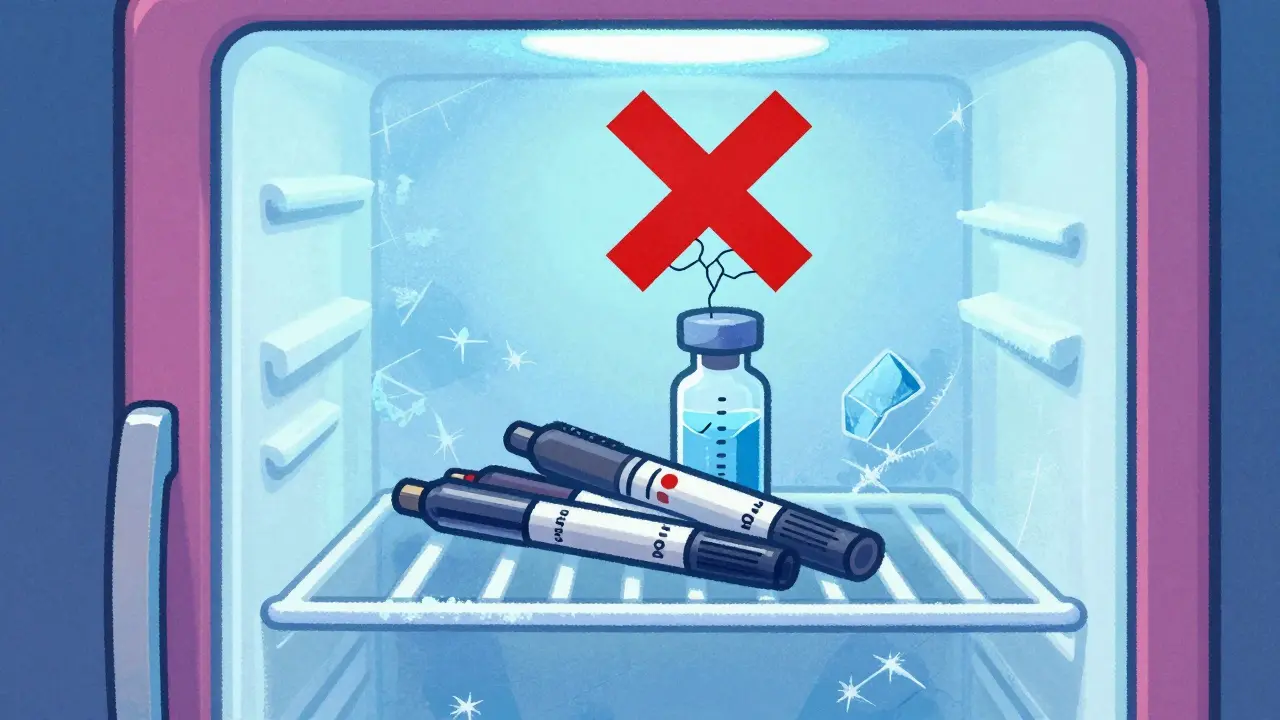
Before you open a new insulin vial, pen, or cartridge, it must stay refrigerated. The sweet spot is between 36°F and 46°F (2°C to 8°C). That’s standard across all major brands: Eli Lilly, Novo Nordisk, and Sanofi. This keeps insulin stable until its expiration date.
But here’s the catch: never freeze insulin. Freezing doesn’t just cool it down-it breaks the molecular structure. Once frozen, insulin forms crystals that can’t be undone, even if you thaw it. The result? Ineffective medication. The Wisconsin Department of Health Services found that 12% of home refrigerators have spots near the back or freezer compartment that dip below 32°F. Store your insulin on a middle shelf, away from walls and ice packs.
Opened Insulin: Room Temperature Is Okay-For a While
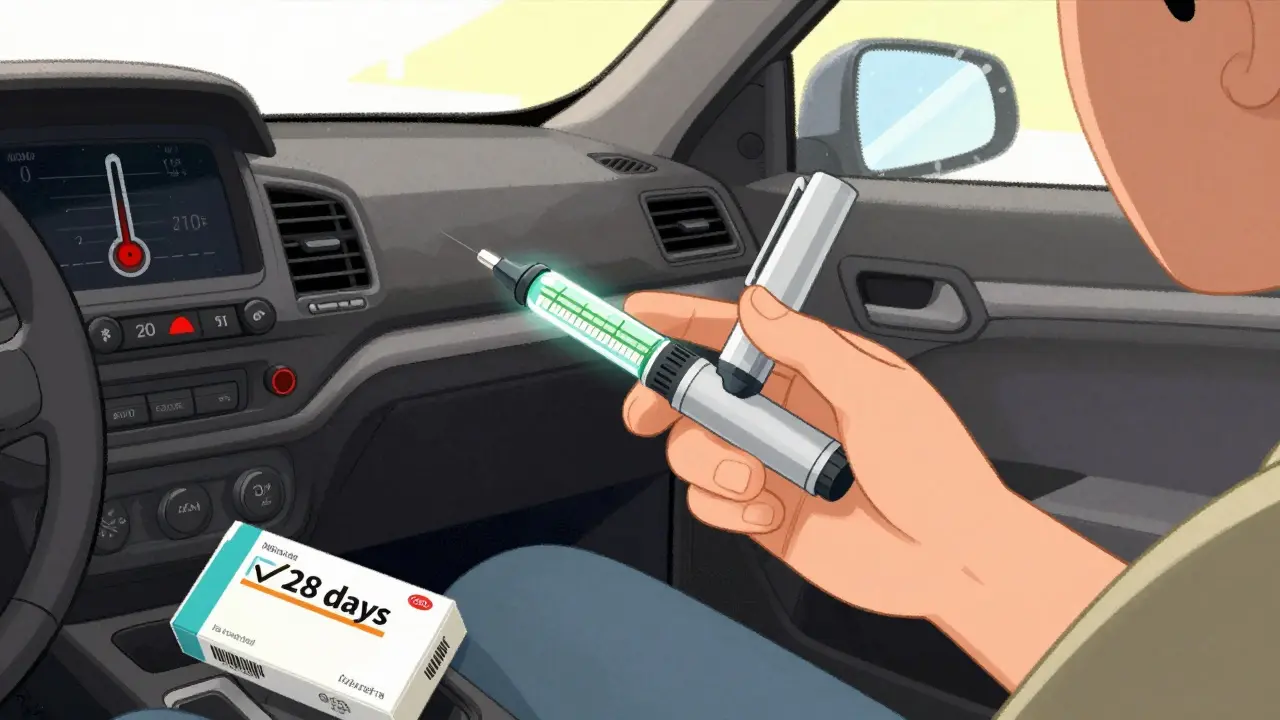
Once you start using insulin, you don’t need to keep it cold. In fact, injecting cold insulin can hurt. Most insulin brands are safe at room temperature (59°F to 86°F) for up to 28 days. That’s the rule for most pens and vials. But not all.
Some types have different rules:
- Isophane insulin (NPH): Lasts only 14 days at room temperature.
- Insulin Degludec (Tresiba): Stays stable for up to 8 weeks after opening.
- Toujeo (insulin glargine U300): Approved in early 2023 for 56 days at room temperature.
Always check the label. Manufacturers now include detailed storage times on packaging, a big improvement from 2010 when only 65% of products did. Today, it’s 100%. If the box says 28 days, don’t stretch it. Pushing past that window risks unpredictable blood sugar swings.
What Happens When Insulin Gets Too Hot?
Heat is the biggest enemy. Once insulin hits 86°F, it starts losing potency. At 98.6°F (body temperature), degradation accelerates. The FDA says insulin loses about 1.3% of its strength every hour above 86°F. At 104°F, it’s completely useless within 48 hours.
Real-world danger? A car on a 75°F day can hit 120°F inside in under 30 minutes. Dr. Anne Peters warned in 2021 that many patients don’t realize how quickly this happens. One Reddit user lost $380 worth of insulin after their fridge failed and warmed to 50°F for two days. Blood sugars went haywire. They didn’t know why-until they checked the fridge.
Cloudiness is another red flag. If your insulin should be clear (like Humalog or NovoLog) and it looks cloudy or has particles, toss it. Same goes for any color change. That’s not normal. It means the insulin has degraded.
Insulin Pumps: A Different Story
If you use an insulin pump, your rules change. Insulin in the pump reservoir or infusion set must be replaced every 72 hours-even if it’s still within the 28-day room temperature window. Why? Because the tubing and needle create a perfect environment for bacterial growth and insulin breakdown.
Also, if insulin leaves its original vial to fill the pump, it must be discarded after 14 days. This is stricter than regular pens or vials. And if the pump gets too hot-say, left in a hot car or near a heater-discard the insulin immediately. No exceptions.
Traveling with Insulin: Keep It Cool Without a Fridge
Traveling? You need a solution. The American Diabetes Association recommends insulated cooling cases with phase-change materials. These keep insulin between 59°F and 86°F for 48 hours. Brands like Frio Wallet are popular. Amazon reviews show a 4.3-star average from nearly 3,000 users. They’re not cheap-$25 to $50-but cheaper than replacing spoiled insulin.
Here’s what to avoid:
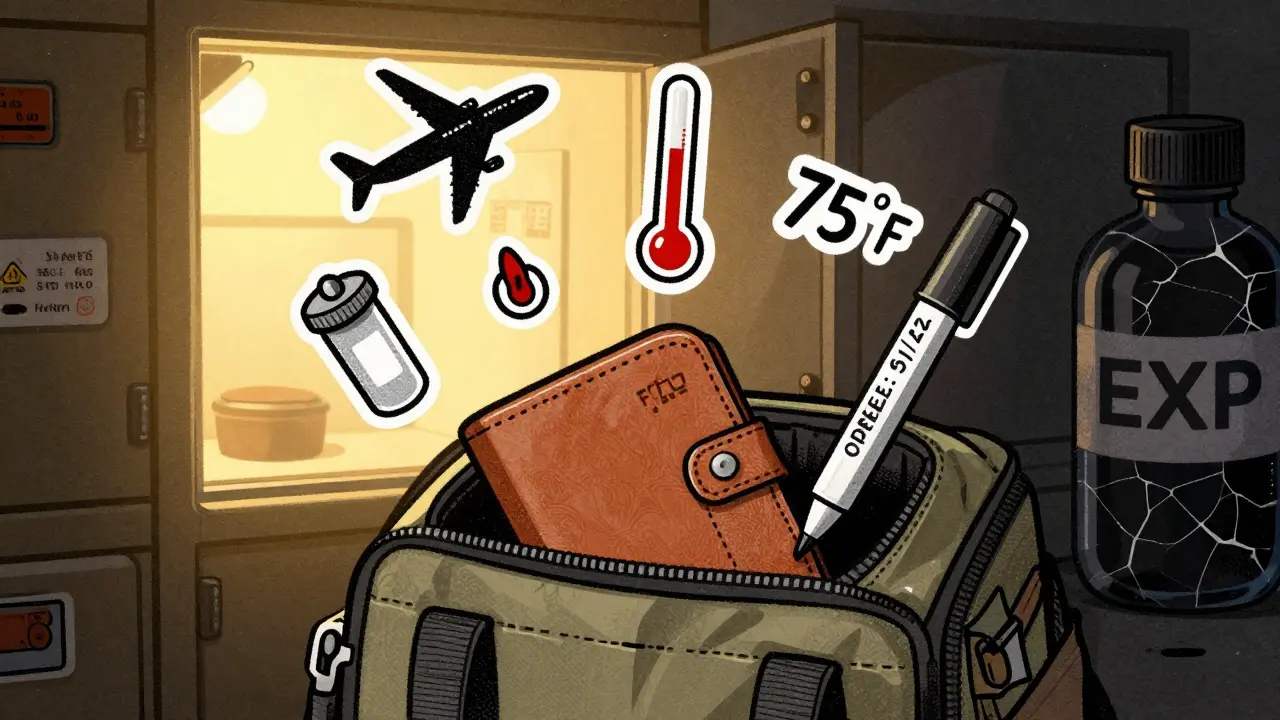
- Don’t leave insulin in checked luggage. Air cargo holds can get below freezing.
- Don’t store it in a car glove box, even for a few hours.
- Don’t rely on ice packs alone-they can freeze insulin if they touch the container.
Carry insulin in your carry-on. Bring a doctor’s note if flying. TSA allows insulin and supplies through security without restriction.
Label Everything. Always.
One of the easiest, most effective habits? Mark the opening date on every pen and vial. Use a permanent marker. A University of Michigan study found this simple step reduced usage past the 28-day limit by 68%.
Also, check expiration dates. A 2022 survey by the American Association of Diabetes Educators found 41% of users don’t check them regularly. That’s dangerous. Expired insulin doesn’t work. Even if it looks fine.
What About Disposal?
Never throw used pens or needles in the trash. Use a sharps container. Most pharmacies sell them for under $10. Once full, return them to a pharmacy or medical waste facility. Many cities have drop-off programs.
For unused insulin you need to discard: Pour it down the sink or toilet. Don’t give it to someone else. Don’t donate it. Insulin is a prescription medication, and once opened, it’s not safe for reuse.
Why This Matters: The Real Cost of Mistakes
Improper storage isn’t just inconvenient-it’s costly. The American Diabetes Association estimates $1.2 billion a year is wasted in the U.S. alone due to spoiled insulin. That includes extra doctor visits, ER trips, and hospital stays from uncontrolled blood sugar.
Dr. Robert Gabbay of the ADA says improperly stored insulin causes about 17% of unexplained blood sugar spikes. That’s nearly one in five cases where someone thinks they’re doing everything right-except storing their insulin.
And in emergencies? During heatwaves, the IDF found 8.2% of diabetic ketoacidosis cases in emergency rooms were linked to degraded insulin. People didn’t know their insulin was bad. They thought their body was failing. It was the storage.
What’s Changing? Better Insulin, Better Storage
The future is brighter. In 2023, Sanofi’s Toujeo got approval for 56 days at room temperature. That’s a game-changer for travelers and people without reliable refrigeration.
Next-generation insulins in development are even more stable. Biocon’s biosimilar formulations have shown they can survive 14 days at 104°F in trials. By 2027, experts predict 60% of new insulins will last 35+ days at room temperature.
But for now, stick to the rules. Don’t wait for better options. Your current insulin needs you to protect it.
Serena Petrie
March 15, 2026 AT 12:41
I just leave mine on the counter. Works fine. 🤷♀️
Buddy Nataatmadja
March 17, 2026 AT 04:17
Funny how we treat insulin like a fragile artifact when it’s literally the difference between life and a hospital bed. I’ve seen people panic over a 2-hour car ride but forget their meter batteries. Priorities, man.
mir yasir
March 17, 2026 AT 15:36
The precision of insulin storage protocols reflects the broader epistemological rigor required in endocrinological management. One cannot afford empirical approximations when molecular conformation dictates physiological outcomes. The cited temperature thresholds are not arbitrary-they are thermodynamically derived.
Stephanie Paluch
March 18, 2026 AT 00:33
I used to keep mine in the fridge door… big mistake. 🥶 Then I got one of those Frio wallets and it’s been a game changer. My BGs finally stopped acting like they’re on a rollercoaster 😌✨
tynece roberts
March 18, 2026 AT 13:50
so like i just kinda wing it? i mean i put mine in the fridge but not the back part? or is that still too cold? idk i just know if i dont use it in like 3 weeks it starts looking weird and then i panic and go buy more. also why do they make the pens so tiny and hard to write on? i lost my marker and now i just stare at them hoping they tell me when theyre expired lol
Hugh Breen
March 20, 2026 AT 01:26
THIS. IS. CRITICAL. 🚨 I’ve got a cousin who nearly ended up in ICU because she thought ‘it still looks clear so it’s fine.’ No. It’s not. Insulin doesn’t scream when it’s dying. It just stops working. And then you’re left wondering why your numbers are sky-high. Carry your meds like you carry your phone. Because your life depends on it more than your DMs do. 💙
Byron Boror
March 22, 2026 AT 00:51
Why are we even talking about this like it’s rocket science? Back in my day, we just stuck it in the fridge and moved on. Now everyone’s got a $50 wallet and a checklist. We’re overcomplicating life. If you can’t afford insulin, don’t be mad at the storage rules-be mad at the system.
Lorna Brown
March 23, 2026 AT 23:17
There’s something deeply human about how we treat this medication-as both a lifeline and a burden. We’re not just storing a chemical; we’re storing hope, control, dignity. The fact that we need to be this meticulous speaks volumes about how fragile our biological systems are-and how little the world prepares us for that fragility.
Rex Regum
March 24, 2026 AT 12:38
I’ve been using insulin for 30 years. I’ve never once checked the fridge temp. I’ve never used a wallet. I’ve never even marked the date. And I’m still alive. So who are you to tell me I’m doing it wrong? You’re not my mom. And this isn’t a parenting seminar.
Kelsey Vonk
March 24, 2026 AT 17:58
I started marking the dates after I had a scary spike last winter. It made me feel like I was taking back some control. Not perfect, but better. And now I have a little sticky note on my fridge: ‘Insulin lives here.’ It’s weirdly comforting. 🌿
Emma Nicolls
March 26, 2026 AT 08:25
i got a new pen last week and i forgot to write the date so i just stared at it for 3 days like a weirdo wondering if it was still good then i finally checked the box and realized it was only 10 days in 😅 i feel dumb but also like maybe everyone else is just pretending they know what theyre doing
Jimmy V
March 28, 2026 AT 07:36
Let’s cut the crap. You don’t need a $50 wallet. You need a cooler with a frozen water bottle and a towel. Put the insulin between the bottle and the towel. It’ll stay cool for 48 hours. No magic. No gimmicks. Just physics. And if you’re flying? Carry it. Always. TSA doesn’t care if you’re diabetic-they care if you’re dead. Don’t test them.