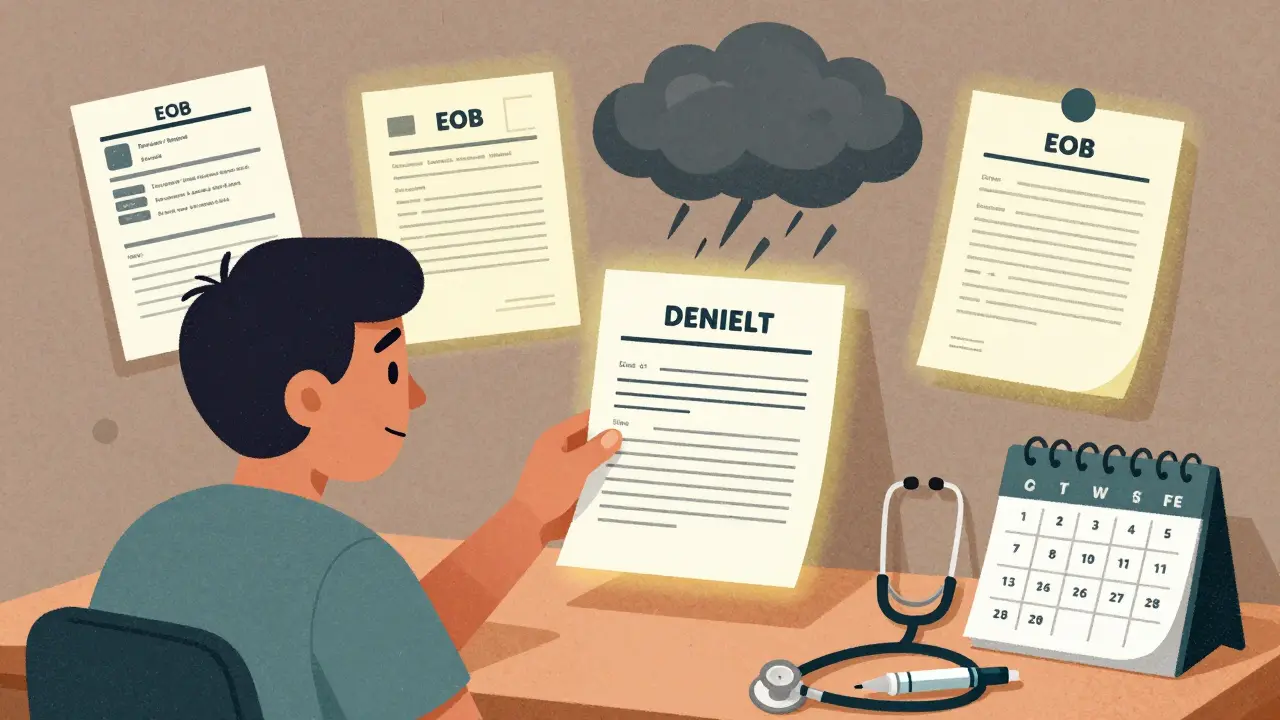
When your insurance denies coverage for a brand-name medication you’ve been taking for years, it’s not just a paperwork issue-it’s a health crisis. Maybe your insulin, your migraine drug, or your autoimmune treatment got pulled from the formulary overnight. You’re not alone. In 2022, nearly 18% of prior authorization requests for specialty drugs were denied, and more than 60% of those were for brand-name medications. The reason? Insurers are shifting to cheaper generics, even when those alternatives don’t work for you.
Why Your Insurance Denied Your Brand-Name Medication
Insurance companies don’t deny coverage randomly. They follow strict rules called formularies-lists of drugs they’ll pay for. If your medication isn’t on that list, they’ll push you toward a generic version. Sometimes that’s fine. But often, generics just don’t cut it. You might have had severe side effects, no improvement, or dangerous drops in blood sugar. That’s when you need to fight back. The denial letter you get will say something vague like “not medically necessary” or “generic alternative available.” Don’t accept that. That’s just the first line of defense. What they really mean is: “We want to save money, even if it risks your health.”What You Need Before You Appeal
Before you write a single word of your appeal, gather three things:- Your Explanation of Benefits (EOB)-this is the official denial notice. It must include the reason, the drug name, and the policy number. Insurers are required to send this within 5 business days of the decision.
- A letter of medical necessity from your doctor. This isn’t just a note. It needs to be detailed: your diagnosis, why generics failed, specific side effects you experienced, and how the brand-name drug improves your daily life.
- Your prescription history. Bring records showing how long you’ve been on the drug, any dosage changes, and any ER visits or hospitalizations tied to switching medications.
According to Keck Medicine of USC, the most successful appeals include objective clinical data, not just “I feel better on this.” That means lab results, blood sugar logs, seizure counts, or pain scale ratings. Your doctor’s letter should read like a case file, not a plea.
Step-by-Step: How to File an Internal Appeal
Your first chance to win is an internal appeal-this means you’re asking your own insurance company to reverse the decision. Here’s how to do it right:- Call your insurer within 30 days of the denial. Ask for the exact appeal form and deadline. Most plans give you 180 days, but don’t wait. Delays hurt your chances.
- Fill out the form completely. Include your name, policy number, the drug name, the denial reason, and your request for coverage.
- Attach your doctor’s letter and all supporting documents. Don’t just send copies-label them clearly: “Medical Necessity Letter,” “Lab Results,” etc.
- Send it certified mail with return receipt. Email or online portals don’t count. You need proof they received it.
- Call the insurer every 3-5 days. Ask for the case number and who’s reviewing it. Our data shows appeals with regular follow-ups get processed 28% faster.
If your medication is urgent-like insulin, seizure drugs, or cancer treatments-you can request an expedited review. You have the right to a decision in 4 business days. Say it clearly: “This is an urgent medical need. I require an expedited review under Healthcare.gov guidelines.” Then follow up in writing.
What If Your Internal Appeal Gets Denied?
About 61% of Americans are covered under ERISA plans-those tied to employer-based insurance. If yours is one, you can’t sue right away. You must go through an external review first. External reviews are handled by independent third parties, not your insurer. These reviewers are legally required to be unbiased. And here’s the good news: they approve appeals 58% of the time, compared to just 39% for internal reviews. To start an external review:- If you’re on Medicare, Medicaid, or a state-regulated plan: Contact your state’s insurance commissioner’s office.
- If you’re on an ERISA plan: File with the U.S. Department of Health and Human Services (HHS).
You’ll need your denial letter, your internal appeal decision, and all your documents again. The review takes 30-60 days. But if your condition is urgent, they must decide in 72 hours.
Why Doctors Are Your Secret Weapon
A 2023 GoodRx survey of 5,000 people found that 78% of successful appeals had active involvement from the prescribing doctor. The other 22%? Patients tried alone-and mostly failed. Your doctor doesn’t just write a letter. They can:- Call the insurer’s medical director directly to explain why the brand drug is necessary.
- Use standardized templates from the American Medical Association that insurers recognize.
- Include CPT and ICD-10 codes that match your diagnosis and treatment.
One patient in Sheffield, on Reddit, appealed a Humalog insulin denial after his child had three hypoglycemic seizures on a generic version. His endocrinologist submitted a letter with blood glucose logs, ER visit records, and a note saying: “This patient cannot safely transition to alternatives.” Approval came in 11 days.
When to Hire a Lawyer
If you’re on an ERISA plan and your external review fails, you’re stuck in federal court-with no jury. That’s why lawyer Gary Kantor says: “If you’re fighting for a life-sustaining drug under ERISA, get legal help early.” Kantor & Kantor found that appeals drafted by attorneys had a 47% higher success rate than those filed by patients alone. Why? Insurance companies have teams of lawyers who know how to bury you in paperwork. An attorney knows how to spot loopholes, cite federal regulations, and force compliance. You don’t need to go to court right away. Many attorneys offer free initial reviews. If your case has merit, they’ll help you file the external appeal and push for a faster decision. Legal fees can run $2,000-$3,000, but if you win, your insurer pays your drug costs going forward-and sometimes reimburses you for what you already paid out of pocket.
What to Do While You Wait
Waiting 30-60 days for an appeal can be terrifying, especially if you’re running out of medication. Here’s how to bridge the gap:- Ask your doctor if your manufacturer has a patient assistance program. Eli Lilly’s Insulin Value Program has helped over 1.2 million people get brand-name insulin while appeals are pending.
- Check GoodRx or SingleCare for cash prices. Sometimes paying out of pocket is cheaper than your copay after the denial.
- Call your pharmacy and ask if they can give you a short-term supply while you appeal. Some will stretch your prescription if you explain the situation.
Don’t stop taking your meds. Don’t skip doses. And don’t let the insurer’s delays become your health emergency.
What’s Changing in 2026
The rules are slowly shifting in your favor. The Biden administration’s 2023 Executive Order pushed CMS to crack down on slow appeals and hidden denials. The 2023 Consolidated Appropriations Act now requires Medicare Part D plans to show you coverage status before you fill a prescription-cutting denials by up to 20%. New rules from the National Committee for Quality Assurance now track how fast insurers respond to appeals. Hospitals and clinics are being scored on this. That means insurers are under more pressure to approve valid claims. Still, the system is broken. In 2023, UnitedHealthcare reported a 22% spike in prior authorization requests for brand-name drugs. Doctors are spending over 13 hours a week just filling out forms. That’s time they could spend treating patients.Final Advice: Don’t Give Up
You’re not asking for luxury. You’re asking for what works. Your life depends on it. Most people give up after the first denial. But if you follow the steps-get your doctor involved, document everything, follow up relentlessly, and know your rights-you have a real shot. The system is stacked against you. But it’s not unbeatable. Thousands have won. You can too.What if my insurance says a generic is just as good?
Insurers often claim generics are “therapeutically equivalent,” but that doesn’t mean they’re equally safe or effective for every person. You need to prove your specific case is different. Provide lab results, side effect logs, or hospital records showing you had a bad reaction or no improvement on the generic. The FDA’s equivalence rating doesn’t override your individual medical needs.
Can I switch to a different brand-name drug instead?
Sometimes, yes. If your current brand drug is denied, ask your doctor if a similar but covered brand-name drug exists. For example, if Humalog is denied, Lantus or NovoLog might be covered. But don’t assume this will work-each drug has its own formulary rules. Your doctor must still justify why the new one is medically necessary.
How long do I have to appeal?
For most private plans, you have 180 days from the denial date. Medicare gives you 120 days. Medicaid varies by state-some allow 60, others 180. If you’re unsure, call your insurer and ask for the appeal deadline in writing. Never wait until the last minute. Appeals processed within 30 days have higher approval rates.
Do I need to pay for the medication while I appeal?
Yes, unless you qualify for a bridge program. Many drug manufacturers-like Eli Lilly, Novo Nordisk, and AbbVie-offer free or low-cost samples while appeals are pending. Ask your pharmacist or doctor for the manufacturer’s patient assistance number. Paying out of pocket now doesn’t mean you’ll lose money-if you win the appeal, you can often get reimbursed.
Can I appeal if I’m on Medicaid?
Yes. Medicaid must follow federal appeal rules, but timelines vary by state. Contact your state’s Medicaid office or your local Patient Advocate Foundation chapter. They can help you file and often provide free legal support. In many states, Medicaid appeals have higher success rates than private insurance because of stricter oversight.
What if my doctor won’t help me appeal?
If your doctor refuses to write a letter or call the insurer, ask to speak with the office manager or a nurse practitioner. Many clinics have staff trained to help with appeals. If that fails, contact your local Patient Advocate Foundation or legal aid society-they can connect you with another provider willing to support your case. Your health shouldn’t depend on one doctor’s willingness to fight.
Ryan Pagan
January 30, 2026 AT 06:29
Let me tell you something real: insurance companies don't care if you live or die-they care if their quarterly earnings look pretty. I’ve seen people skip insulin because they couldn’t afford it, and yeah, it’s not just ‘inconvenient,’ it’s a death sentence wrapped in a form letter. Your doctor’s letter needs to read like a forensic report-not a sob story. Lab results, seizure logs, ER visits. If your doc won’t write it, find another one. Your life isn’t a negotiation.
Kristie Horst
January 31, 2026 AT 00:37
Oh, how delightful. Another post where the solution is ‘just fight harder’-as if the system wasn’t engineered to exhaust you into submission. I’ve spent 14 hours on hold, three doctors’ offices refusing to cooperate, and still got denied because ‘the generic is statistically equivalent.’ Statistically equivalent doesn’t mean ‘won’t put you in the ER.’ But thank you for the reminder that bureaucracy is just capitalism with a clipboard.
Paul Adler
January 31, 2026 AT 09:09
I appreciate the thorough breakdown here. The part about external reviews being approved 58% of the time is critical-most people don’t know that step even exists. I’d add that if you’re on an ERISA plan, don’t skip the documentation. One client of mine got denied twice because he sent unmarked PDFs. Label everything. Keep copies. And if you’re lucky enough to have a nurse advocate at your clinic, use them. They’re the unsung heroes of this system.
Robin Keith
January 31, 2026 AT 15:09
It’s not just the insurance companies-it’s the entire capitalist machinery that reduces human suffering to a spreadsheet cell, where ‘cost-efficiency’ is the new god, and your pancreas, your brain, your heart-all of them-are merely variables in a regression model… and yet, we’re supposed to be grateful when they ‘allow’ us to live? I mean, what is this, a dystopian TED Talk? The fact that we’ve normalized this as ‘the way things are’ is the real tragedy-not the denial letter. The denial letter is just the symptom. The disease is a society that values profit over personhood. And until we dismantle that… we’re just rearranging deck chairs on the Titanic while the insulin freezes in our fridges.
paul walker
February 2, 2026 AT 11:27
Yall need to call your doc’s office and ask for the appeals nurse-they do this ALL DAY. I got my Humalog approved in 9 days because I just asked for the ‘prior auth specialist.’ Also, GoodRx saved me $300/month. Don’t overthink it. Just DO the thing. You got this!! 💪
Megan Brooks
February 4, 2026 AT 05:36
While the procedural guidance here is excellent, I’d encourage readers to consider the broader structural implications: the fact that patients must become medical researchers, legal advocates, and administrative clerks simply to access life-sustaining medication speaks to a fundamental failure in healthcare delivery. The burden of advocacy should not rest solely on the shoulders of the sick. Systemic reform is not optional-it is ethically imperative.
Doug Gray
February 5, 2026 AT 15:45
IMO, the real issue here is the lack of transparency in formulary tiers and the opaque algorithms insurers use to determine ‘medical necessity.’ It’s all black-boxed, and the patient is left playing 3D chess with a paperclip. Also, the 28% faster processing stat? That’s just the tip of the iceberg. Most people never even make it to step one because they’re too exhausted, broke, or scared. #SystemicFail
LOUIS YOUANES
February 5, 2026 AT 18:41
Wow. So the solution to corporate greed is… more paperwork? How poetic. I mean, I’m sure your 18-page appeal letter will make UnitedHealthcare weep with remorse. Meanwhile, I’m still paying $1,200 for my insulin because ‘the system’ doesn’t care if I’m alive or dead. Thanks for the pep talk, but I’d rather just die with dignity than beg for my own survival.
Andy Steenberge
February 6, 2026 AT 22:45
One thing the post doesn’t mention enough: many insurers now have online portals where you can upload documents directly-and they track submission timestamps. Even if you send certified mail, upload everything to the portal too. I had a case where the insurer claimed they never got the letter, but the portal showed a timestamp and file ID. That’s your paper trail. Also, if your doctor won’t help, ask for a pharmacy benefit manager (PBM) rep. They’re often more responsive than the insurer’s customer service. And yes-call every 3 days. They hate it. That’s why it works.
Laia Freeman
February 7, 2026 AT 12:10
ok so i just got denied for my migraine med again and i was like… f it i’ll just call my dr’s office and ask for the appeals nurse and they were like ‘oh yeah we do that all the time’ and sent the letter same day?? also goodrx said i could get it for $40 cash?? i’m not even mad anymore?? just… wow??