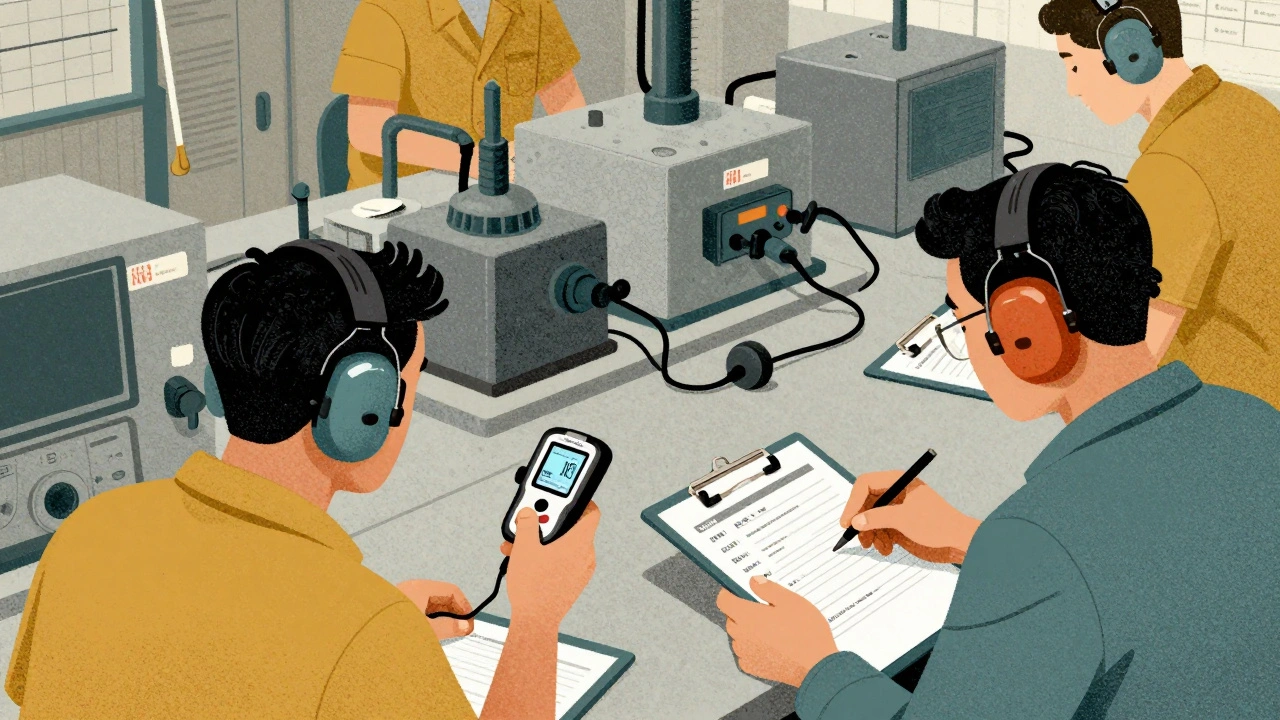
Every year, millions of workers lose their hearing-not from aging, not from music, but from noise they’re exposed to every day on the job. In the U.S., hearing conservation programs are the law, not just a best practice. If your workplace hits 85 decibels over an 8-hour shift, you’re legally required to have a plan in place to protect your ears. And yet, nearly two out of three companies still get it wrong.
Why Hearing Conservation Isn’t Optional
Noise-induced hearing loss (NIHL) is permanent. Once the hair cells in your inner ear are damaged, they don’t grow back. Unlike a sprained ankle or a cut, you can’t heal from it. And it doesn’t happen overnight. It creeps up slowly, often unnoticed until it’s too late. By the time someone realizes they’re missing conversations or turning the TV up too loud, the damage is done. The science is clear: 22 million American workers are exposed to dangerous noise levels every year. That’s one in seven people in the workforce. And while many think earplugs are enough, the real solution is a full hearing conservation program-not just gear, but structure, testing, and accountability.The Five Legal Requirements of a Hearing Conservation Program
OSHA’s 29 CFR 1910.95 spells out exactly what’s needed. There’s no wiggle room. If you’re above 85 dBA over an 8-hour shift, you must have all five components:- Noise monitoring-You can’t protect what you don’t measure. Employers must use calibrated noise dosimeters or sound level meters to map out which areas, machines, or tasks push workers over the action level. This isn’t a one-time check. Anytime you change equipment, add a new line, or reconfigure a workspace, you must retest.
- Audiometric testing-This is the heartbeat of the program. Every employee exposed to 85 dBA or higher must get a baseline hearing test within six months of starting the job. They must be out of noise for at least 14 hours before the test. After that, annual tests are mandatory. The test must include frequencies at 500, 1000, 2000, 3000, and 4000 Hz, conducted in a room that meets strict soundproofing standards. The audiometer must be calibrated to ANSI S3.6-2018, not the outdated 1969 version.
- Hearing protection-Earplugs and earmuffs aren’t optional extras. Employers must provide at least two types of protectors and let workers choose. They must also train employees on how to insert earplugs correctly-most people get it wrong. The goal isn’t just to hand out gear; it’s to make sure it actually works. Protection must reduce exposure to 90 dBA or lower.
- Training-Annual training isn’t a checkbox. It needs to explain how noise damages hearing, how protectors work, why testing matters, and what to do if you notice a change in your hearing. Workers who understand the risk are far more likely to use protection consistently.
- Recordkeeping-You must keep noise exposure records for at least two years. Audiometric test results? Those stay with the employee’s file for as long as they work there. If OSHA shows up, you need to produce them-fast.
What Happens When Hearing Loss Is Detected?
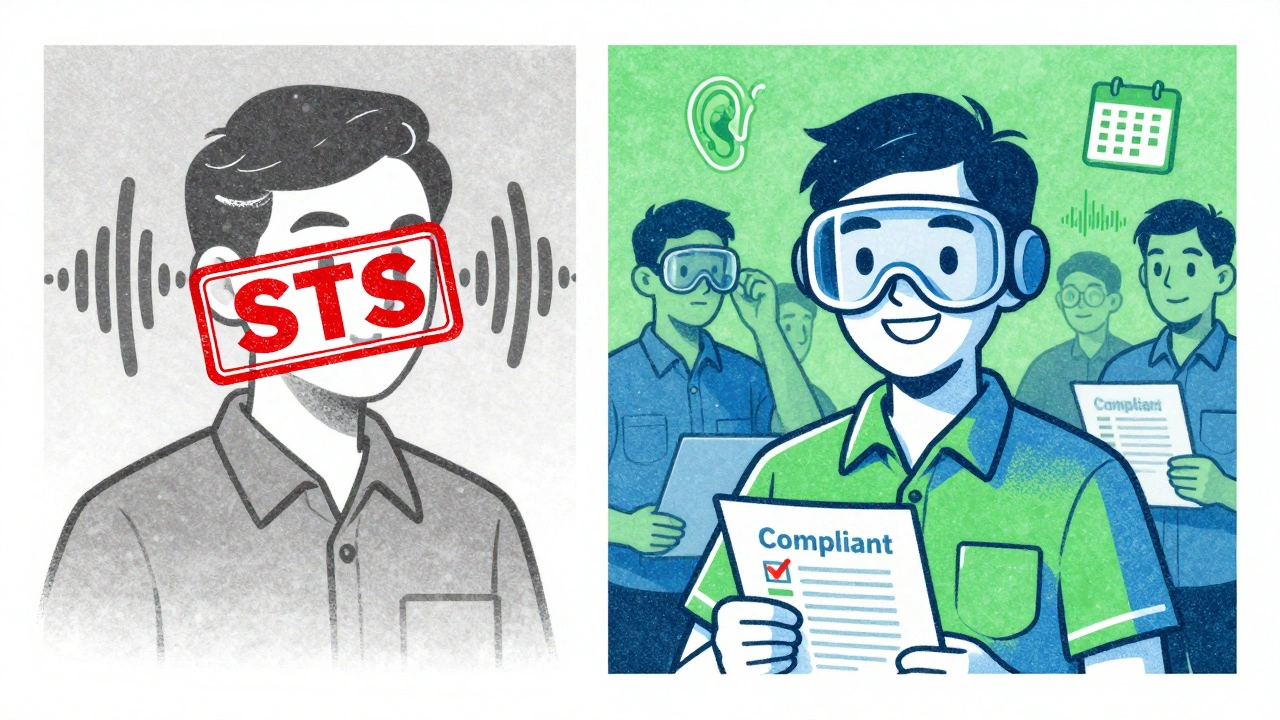
The real test of a program isn’t whether it runs-it’s what happens when it finds a problem. If an employee’s hearing shifts by 10 dB or more at 2000, 3000, and 4000 Hz compared to their baseline, that’s called a Standard Threshold Shift (STS). It’s a red flag. When an STS is found, the employer has 30 days to act:- Notify the employee in writing within 21 days.
- Re-fit and retrain them on hearing protection.
- Offer a protector with higher noise reduction if needed.
- Refer them for a clinical audiological exam if there’s any suspicion of medical issues like ear infections or tumors.
The Hidden Costs of Ignoring Hearing Conservation
Some employers think HCPs are expensive. They’re right-but the cost of not having one is worse. A full program runs $250-$400 per employee per year. Audiometric testing makes up nearly half that cost. But companies with strong programs see 5-10% higher productivity and 15-20% fewer absences. Why? Because workers aren’t struggling to hear instructions, aren’t miscommunicating on the floor, and aren’t dealing with the stress of tinnitus or social isolation from hearing loss. The financial risk is real too. OSHA issued 1,842 citations for hearing conservation violations in 2022. Penalties range from $15,625 to over $150,000 per violation. And it’s not just big factories. Small businesses with under 50 employees have a 37% non-compliance rate-nearly double that of larger firms.Why Most Programs Fail
The biggest problem isn’t the law-it’s execution. A 2023 SHRM survey of 1,200 safety managers found:- 68% struggle with employee participation in audiometric testing. People skip appointments. They think, “I’m fine.” But hearing loss doesn’t announce itself.
- 52% can’t get workers to fit hearing protection properly. A poorly inserted earplug can cut protection by 75%.
- 47% have trouble keeping accurate exposure records. Spreadsheets get lost. Data isn’t updated after equipment changes.
What’s Changing in 2025?
OSHA is updating its standards. The proposed rule, expected to be finalized in late 2024, includes:- Requiring the latest ANSI S3.6-2018 audiometer calibration standard (replacing the 1969 version).
- Adding 6000 Hz to the required test frequencies-this catches early high-frequency hearing loss before it spreads.
- Requiring protectors that reduce exposure below 90 dBA when noise hits 100 dBA or higher. Right now, 90 dBA is the limit. That’s not enough.
What You Should Do Now
If you’re an employer:- Test your noise levels. Don’t guess. Use a calibrated dosimeter.
- Set up annual audiometric testing with a certified provider.
- Offer real choices in hearing protection-not just the cheapest option.
- Train employees every year, not just once.
- Track every test result and exposure reading.
- Take your hearing tests seriously. Show up. Don’t skip them.
- Ask for help fitting your earplugs. Most people do it wrong.
- Speak up if you notice ringing in your ears or trouble hearing in meetings.
- Know your rights. You’re not asking for a favor-you’re enforcing the law.
Final Thought
Hearing is one of the senses you can’t replace. You can get a new hip. You can fix a bad knee. But once your hearing is gone, it’s gone for good. A good hearing conservation program isn’t about avoiding fines. It’s about keeping people connected-to their families, their jobs, their lives.Is a hearing conservation program required by law?
Yes. Under OSHA regulation 29 CFR 1910.95, any workplace where employees are exposed to noise at or above an 8-hour time-weighted average of 85 decibels (dBA) must have a formal hearing conservation program. This includes noise monitoring, audiometric testing, hearing protection, training, and recordkeeping.
How often do employees need audiometric testing?
Employees exposed to noise at or above 85 dBA must get a baseline audiogram within six months of starting the job. After that, they must be tested annually. The test must be conducted in a quiet room using a calibrated audiometer, and the employee must be free from workplace noise for at least 14 hours before the test.
What is a Standard Threshold Shift (STS)?
An STS is a significant change in hearing ability, defined as an average shift of 10 decibels or more at 2000, 3000, and 4000 Hz compared to the employee’s baseline audiogram. When an STS is detected, the employer must notify the employee in writing within 21 days and take steps to improve protection and retrain them.
Can I use any earplugs for hearing protection?
No. Employers must provide a variety of hearing protectors and allow employees to choose. Not all earplugs are equal-some have higher Noise Reduction Ratings (NRR). More importantly, proper fit matters. Most people insert earplugs incorrectly, cutting their effectiveness by up to 75%. Training on correct insertion is required by law.
What happens if my employer doesn’t have a hearing conservation program?
OSHA can issue citations and fines ranging from $15,625 to $156,259 per violation. In 2022, over 1,800 violations were cited, mostly for inadequate testing and training. Beyond penalties, failing to protect hearing puts workers at risk of permanent hearing loss and increases workplace errors and absenteeism.
Are small businesses exempt from hearing conservation requirements?
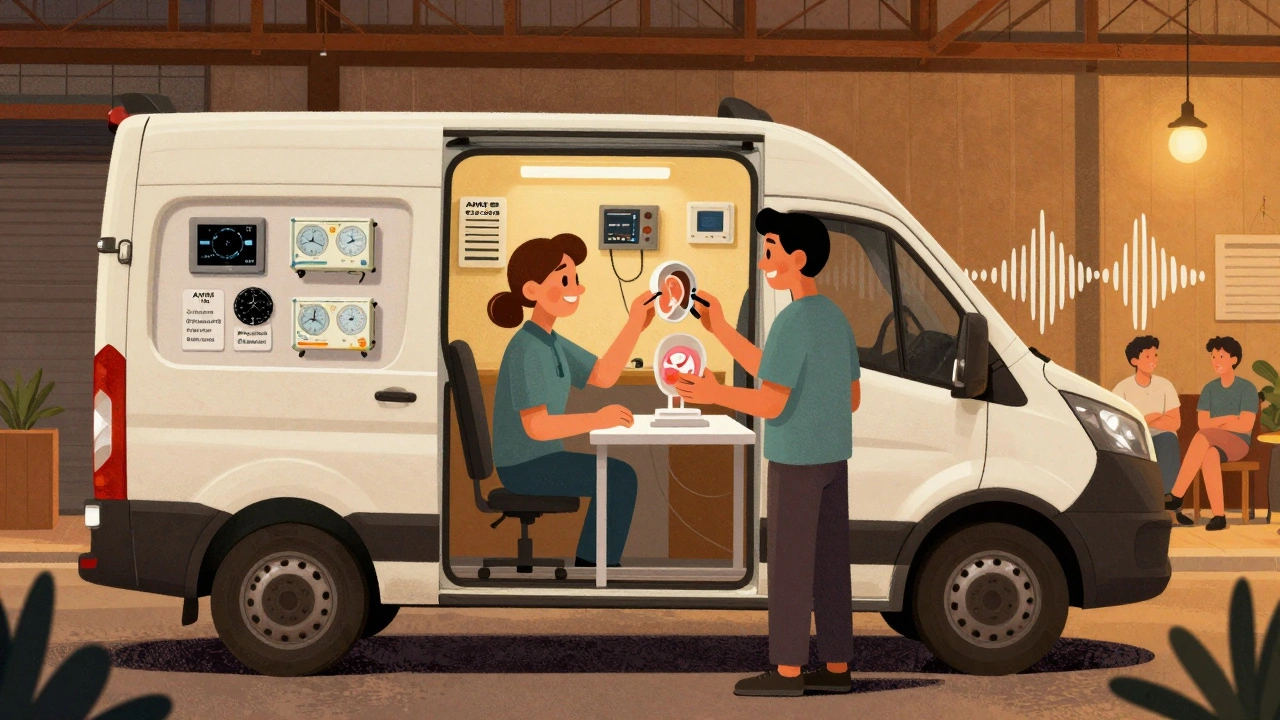
No. The law applies to all employers, regardless of size. However, small businesses with fewer than 50 employees have a 37% non-compliance rate, often due to lack of resources or awareness. Mobile audiometric testing services and low-cost noise monitoring tools can help small operations meet requirements without heavy overhead.
Can hearing loss from work be reversed?
No. Noise-induced hearing loss is permanent. The hair cells in the inner ear that detect sound don’t regenerate. That’s why prevention is critical. Annual testing and proper hearing protection can stop the damage before it becomes irreversible. Early detection saves hearing.
What’s the difference between OSHA’s action level and permissible exposure limit?
The action level is 85 dBA-this triggers the requirement for a hearing conservation program. The permissible exposure limit (PEL) is 90 dBA-this is the maximum noise level allowed without additional controls. Experts argue the PEL is outdated; even 85 dBA over a lifetime causes hearing loss in 8-12% of workers. New OSHA proposals aim to lower this limit.
Kumar Shubhranshu
December 6, 2025 AT 08:57
85 dB is the trigger? My factory hits 92 at the press station and we just hand out foam plugs. Everyone thinks it’s fine. Guess what? I can’t hear my kid cry anymore.
olive ashley
December 6, 2025 AT 09:23
OSHA’s just playing politics. They don’t care if you go deaf-they care if you sue them later. That’s why they make you do all this paperwork. Real solution? Quiet machines. Not more forms.
Myles White
December 6, 2025 AT 19:43
I’ve worked in manufacturing for 22 years and I’ve seen every version of this program. The real issue isn’t the law-it’s the culture. Workers see hearing protection as a nuisance, not a necessity. You can have the fanciest audiometer in the world, but if your foreman tells people to ‘tough it out’ because ‘it’s just noise,’ nothing changes. Training has to be repeated monthly, not annually. And it has to come from peers, not HR drones in suits. The most successful plants I’ve seen? They had worker-led safety teams who did spot-checks and peer-to-peer reminders. No forms. Just respect.
Mayur Panchamia
December 8, 2025 AT 09:50
85 dBA?! That’s laughable! In India, we work 12-hour shifts in 100+ dB factories with no testing, no earplugs, and no complaints-because we know what real work is! You Americans cry over a little noise while we build the world with calloused hands and busted eardrums! Who’s more productive? Huh?! Who’s more REAL?! You think a calibrated audiometer saves hearing? Nah-it’s grit. Grit and sweat. That’s what saves you.
brenda olvera
December 8, 2025 AT 11:11
My uncle was a welder for 40 years and he never wore ear protection. He still talks to us fine. Maybe the real problem is people are too soft now? I think we need to stop treating noise like it’s a disease. It’s just part of the job.
Priya Ranjan
December 8, 2025 AT 15:37
Of course they’re failing. People skip tests because they don’t want to be labeled ‘damaged.’ They fear losing their job. Employers know this. That’s why they don’t push hard enough. It’s not about compliance-it’s about fear. And fear doesn’t get fixed with forms.
Ibrahim Yakubu
December 9, 2025 AT 16:38
Let me tell you something about OSHA. They don’t care about your ears. They care about liability. They want you to sign papers so when you go deaf, you can’t sue them. The real conspiracy? They let companies use outdated audiometers because it saves money. And then they fine you for not using the new ones. It’s a trap. You’re being set up.
Andrew Frazier
December 9, 2025 AT 19:03
Wow. So now we’re supposed to test our ears every year like we’re in a sci-fi movie? I work in a warehouse. I don’t need a 2018 audiometer. I need a raise. And if I can’t hear my buddy yell ‘watch out!’ over the forklift, maybe I’m just too old for this job. Stop overengineering everything.
Chris Park
December 11, 2025 AT 07:34
Correction: The PEL is not 90 dBA. It’s 90 dBA for 8 hours. But OSHA’s own data shows that 85 dBA for 8 hours causes permanent hearing loss in 12% of workers. So technically, the permissible exposure limit should be lower. The fact that they haven’t changed it proves this is about corporate lobbying, not science. And yes, I checked the NIOSH guidelines. They agree.
Kay Jolie
December 11, 2025 AT 10:16
As a safety compliance officer, I can tell you the real bottleneck isn’t training-it’s the logistics of audiometric testing. Mobile units are the future, but most companies still rely on clinics that require employees to take time off. That’s why participation is so low. We implemented a van that comes every Tuesday-no appointments, no travel, no excuses. Participation jumped from 43% to 89%. It’s not about the law-it’s about removing friction.
Clare Fox
December 11, 2025 AT 11:40
It’s funny how we treat hearing like it’s disposable. We’ll spend thousands on ergonomic chairs, safety vests, even hand sanitizer-but when it comes to the organ that lets us hear our children laugh, our partner say ‘I love you,’ or music that moves us-we shrug and say ‘it’s just noise.’ Maybe the problem isn’t the program-it’s how little we value the quiet things.
Akash Takyar
December 13, 2025 AT 09:30
Kindly note: The proposed OSHA update to include 6000 Hz is scientifically sound, as high-frequency hearing loss is the earliest indicator of noise-induced damage. Employers must adopt this proactively, not reactively. Moreover, the NRR of protectors is often overstated in marketing-real-world attenuation is 50% lower. Therefore, training must emphasize fit-testing with real-time feedback devices. This is not optional-it is a moral imperative.
Gwyneth Agnes
December 14, 2025 AT 03:33
My dad lost his hearing at 52 from working in a sawmill. He never complained. He just turned up the TV. Now he can’t hear his grandchildren. This isn’t about rules. It’s about love.
Nava Jothy
December 15, 2025 AT 19:45
Oh my GOD. I just read this and I’m crying. 🥺 I work in a factory and I thought my tinnitus was just stress. I’ve been skipping my tests because I didn’t want to be ‘that guy.’ But now… I’m going to my appointment tomorrow. I’m not losing my hearing for some boss’s bottom line. 💪❤️