Medication Label Clarity Converter
How it works: Select a common clinical instruction to see how it can be rewritten using Universal Medication Schedule (UMS) principles to reduce dosing errors.
💡 Pro Tip: The Teach-Back Method
Don't just read the label. To ensure safety, use the Teach-Back method. Ask your provider: "To make sure I have this right, I should take one pill at 8am and one at 8pm, correct?"
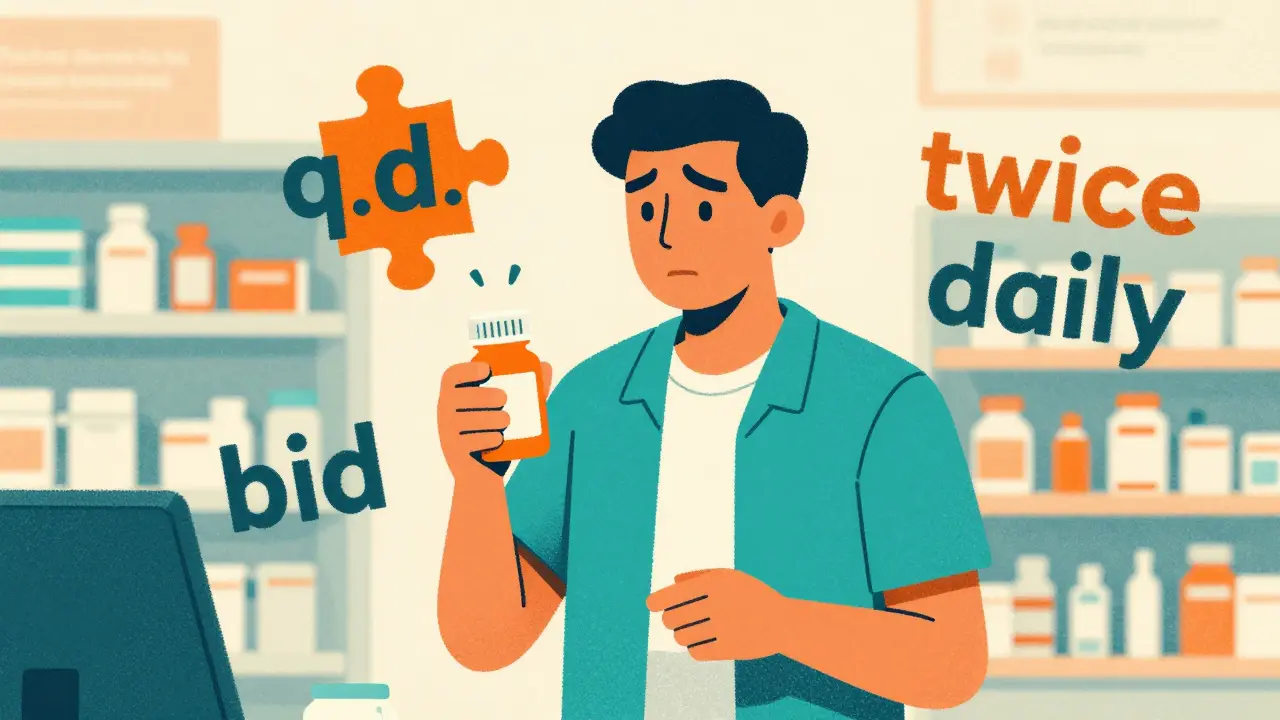
Imagine picking up a prescription and seeing the instruction "Take 1 tablet by mouth twice daily." It sounds simple, right? But for millions of people, that sentence is a riddle. Does "twice daily" mean exactly every 12 hours? Does it mean once in the morning and once at night? Or does it mean taking two pills at the same time? These aren't silly questions. In reality, a massive gap exists between how medical professionals write instructions and how the average person reads them. When this gap opens, the result isn't just confusion-it's dangerous dosing errors.
The core of the problem is Health Literacy is the degree to which individuals have the capacity to obtain, process, and understand basic health information needed to make appropriate health decisions. It is not the same as knowing how to read; it is about understanding the specific, often complex language used in healthcare. Research shows that about 50% of adults struggle to understand health information written above an eighth-grade level, yet many medication labels are written at a 10th-grade level. This mismatch is a primary driver of the estimated 1.3 million medication errors occurring annually in the U.S. alone.
The Danger of Traditional Labeling
Traditional pharmacy labels often rely on medical shorthand that feels natural to a pharmacist but is alien to a patient. For example, "q.d." or "bid" are common in clinical settings, but even when translated to "twice daily," the ambiguity remains. A study found that 47% of patients misunderstood standard instructions like "twice daily," whereas only 28% struggled when the label explicitly said, "Take 1 tablet in the morning and 1 tablet in the evening."
This confusion often leads to specific, repeatable mistakes. Some people interpret "take every 4-6 hours" as a command to take 4 to 6 tablets at once. Others confuse "mg" (milligrams) with "ml" (milliliters), which can lead to massive overdoses, especially with liquid medications. In pediatric care, this is even more critical. Some caregivers have reported thinking "give 5 mL twice daily" meant 5 mL total split over two doses, rather than 5 mL each time. These aren't failures of intelligence, but failures of communication design.
Smart Strategies for Better Understanding
To bridge this gap, healthcare systems are moving toward "patient-centered" labeling. This approach prioritizes clarity over brevity. One of the most effective tools in this arsenal is the Universal Medication Schedule (or UMS), which is a standardized system that organizes medication timing into four predictable daily intervals: morning, noon, evening, and bedtime. Instead of vague timeframes, the UMS gives patients a concrete anchor for their day. When health systems adopted this, dosing confusion among elderly patients taking multiple medications dropped by 47%.
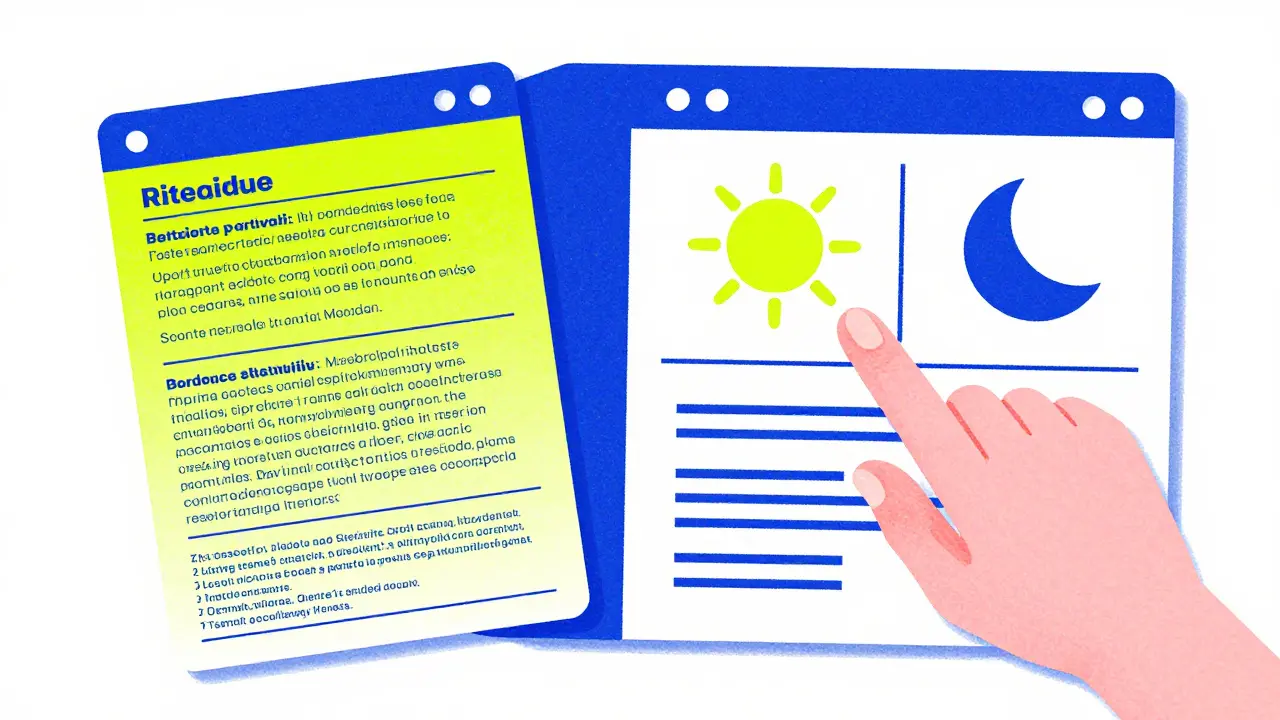
Another powerful strategy is the use of visual aids. The U.S. Pharmacopeia (USP) has pushed for design principles that include pictograms. Since a picture is often clearer than a word, labels with icons showing a sun for morning or a moon for bedtime increase correct interpretation by about 28% for those with limited literacy. The goal is to make the label understandable even if the patient cannot read the text fluently.
| Feature | Traditional Labels | Literacy-Informed Labels |
|---|---|---|
| Typical Reading Level | 10th Grade+ | 5th Grade or lower |
| Instruction Style | "Twice Daily" (Vague) | "Morning and Evening" (Explicit) |
| Visual Support | Text only | Pictograms and icons |
| Timing Format | Variable/Clinical | Universal Medication Schedule (UMS) |
| Misunderstanding Rate | High (~47%) | Lower (~28%) |
The "Teach-Back" Method: Your Best Safety Net
Even the best label can be misinterpreted. This is where the Teach-Back Method comes in. This is a communication technique where the healthcare provider asks the patient to explain the instructions back to them in their own words. It isn't a test of the patient's intelligence, but a test of how well the provider explained the medication. If a patient says, "So I take these two pills together at 8 AM," and the instruction was actually one pill every 12 hours, the error is caught instantly.
Implementing teach-back adds only a minute or two to a pharmacy visit, but it can reduce misunderstanding rates by 33%. When combined with "communication bundles"-which include simplified handouts and visual demonstrations-dosing errors for liquid medications in children have been reduced by as much as 34%. The key is moving from a "did you understand?" question (which almost everyone answers with "yes" to avoid embarrassment) to "show me how you will take this."
How to Manage Dosing at Home
If you are managing medications for yourself or a loved one, you can implement your own health literacy strategies to ensure safety. First, don't rely on memory. Use a pill organizer that aligns with the UMS intervals (morning, noon, evening, bed). Second, ask your pharmacist to clarify any vague terms. If a label says "take with food," ask specifically: "Does this mean 30 minutes before I eat, while I am eating, or right after?"
For those using liquid medications, avoid using kitchen spoons. A standard teaspoon can vary wildly in volume. Always use a calibrated oral syringe or the dosing cup provided with the medication. If the label is confusing, ask the provider to draw the correct line on the syringe with a permanent marker. This removes the need for the patient to "calculate" the dose, which is where many numeracy-related errors occur.

The Path Toward Systemic Change
The industry is finally waking up to these issues. The FDA and USP are moving toward mandating standardized pictograms and more rigorous testing of label comprehension across diverse populations. We are seeing a shift where pharmaceutical companies must prove that a regular person-not a scientist-can actually understand the instructions on the box. Some companies are even experimenting with AI-powered tools to assess whether a label is too complex before it ever hits the pharmacy shelf.
The financial incentive is also there. Every dollar invested in these health literacy initiatives is estimated to save nearly four dollars in healthcare costs by preventing emergency room visits caused by medication overdoses or treatment failures. Safety plans are no longer just about the chemistry of the drug, but about the clarity of the communication.
What is the difference between health literacy and general literacy?
General literacy is the ability to read and write. Health literacy is the ability to apply those reading skills to health-related information. You might be able to read a novel perfectly but still struggle to understand a medical label because of the specialized terminology, complex dosing schedules, and clinical shorthand used in healthcare.
What is the Universal Medication Schedule (UMS)?
The UMS is a standardized way of labeling medication times to reduce confusion. Instead of using phrases like "twice daily," it uses specific anchors: morning, noon, evening, and bedtime. This helps patients, especially those on multiple medications, create a predictable routine and avoid missing doses or doubling up.
Why is the "Teach-Back" method so effective?
The Teach-Back method works because it reveals gaps in understanding in real-time. When a patient explains the instructions back to the provider, any misconceptions (like confusing "mg" with "ml") become immediately obvious. It shifts the burden of clarity from the patient to the provider, ensuring the message was actually received as intended.
How can I tell if a medication label is poorly designed?
Look for "red flags" such as the use of medical abbreviations (like q.d. or p.r.n.), vague timing (like "every few hours"), or small, cramped text with no visual aids. If you have to do math to figure out the dose, or if the instructions don't tell you exactly *when* during the day to take the pill, the label is likely not following health literacy best practices.
What should I do if I don't understand my prescription label?
Do not guess. Call your pharmacist or doctor immediately. Use specific questions: "Does 'twice daily' mean 8 AM and 8 PM?" or "Can you show me exactly where the 5mL line is on this syringe?" You can also ask your pharmacist to write the instructions in simpler language or provide a written schedule that uses the morning/noon/evening/bedtime format.
Next Steps for Patient Safety
Whether you are a patient, a caregiver, or a healthcare provider, the goal is the same: zero dosing errors. If you are a caregiver, start by auditing your medicine cabinet. Check for labels that are faded or confusing and ask your pharmacy for updated, simplified versions. If you are a provider, start integrating the teach-back method into every discharge or pickup. These small changes in communication are the most effective safety plan available for preventing medication errors.