
Generic Drug Cost Calculator
Calculate Your Savings
Enter the brand name drug cost and duration to see how much you could save with the generic equivalent.
Important Note: The FDA requires generic drugs to be therapeutically equivalent to brand-name drugs. This means they contain the same active ingredients, strength, dosage form, and work in the same way in your body.
What’s Really Different Between Generic and Brand Name Drugs?
You pick up your prescription and notice something’s off. The pills are a different color. The name on the bottle isn’t the one your doctor mentioned. You start wondering: is this really the same medicine? It’s a common worry. But here’s the truth: if it’s an FDA-approved generic, it’s not just similar-it’s the same in every way that matters for your health.
The FDA doesn’t approve generics as "good enough" alternatives. They’re required to be identical in active ingredients, strength, dosage form, and how they work in your body. The only real differences? The label, the shape, the color, and the price. And those differences don’t affect how the drug treats your condition.
Why Do Generic Drugs Look So Different?
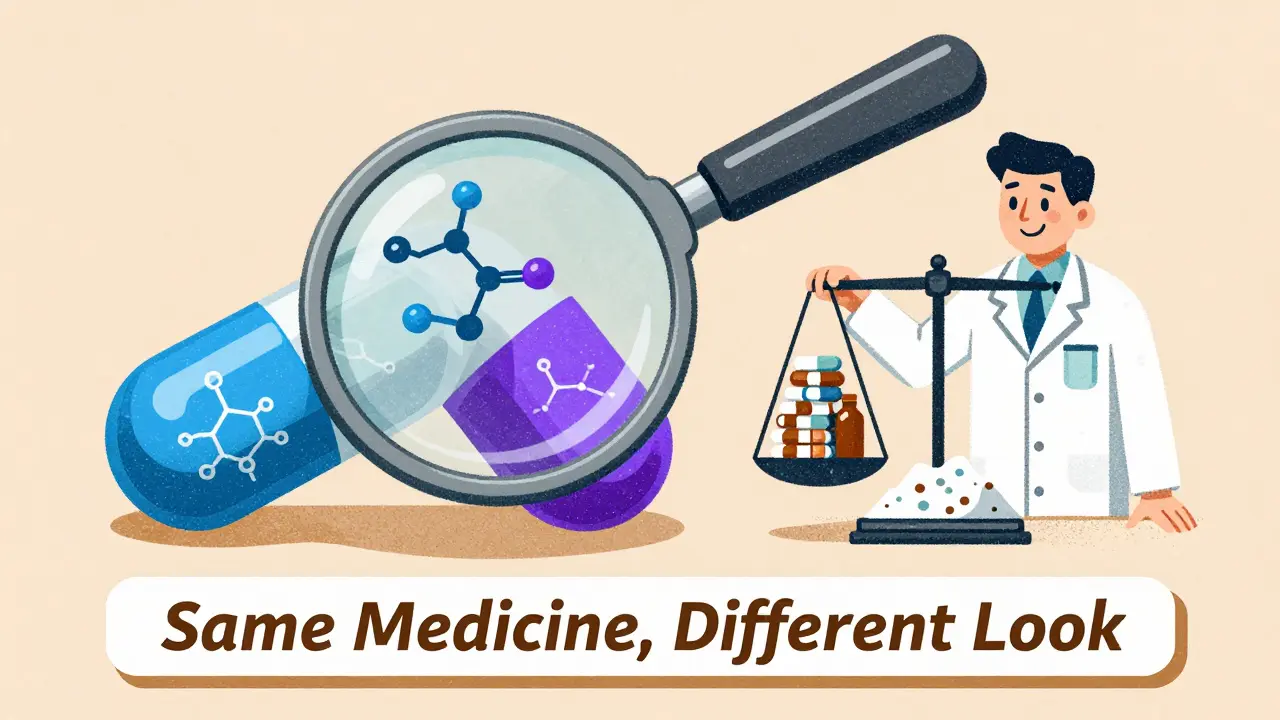
Ever wonder why generic omeprazole is a blue capsule while Prilosec is a purple one? It’s not about effectiveness-it’s about law. U.S. trademark rules force generic manufacturers to make their pills look different from the brand-name version. That means different colors, shapes, sizes, or markings. It’s meant to prevent confusion in the marketplace, not because the drug inside is any less reliable.
The active ingredient? Exactly the same. Omeprazole is omeprazole whether it’s sold as Prilosec or as a generic. The FDA requires that every generic contains the exact same amount of the active pharmaceutical ingredient (API) and delivers it the same way-whether it’s swallowed, injected, or absorbed under the tongue.
The Label Difference: Chemical Names vs. Brand Names
Look closely at your prescription bottle. Brand-name drugs use the marketing name-like Lipitor, Zoloft, or Nexium. Generic bottles? They list the chemical name: atorvastatin, sertraline, esomeprazole. That’s not a trick. It’s how the FDA mandates labeling to ensure clarity and consistency across all products.
Here’s the key: every warning, side effect, dosage instruction, and contraindication on a generic label must match the brand-name version. The FDA’s 2021 guidance requires identical information on indications, adverse reactions, and usage guidelines. So if your brand-name drug warns about dizziness or interactions with grapefruit juice, so does the generic. No exceptions.
Therapeutic Equivalence: How the FDA Makes Sure Generics Work the Same
Before a generic drug hits the shelf, it has to pass a strict test called bioequivalence. This isn’t a marketing claim-it’s a lab-based science. The FDA requires studies with 24 to 36 healthy volunteers to measure how quickly and completely the drug enters the bloodstream. The key metrics are Cmax (peak concentration) and AUC (total exposure over time).
The generic must deliver the active ingredient within 80% to 125% of the brand-name drug’s levels. That might sound like a big range, but here’s what experts say: that range is actually tighter than the natural variation between different batches of the same brand-name drug. Dr. Ameet Nagpal, a top pharmacist, put it plainly: "The body doesn’t treat a brand-name pill from one batch the same as another batch. The generic has to meet a stricter standard than the brand does with itself."
That’s why the FDA says 90% of generics cost less than $10 a month and still work just as well. They’re not cheaper because they’re lower quality-they’re cheaper because manufacturers don’t spend millions on ads, fancy packaging, or patent litigation.
Cost Difference: The Real-World Impact
Let’s talk numbers. In Q2 2023, a 30-day supply of brand-name Lipitor (atorvastatin) cost $375.22. The generic? $4.00 at Walmart. That’s a 99% drop in price. And it’s not an outlier. Across the board, generics cost 80% to 85% less than their brand-name counterparts.
The Congressional Budget Office found that from 2007 to 2016, generic drugs saved the U.S. healthcare system $1.67 trillion. In 2023 alone, that number was $313 billion in annual savings. And it’s not just big systems that benefit. For individuals, it means choosing between taking your blood pressure medication or skipping it because you can’t afford it. A Kaiser Permanente survey in 2022 showed that 78% of patients said generic cost savings helped them stick to their treatment plan.
On Drugs.com, generic atorvastatin has a 6.6/10 rating from over 1,800 reviews. Lipitor? 6.3/10 from 873 reviews. People aren’t noticing less effectiveness-they’re noticing less cost.
When Generics Aren’t the Same-And What to Watch For
There’s one important exception: narrow therapeutic index (NTI) drugs. These are medications where even tiny changes in blood levels can lead to serious problems-either the drug doesn’t work, or it becomes toxic.
The FDA specifically flags three: warfarin (a blood thinner), levothyroxine (for thyroid issues), and phenytoin (for seizures). For these, doctors often recommend sticking with the same manufacturer-even if it’s a generic-because switching between different generic versions can cause small fluctuations in absorption.
That doesn’t mean generics are unsafe. It means precision matters. If you’re on one of these drugs, your pharmacist should alert you if the generic manufacturer changes. And your doctor may monitor your blood levels more closely after a switch.
And yes, complex drugs like insulin or monoclonal antibodies are harder to copy. That’s why you don’t see generic versions of Humira or Ozempic yet-though the first generic semaglutide was approved in September 2023. These are called biosimilars, and they follow a different approval path. But for the vast majority of pills you take-antibiotics, statins, antidepressants, blood pressure meds-generics are not just acceptable. They’re the standard.
What Pharmacists Know That Patients Don’t
In 49 out of 50 U.S. states, pharmacists can automatically swap a brand-name drug for a generic unless the doctor writes "Dispense as Written" on the prescription. That’s the law. And most doctors are fine with it. The American Medical Association found that 94% of physicians feel confident prescribing generics.
On Reddit’s r/pharmacy thread from May 2023, a pharmacist with 15 years of experience wrote: "I’ve switched thousands of patients from brand to generic. Zero therapeutic issues-except for a few on levothyroxine. We just check TSH levels after the switch."
That’s the pattern. For most people, switching is seamless. The only complaints? Confusion over pill appearance. A University of Michigan study found 12% of patients felt uneasy when their pills changed color. But after a few days, once they checked the label and saw the same active ingredient, the worry faded.
How to Check If Your Generic Is Approved
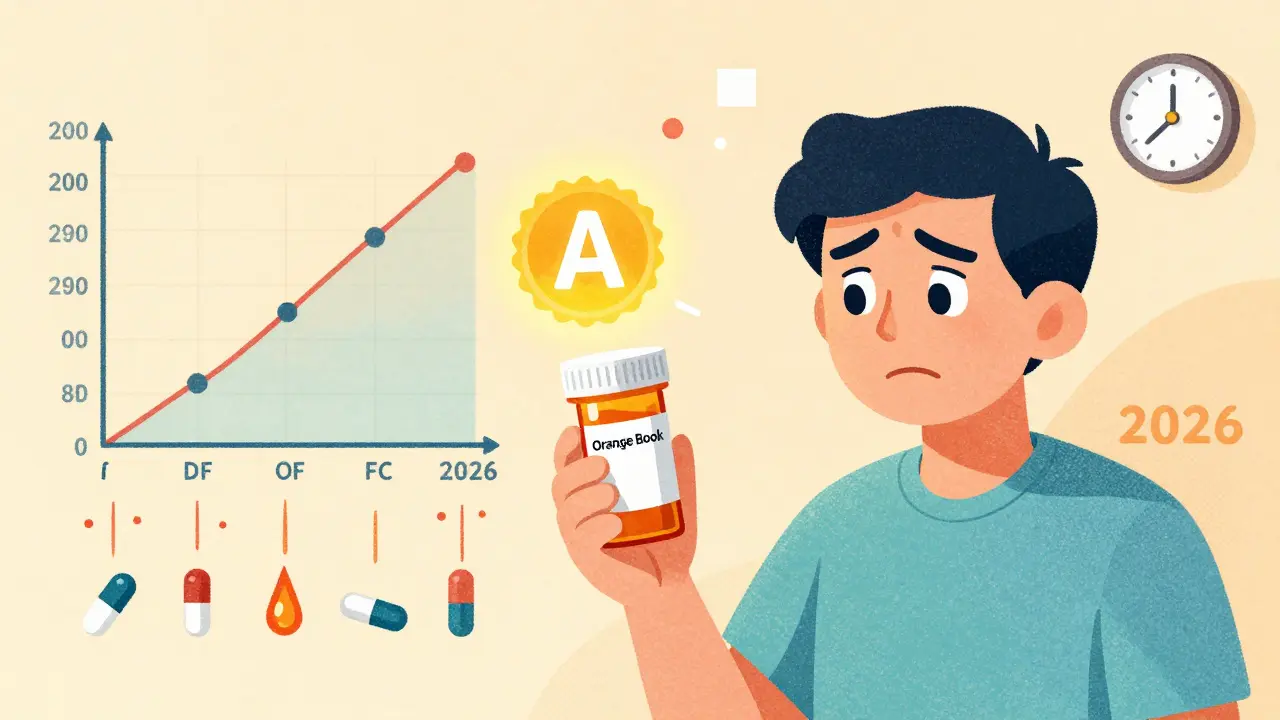
Want proof your generic is legit? Go to the FDA’s Orange Book. It’s a free, public database that lists every approved drug and its therapeutic equivalence rating. Look for the "A" rating-that means the generic is therapeutically equivalent to the brand.
For example, if you’re taking metformin, search "metformin hydrochloride" in the Orange Book. You’ll see dozens of generic manufacturers, all with an "A" rating. That’s your green light.
The FDA also launched a Generic Drug Program Dashboard in 2023. You can track application status, review timelines, and even see which complex generics are in the pipeline. It’s not just for doctors and pharmacists-it’s for anyone who wants to know the system works.
What’s Changing in 2026?
The generic drug market is growing. In 2022, it was worth $127.4 billion. By 2027, the Generic Pharmaceutical Association predicts generics will save the U.S. healthcare system $3.35 trillion over five years. Why? Because more brand-name drugs are losing patents.
Between 2023 and 2028, $268 billion in brand-name drug sales will open up to generic competition. That includes new drugs for diabetes, heart disease, and mental health. The FDA is speeding things up too. Under GDUFA III, priority generic applications are reviewed in 10 months-not the 30+ months they used to take.
And the focus is shifting to harder-to-make generics: extended-release pills, inhalers, topical creams, and drug-device combos like epinephrine auto-injectors. The first generic EpiPen is expected soon.
Bottom Line: Your Health Isn’t Compromised
You don’t need to pay more to get better results. Generics aren’t a compromise. They’re the rule. The FDA doesn’t cut corners. They demand proof. And the data backs it up: 90% of prescriptions filled in the U.S. are generics. And they’re saving billions every year.
If you’re worried about switching, talk to your pharmacist. Ask: "Is this generic approved by the FDA?" Check the label for the active ingredient. Look up the rating in the Orange Book. And remember: the color change? That’s just the law. The medicine? That’s the same.
For most people, the only thing that changes when you switch to a generic is your wallet. And that’s a good thing.
Are generic drugs as safe as brand-name drugs?
Yes. The FDA requires generic drugs to meet the same strict standards for safety, purity, and strength as brand-name drugs. Every generic must prove it delivers the same active ingredient in the same way and works the same way in your body. Post-market surveillance through the FDA’s Adverse Event Reporting System tracks safety just like it does for brand-name drugs.
Why do generic drugs cost so much less?
Generic manufacturers don’t have to repeat expensive clinical trials because they’re proving bioequivalence, not new safety. They also don’t spend money on advertising, fancy packaging, or patent litigation. The savings are passed directly to consumers. On average, generics cost 80-85% less than brand-name drugs.
Can I switch between different generic brands?
For most drugs, yes. But for narrow therapeutic index drugs like warfarin, levothyroxine, or phenytoin, switching between different generic manufacturers can cause small changes in how your body absorbs the drug. If you’re on one of these, your doctor may recommend sticking with the same manufacturer. Always check with your pharmacist before switching.
Do generics take longer to work?
No. Bioequivalence testing ensures generics reach the same peak concentration in your blood at the same time as the brand-name version. The absorption rate must fall within 80-125% of the brand’s rate. That’s not a delay-it’s a tight match.
What if I don’t feel the same on a generic?
If you notice a change in how you feel after switching to a generic, talk to your doctor or pharmacist. For most people, there’s no difference. But if you’re on a narrow therapeutic index drug, your levels may need checking. Sometimes, the issue isn’t the drug-it’s the change in pill size, color, or taste, which can cause psychological unease. Your pharmacist can help you identify if it’s a real effect or just perception.
Sonal Guha
January 12, 2026 AT 19:49
Generics work fine unless you’re on warfarin or levothyroxine then you better stick to one brand or your TSH goes haywire
Audu ikhlas
January 13, 2026 AT 14:20
Why do americans think everythin needs to be branded? In Nigeria we just take the pill with the right chemical name no matter what color it is. You people pay extra for packaging like its a luxury car. Sad.
gary ysturiz
January 13, 2026 AT 20:17
This is such a needed post. So many people are scared to switch to generics because they think they’re getting second-rate medicine. But the science is clear - it’s the same drug. The only thing different is the price tag and the pill color. Save your money and take your meds. Your body won’t know the difference.
laura manning
January 15, 2026 AT 16:16
While the FDA’s bioequivalence standards are statistically robust, the 80%-125% confidence interval for Cmax and AUC is, in fact, a wide margin - and while it may be narrower than intra-brand variability, it still permits clinically significant differences in absorption kinetics for certain patient populations - particularly those with gastrointestinal disorders or polypharmacy burdens. Therefore, blanket assertions of interchangeability, while generally valid, require contextual nuance.
Bryan Wolfe
January 17, 2026 AT 08:12
Love this breakdown! Seriously - if you’ve been avoiding generics because you think they’re ‘weaker’ or ‘fake,’ you’re not saving money, you’re paying for marketing. I switched my mom from Lipitor to generic atorvastatin last year - same results, same side effects (or lack thereof), and she’s now got $370 extra in her pocket every month. That’s a vacation. That’s groceries. That’s peace of mind.
Jay Powers
January 19, 2026 AT 02:45
People get freaked out by the color change but once they check the label and see the same active ingredient they calm right down. I’ve seen it a hundred times. The real issue isn’t the drug - it’s the fear of change. We need better patient education, not more brand loyalty
Christina Widodo
January 19, 2026 AT 02:53
Wait so if the FDA says generics are identical, why do some people say they feel different on them? Is it placebo or is there something I’m missing? I’m on sertraline and switched generics last month - felt kinda off for a week but then fine. Coincidence?
Prachi Chauhan
January 20, 2026 AT 14:26
Life is a series of trade-offs. We trade money for time, comfort for effort, and now we’re trading brand names for bioequivalence. But the deeper truth? We’ve been conditioned to equate price with value. A pill doesn’t care if it’s called Zoloft or sertraline. It only cares if it reaches your synapses. The real innovation isn’t in the drug - it’s in our willingness to unlearn fear.
TiM Vince
January 22, 2026 AT 09:58
As someone who’s lived in 7 countries, I’ve seen how Americans treat medicine like a luxury brand. In Japan, India, Germany - generics are the default. No one bats an eye. The fact that we need a 2000-word explainer to convince people that a blue pill can do the same job as a purple one says more about our culture than our pharmacology.