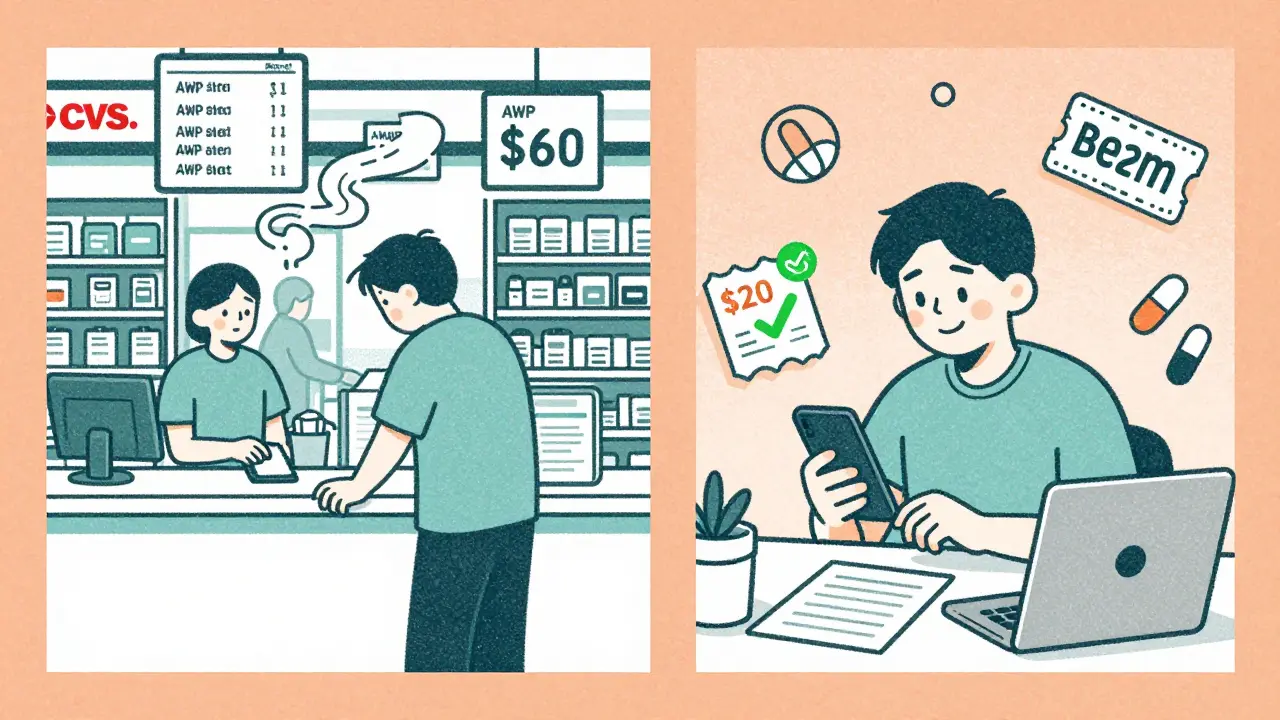
Buying generic medications online can save you up to 80% compared to walking into your local pharmacy. If you’ve ever paid $60 for a 30-day supply of Metformin at CVS or Walgreens, only to find it for $20 online, you’re not alone. The price gap isn’t a glitch-it’s the system. And understanding how it works could save you hundreds, even thousands, a year.
Why the Same Pill Costs So Much More at Retail
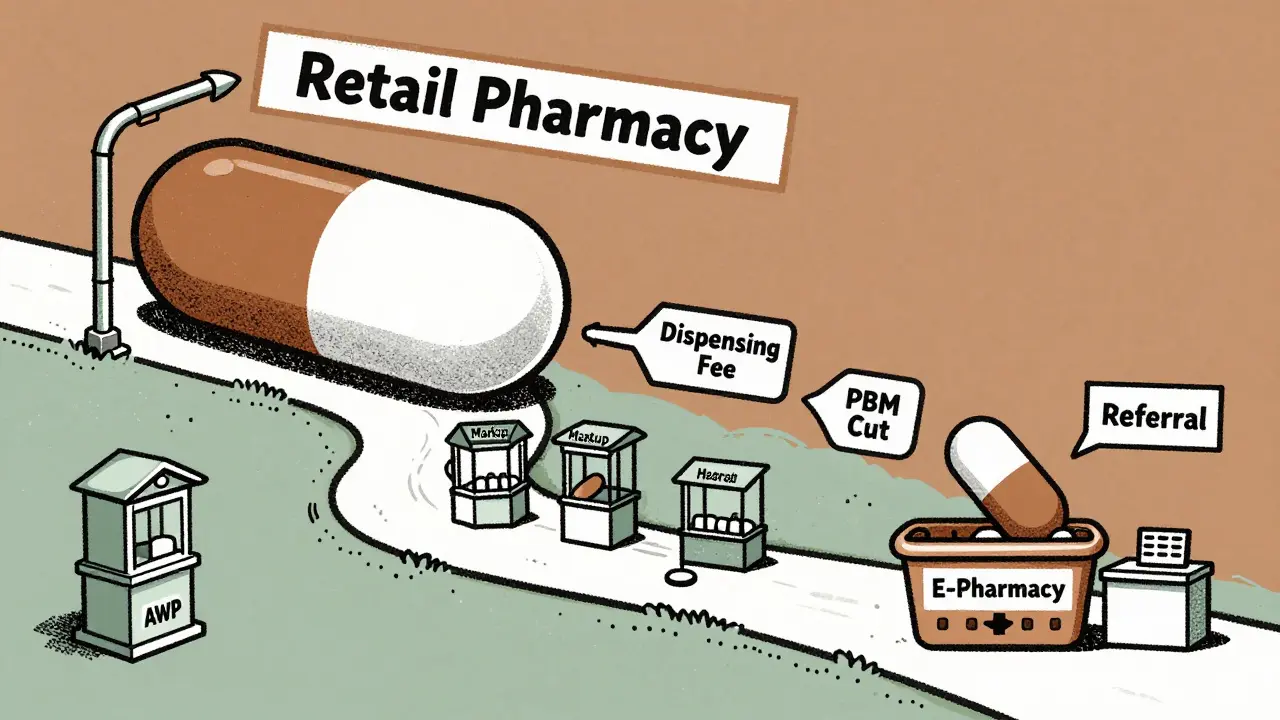
Retail pharmacies don’t set prices based on what the drug actually costs to make. They use a formula called AWP + markup + dispensing fee. AWP stands for Average Wholesale Price, a number that’s often inflated and outdated. For example, if the AWP for Amoxicillin is $25, the pharmacy might add 20% ($5) and then tack on a $5 dispensing fee. That’s $35 before taxes. Meanwhile, online platforms like Beem or GoodRx cut out the middlemen entirely. They negotiate fixed, transparent prices directly with pharmacies-no AWP, no hidden markups.That’s why Lipitor (atorvastatin) 20mg (30 tablets) costs $250 at CVS but only $50 on Beem. Metformin? $60 retail, $20 online. Amoxicillin? $30 in-store, $10 online. These aren’t outliers. They’re the norm.
How E-Pharmacies Actually Work
E-pharmacies like Beem, SingleCare, and GoodRx aren’t pharmacies themselves. They’re price comparison engines. Think of them like Kayak for prescriptions. You enter your drug name, dosage, and quantity. The platform scans hundreds of participating local pharmacies and shows you the lowest cash price available-no insurance needed.You pay online, get a coupon or barcode, then walk into a nearby pharmacy (like Rite Aid, Kroger, or even Walmart) and pick up your meds. No shipping delays. No subscription. Just the price you see, upfront.
These platforms make money by charging pharmacies a small fee for each referral. That’s why they can offer such steep discounts: they’re not trying to profit off the drug-they’re just helping you find the best deal.
What You Save (And What You Don’t)
For common generic medications-things like blood pressure pills, cholesterol meds, antibiotics, and diabetes drugs-online platforms win by a landslide. A 2023 analysis by Trybeem found that for 82% of the top 50 most prescribed generics, online prices were at least 50% lower than retail cash prices.But it’s not universal. Specialty drugs-like those for multiple sclerosis, rheumatoid arthritis, or cancer-don’t see the same discounts. Glatiramer acetate, for example, still costs over $24,000 a year even through Mark Cuban’s Cost Plus Drug Company. Why? These drugs are complex to manufacture, store, and dispense. They’re not sold in bulk. And they’re often tied to insurance networks that negotiate rebates behind closed doors.
Here’s the catch: if you have insurance, your copay might already be low. A 2023 Ohio State University study found that for 76% of medications, the difference between insured retail copays and online cash prices was less than $200 per year. For some people, insurance is still the better deal.
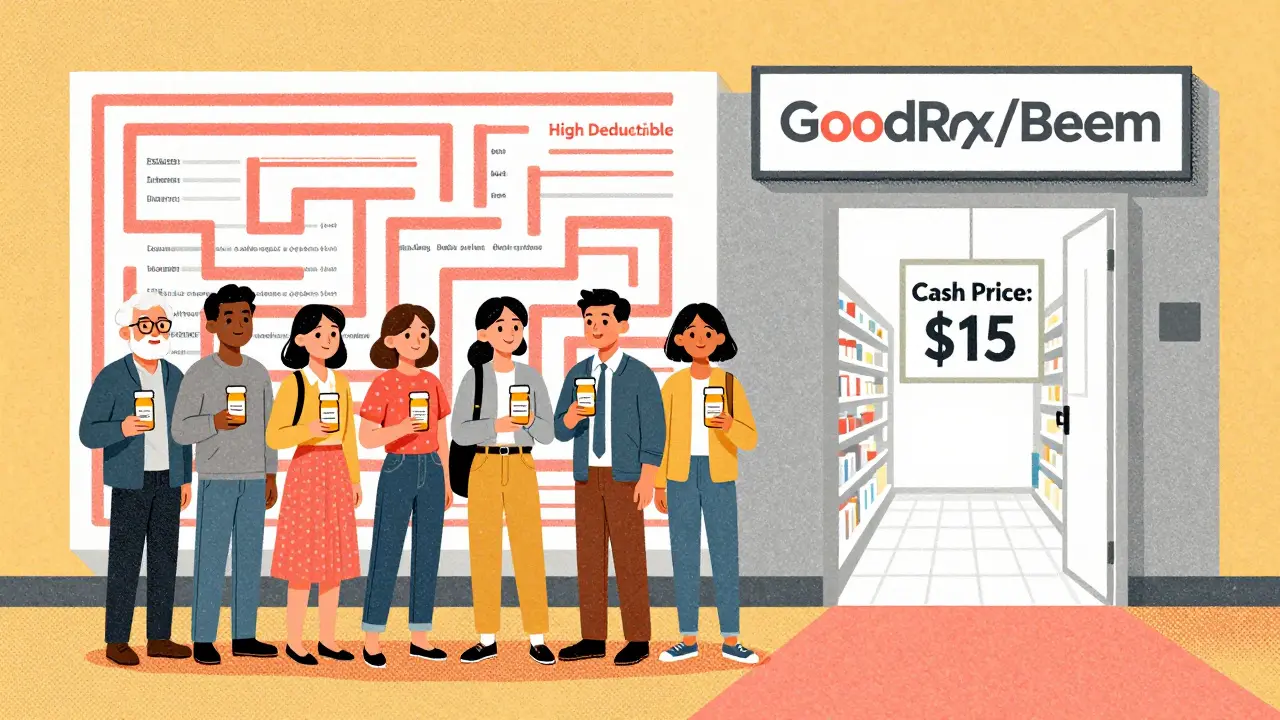
But if you’re uninsured, underinsured, or your plan has a high deductible, online pharmacies are a lifeline. One patient paid $4,000 a year for a generic thyroid med through insurance with a $5,000 deductible. Switched to Beem. Paid $120. Same pill. Same pharmacy.
Why Retail Still Has Its Place
Online pharmacies aren’t perfect. You can’t walk in with a new prescription and walk out with your meds right away. Most require you to have a valid prescription on file, and you’ll need to wait for the pharmacy to process your order-even if it’s just down the street.Also, you lose in-person access to a pharmacist. Need to ask if your new blood pressure med interacts with your fish oil? Want to know if your pills look different this month? Retail pharmacies let you talk to someone face-to-face. Online platforms offer chat support, but it’s not the same.
And if you’re on a tight schedule? Waiting 1-3 days for delivery or picking up at a partner pharmacy can be inconvenient. For urgent needs-like antibiotics for an infection-walking into a nearby CVS is still faster.
The Bigger Picture: Why This Gap Exists
The U.S. pharmacy system is broken. There are about 60,000 retail pharmacies. Two-thirds are chains or big retailers like Walmart. They make up 56% of all prescription sales. But they’re caught in a web of contracts with Pharmacy Benefit Managers (PBMs)-middlemen who negotiate drug prices for insurance companies. PBMs take a cut. Pharmacies get squeezed. And patients pay the price.E-pharmacies bypass all that. They deal directly with pharmacies that are desperate for volume. When a small independent pharmacy gets a steady stream of online customers, they’re happy to offer rock-bottom prices. It’s a win-win: you save money. They stay in business.
The Congressional Budget Office confirmed in 2024 that drug prices vary wildly because pharmacies pay different amounts to distributors based on private contracts. That’s why two stores five blocks apart can charge $80 and $25 for the same pill.
Who Benefits the Most?
The biggest winners are:- People without insurance
- Those with high-deductible plans
- Seniors on Medicare Part D who hit the coverage gap
- Patients on long-term maintenance meds (like statins, metformin, lisinopril)
- Anyone tired of surprise pharmacy bills
It’s not just about saving a few bucks. It’s about being able to afford your meds month after month. A 2021 Commonwealth Fund report found that nearly 1 in 4 Americans skip doses or don’t fill prescriptions because of cost. Online pharmacies don’t fix the system-but they give you a way around it.
How to Start Saving Today
You don’t need a tech degree. Here’s how to get started:- Go to Beem, GoodRx, or SingleCare on your phone.
- Search for your medication by name or barcode.
- Enter your zip code to see local prices.
- Choose the lowest price and click “Get Coupon.”
- Take the coupon (digital or printed) to the pharmacy.
- Ask the pharmacist to apply the discount.
Pro tip: Always check the price before you pay. Pharmacies sometimes forget to apply the coupon. If they say “We don’t take that,” ask if they’re a participating location. If they’re not, try another one nearby. Most platforms list multiple options.
Set up refill reminders. Most apps let you schedule automatic alerts so you never run out. No more last-minute trips to the pharmacy at 8 p.m. on a Sunday.
The Future Is Online
The global mail-order and e-pharmacy market is projected to hit $249 billion by 2029, growing at nearly 18% per year. J.D. Power’s 2025 U.S. Pharmacy Study found that customer satisfaction with mail-order pharmacies is rising steadily. More people are using them. More pharmacies are joining. More drugs are being added.Traditional pharmacies aren’t disappearing. But they’re being forced to adapt. Walmart and Kroger have already started offering their own discount programs. CVS now has a “CVS ExtraCare” savings card. But even those rarely beat the prices you’ll find on Beem or GoodRx.
This isn’t a trend. It’s a shift. And it’s happening fast. If you’re still paying retail for generics, you’re leaving money on the table.
Final Thought: Don’t Assume Your Insurance Is Cheaper
Just because you have insurance doesn’t mean you’re getting the best deal. Many people pay more out of pocket than they would if they just paid cash online. Always compare. Use an app. Check before you pay. It takes 90 seconds-and it could save you hundreds.Can I use e-pharmacy discounts with my insurance?
You can’t combine them. If you use a discount like GoodRx or Beem, you pay cash and the pharmacy doesn’t bill your insurance. Sometimes, that cash price is lower than your insurance copay. Always compare both options before paying.
Are online pharmacy discounts safe?
Yes, if you use trusted platforms like GoodRx, Beem, or SingleCare. These services partner with licensed U.S. pharmacies. The drugs are the same ones you’d get at CVS or Walgreens-just cheaper. Avoid websites that sell meds without a prescription or ship from overseas.
Why is my Metformin $60 at CVS but $20 online?
CVS uses the AWP + markup pricing model, which inflates the price. Online platforms negotiate fixed discounts directly with pharmacies, cutting out middlemen. The actual cost of the drug hasn’t changed-it’s the pricing system that’s outdated.
Do I need a prescription to use e-pharmacies?
Yes. You still need a valid prescription from your doctor. E-pharmacies don’t prescribe-they just help you buy the medication you already have a prescription for, at a lower price.
What if the pharmacy says they don’t accept the coupon?
Ask if they’re a participating pharmacy in the network. If they say no, try another location listed on the app. Most platforms show 3-5 nearby options. If none work, try a different discount service. Prices vary by pharmacy, even within the same chain.
Can I use these discounts for specialty drugs?
For most specialty drugs, discounts are limited. These drugs are expensive to produce and often require special handling. You’ll usually get better savings through insurance or patient assistance programs. But for common generics, e-pharmacies are unbeatable.
Vince Nairn
January 8, 2026 AT 06:59
So basically pharmacies are just rent-seeking middlemen with a side of greed? No wonder my insulin bill makes me cry. I used to think the system was broken, turns out it was designed this way to bleed people dry.
Katrina Morris
January 9, 2026 AT 11:03
i just tried goodrx for my metformin and saved like 70% omg i feel like a genius
my pharmacist was confused but then said 'oh you're one of those people' lol
steve rumsford
January 9, 2026 AT 18:28
they dont want you to know this because if everyone did this the whole pharmacy model collapses
and then what do they do with all those overpriced lollipops at the counter?
Mina Murray
January 11, 2026 AT 10:21
you guys are being manipulated. these 'discounts' are just a front for PBMs to push you toward cheaper generics they control. the real drug cost hasn't changed. they just shifted the profit to a different pocket. also, did you know GoodRx owns a pharmacy? coincidence? i think not.
Rachel Steward
January 11, 2026 AT 19:58
the real issue isn't the price gap-it's that we've normalized paying $60 for a pill that costs $0.25 to manufacture. the system isn't broken, it's working exactly as intended: extract maximum value from human desperation. we've turned healthcare into a casino where the house always wins unless you cheat. and using Beem? that's not cheating. that's survival.
you think this is about savings? no. it's about dignity. it's about not choosing between your meds and your kid's lunch. the fact that we have to hack a broken system just to stay alive says everything about how sick this country really is.
and yes, i know someone who switched from insurance to cash pricing and saved $3,200 a year. they still have the same doctor, same pill, same pharmacy. just less debt. that's not a loophole. that's justice.
if you're still using insurance for generics without checking cash prices first, you're not being smart-you're being complicit.
the only thing worse than paying too much is believing you have no choice.
Anthony Capunong
January 12, 2026 AT 18:55
why do americans always act like they're the first to figure out this stuff? we've had this in canada for decades. you pay the list price or you don't get it. no magic apps needed. also, why are you all so shocked? it's capitalism. of course they're gouging you.
Emma Addison Thomas
January 14, 2026 AT 13:16
interesting perspective, though i wonder if this model scales well for rural areas where there aren't 5 pharmacies nearby. also, what happens when you're elderly and not tech-savvy? the convenience is real, but so is the digital divide.
Kyle King
January 15, 2026 AT 15:56
they're all in on this. the government, the pharma companies, the pharmacies, the apps-they're all part of the same cartel. you think Beem is helping you? nah. they're just the new middleman. wait till they start selling your data. next thing you know, your blood pressure meds are being used to target you with ads for weight loss supplements. it's all connected.