Deprescribing Risk Calculator
This tool helps identify medications that may be candidates for safe deprescribing based on evidence-based guidelines. It's designed to assist in discussions with healthcare providers.
Select Medications You're Taking
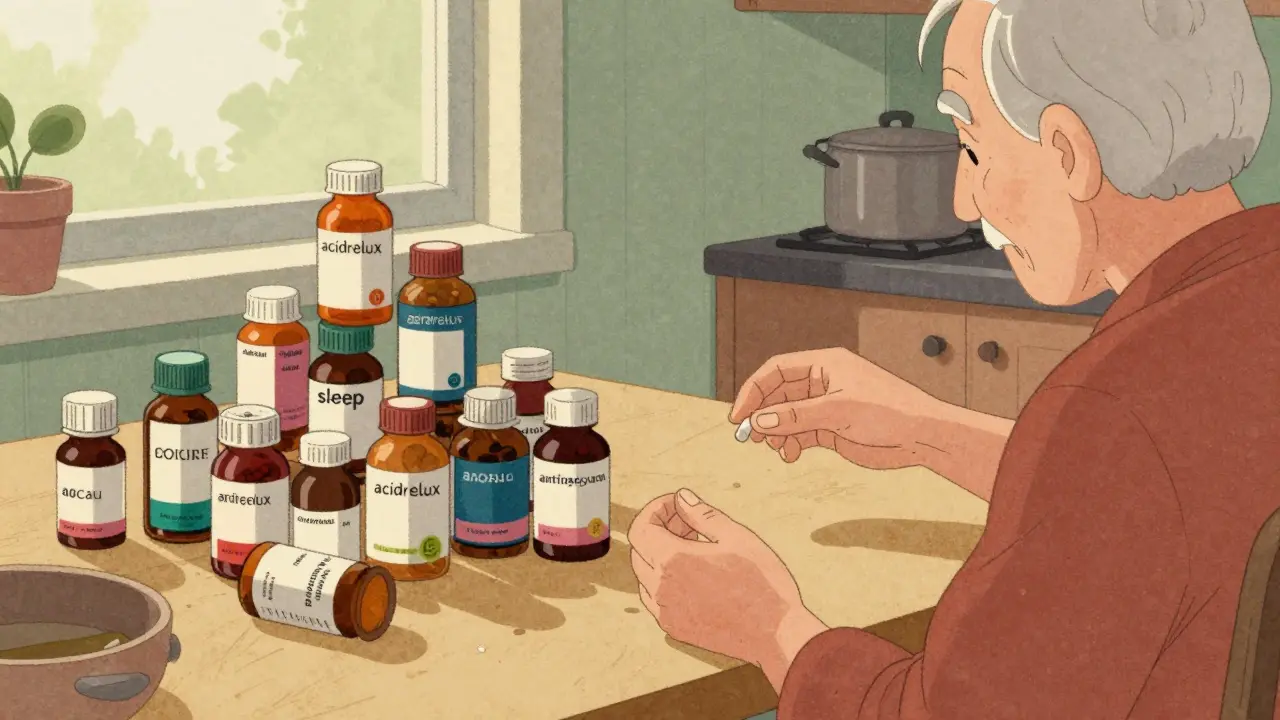
Every year, millions of older adults take medications that no longer help them-and may be hurting them. It’s not laziness or neglect. It’s the quiet buildup of prescriptions over decades: a pill for acid reflux, another for sleep, one for blood pressure, a painkiller, an antidepressant, maybe even an antipsychotic for agitation. Over time, these add up. Five, seven, ten pills a day. And with each new medication, the risk of side effects, falls, confusion, and hospital stays grows. This isn’t normal aging. It’s polypharmacy-and it’s a silent crisis in older healthcare.
What Is Deprescribing? It’s Not Just Stopping Pills
Deprescribing isn’t about cutting drugs randomly. It’s a careful, step-by-step process to stop or lower doses of medicines that are no longer doing more good than harm. Think of it like cleaning out a medicine cabinet you haven’t looked at in 10 years. Some things are still useful. Some are expired. Some never should’ve been there in the first place. The idea took shape in the early 2010s, led by researchers in Canada like Barbara Farrell and Cara Tannenbaum. Today, deprescribing.org is the go-to hub for evidence-based guidelines. These aren’t opinions. They’re built from clinical trials, expert reviews, and real patient outcomes. The goal? Reduce side effects, improve quality of life, and avoid hospital trips caused by drug reactions.Who Benefits Most From Deprescribing?
It’s not just for people in nursing homes. It’s for anyone over 65 taking five or more medications-especially if they’ve got multiple chronic conditions like diabetes, heart disease, arthritis, or dementia. About 40% of older adults globally are on too many drugs, according to the World Health Organization. And in the U.S., one in three hospital admissions for seniors is linked to medication problems. Some groups are at higher risk:- People who see multiple doctors (each prescribing their own meds)
- Those with memory issues or who struggle to manage pill schedules
- Patients on long-term proton-pump inhibitors (PPIs) for heartburn
- Older adults taking benzodiazepines for sleep or anxiety
- Those on opioids for chronic pain without clear benefit
The Five Best-Understood Medication Classes for Deprescribing
Not all drugs are equal when it comes to safely reducing them. Five classes have solid, tested frameworks:- Proton-pump inhibitors (PPIs) - Like omeprazole or pantoprazole. Many take these for years for heartburn, but most don’t need them long-term. The guideline: check if you still have symptoms. If not, try cutting the dose by half, then stop over 4-8 weeks. Watch for rebound acid, but it’s usually mild and short-lived.
- Benzodiazepines and sleep aids - Drugs like lorazepam, diazepam, or zolpidem. These increase fall risk and confusion. The plan: slowly reduce by 10-25% every 1-2 weeks. Replace with sleep hygiene, not another pill. Studies show most patients adjust well.
- Antipsychotics - Often prescribed for dementia-related agitation. But they raise stroke risk and can cause stiffness or tremors. Guidelines say: try non-drug approaches first-music therapy, routines, calming environments. If meds are still needed, reduce to the lowest possible dose.
- Antihyperglycemics - Blood sugar pills like sulfonylureas (glyburide) or insulin. In older adults with limited life expectancy, tight blood sugar control can cause dangerous lows. The fix: aim for less strict targets. Switch to safer drugs like metformin if possible.
- Opioid painkillers - For chronic pain without clear benefit. These can cause dizziness, constipation, and addiction. Taper slowly: reduce by 10% every 1-4 weeks. Combine with physical therapy or acupuncture. Many patients report feeling clearer-headed after stopping.
How Deprescribing Works in Practice: The Shed-MEDS Steps
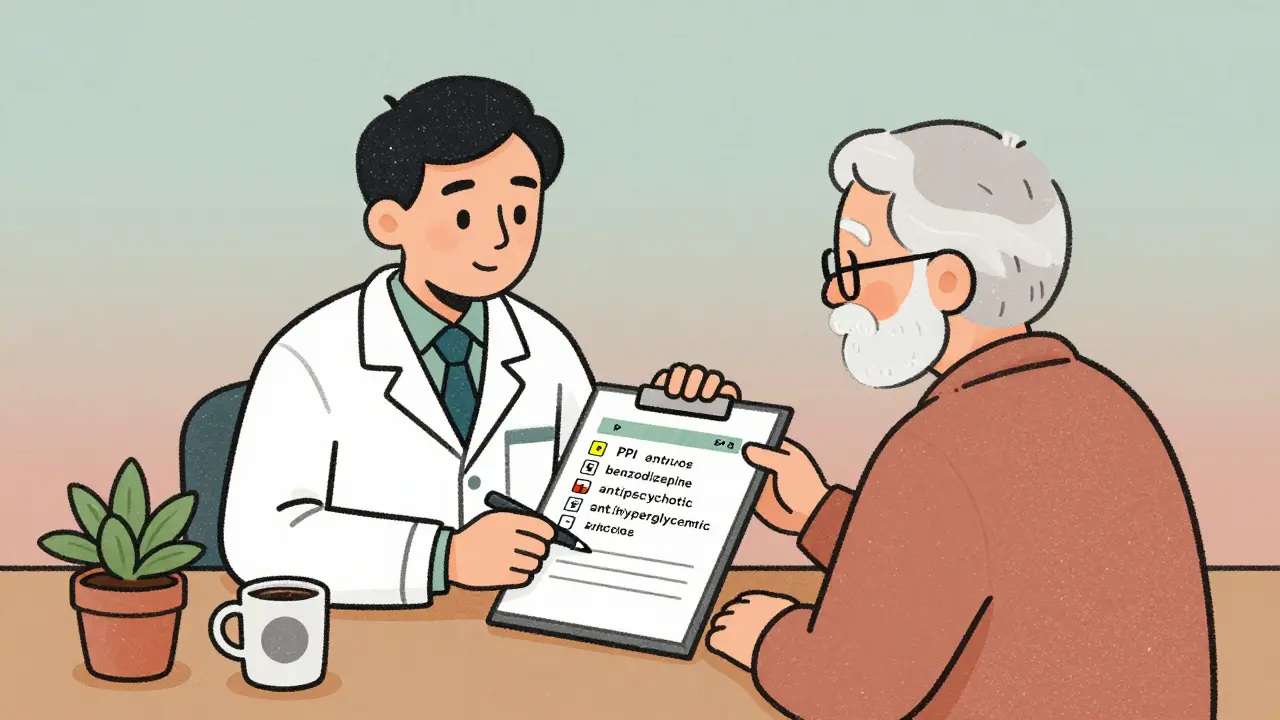
One of the most reliable frameworks is Shed-MEDS. It’s simple, practical, and used in hospitals and clinics across North America. Here’s how it works:- Best Possible Medication History - Get every pill, supplement, and OTC drug on paper. Ask the patient. Check pharmacy records. Don’t assume.
- Evaluate - For each drug, ask: Is it still helping? Is the risk worth it? Is there a better alternative? Use tools like STOPP/START criteria or Beers Criteria to guide you.
- Deprescribing Recommendations - Pick one or two meds to target first. Start with the highest risk or lowest benefit. Create a taper plan. Don’t rush.
- Synthesis - Share the plan with the patient. Explain why. Get their input. Write it down. Schedule follow-up.
Why Isn’t Everyone Doing This?
You’d think this would be standard. But here’s the reality:- Most doctors have 7-10 minutes per patient. Deprescribing takes 30-45 minutes the first time.
- Electronic health records don’t help. They remind you to prescribe, not to stop.
- Patients are scared. ‘I’ve taken this for 15 years-what if I get worse?’
- Guidelines exist for five drug classes. There are over 500 combinations without clear rules.
What Patients Really Think
When asked, most older adults welcome fewer pills. A 2022 study found 65% felt more in control and less overwhelmed. One woman said, ‘I used to spend my mornings counting pills. Now I just drink coffee.’ But 22% felt anxious. ‘What if my pain comes back?’ ‘What if I can’t sleep?’ That’s why education matters. Patients need to know: this isn’t abandonment. It’s a smarter way to care. Pharmacists report success: ‘I tapered 18 out of 22 patients off benzodiazepines. Only two had mild withdrawal. They all slept better without the fog.’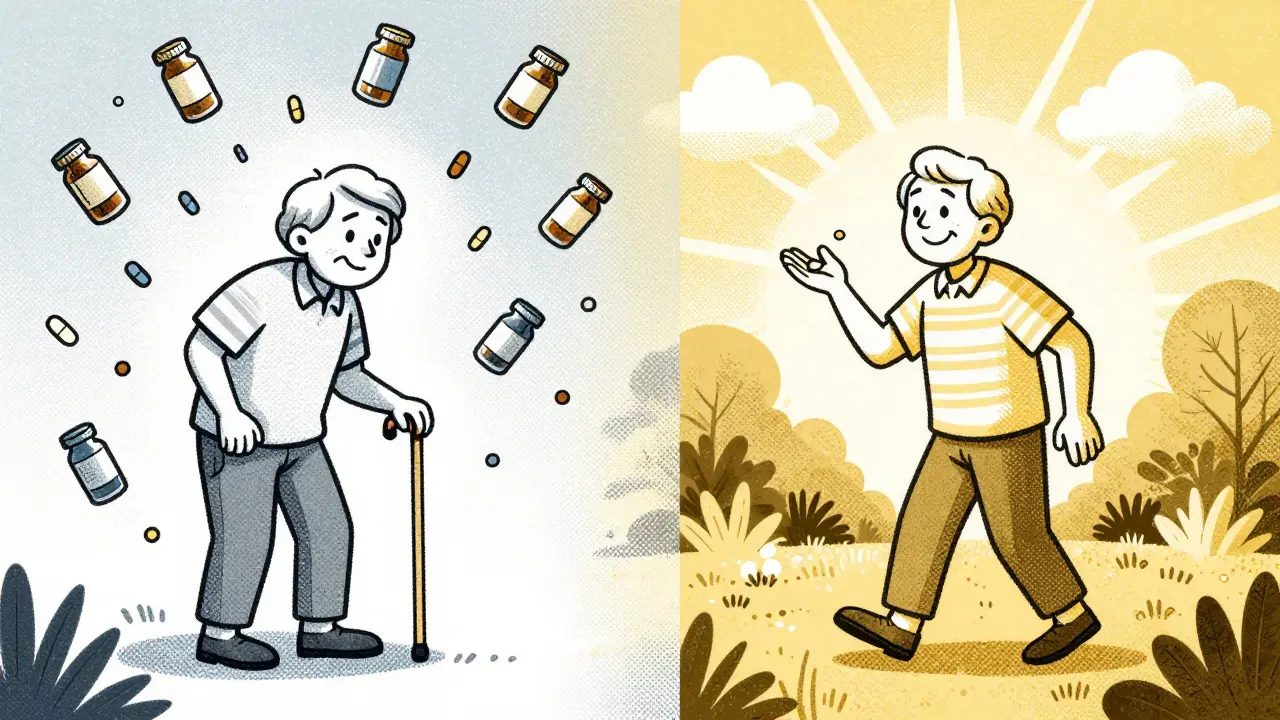
What’s Changing in 2025?
Deprescribing is moving from a niche idea to mainstream care.- The American Medical Association adopted its first deprescribing policy in June 2024, saying doctors should ‘routinely assess’ all medications.
- Medicare will start measuring deprescribing as part of physician pay in 2026.
- The FDA has funded over $8 million in research since 2020 to build new guidelines-for antidepressants, anticoagulants, and more.
- AI tools are being tested to scan EHRs and flag drugs that might be safe to stop.
How to Start Deprescribing-Even If You’re Not a Doctor
You don’t need to be a clinician to help. Here’s what you can do:- Ask your doctor or pharmacist: ‘Are all these meds still necessary?’
- Bring a full list of everything you take-including vitamins, herbs, and OTC drugs.
- Ask: ‘What’s the goal of this medicine? Has it helped lately?’
- Don’t stop anything cold turkey. Always ask for a taper plan.
- Use deprescribing.org’s free tools to see if your meds are on their list.
The Big Picture: Safer, Simpler, Smarter Care
Deprescribing isn’t about saving money-though it does. A 2023 study found for every $1 spent on deprescribing programs, $3.20 was saved in reduced hospital stays and medication costs. It’s about dignity. About not living in a fog of pills. About giving people back their energy, their balance, their peace of mind. The science is clear: reducing unnecessary medications cuts side effects, prevents falls, and improves life quality-without increasing risk. The challenge now? Making it normal. Making it easy. Making it part of every older adult’s care plan.It’s not about taking pills away. It’s about giving people back their health.
Winni Victor
December 25, 2025 AT 04:44
So let me get this straight-we’re supposed to trust some Canadian researchers who think old people should just stop taking their meds like they’re weaning a cat off tuna? I’ve seen my grandma go from ‘I can’t sleep’ to ‘I can’t remember my own name’ after they cut her lorazepam. Now she’s screaming at the TV at 3 a.m. because the cat’s plotting against her. Who’s the real villain here-the pill or the system that left her with nothing else?
Terry Free
December 25, 2025 AT 08:51
Deprescribing? More like deprioritizing patient safety. You don’t just ‘taper’ someone off antipsychotics like you’re adjusting the thermostat. These aren’t Adderall rants from college kids-they’re people with real psychosis. If you reduce meds without proper monitoring, you’re not helping-you’re playing Russian roulette with dementia patients. And don’t give me that ‘non-drug approaches’ nonsense. Music therapy doesn’t stop hallucinations. Pharmacology does.
Lindsay Hensel
December 26, 2025 AT 15:31
This is one of the most compassionate, clinically grounded pieces I’ve read in years.
It’s not about removing medication-it’s about restoring agency.
Every pill a person takes is a decision made in a moment of fear, uncertainty, or exhaustion.
Deprescribing honors the dignity of someone who has spent decades trusting the system.
It asks: Are we healing them-or just managing symptoms until they collapse?
Thank you for naming the silence around polypharmacy.
It’s not neglect. It’s neglect by design.
Linda B.
December 27, 2025 AT 10:03
The pharmaceutical industry funded every single study mentioned here and the WHO guidelines are just a front for the CDC's global depopulation agenda they've been pushing since 2012 through the Gates Foundation and the CDCs secret partnership with Big Pharma to reduce elderly populations and cut social security costs its all in the leaked memos from the 2018 CDC summit in Atlanta if you know where to look
Christopher King
December 28, 2025 AT 23:54
Let’s get real. We’ve turned aging into a medical problem to be solved, not a human experience to be lived.
They don’t want you to stop taking pills because you’re better-they want you to stop taking pills because they’re tired of paying for your hospital stays.
And now they’re slapping a shiny ‘evidence-based’ label on it like it’s yoga for the soul.
But here’s the truth: if your doctor doesn’t have time to listen to you for 45 minutes, then your life isn’t being cared for-it’s being optimized.
We’ve commodified vulnerability. And deprescribing? It’s just the latest profit-driven rebrand of elder abandonment.
Who benefits? The insurance companies. The EHR vendors. The bureaucrats who get bonuses for ‘reducing polypharmacy rates.’
Not you. Not your grandma. Not the quiet woman who just wants to sleep without nightmares.
Oluwatosin Ayodele
December 30, 2025 AT 12:07
Interesting data but you missed the African context entirely. In Nigeria, many elderly use traditional herbs alongside prescribed drugs-no one tracks this. The Beers Criteria? Designed for Western, monopharmacological systems. In Lagos, an 80-year-old might take three pills and five herbal concoctions from the market. No one asks why. No one has time. The real crisis isn’t polypharmacy-it’s the absence of any pharmacovigilance system at all. You can’t deprescribe what you don’t know is being taken.
Jason Jasper
December 30, 2025 AT 14:41
I’ve been helping my dad taper off his PPI. Took 10 weeks. He had a week of heartburn that felt like a furnace-but then it was gone.
He sleeps better now.
He walks without the cane more often.
And he didn’t die.
That’s the quiet win no one talks about.
Justin James
January 1, 2026 AT 06:22
You think this is about pills? Think deeper.
The real agenda is control. The FDA, AMA, Medicare-they all want you dependent on systems, not on your own body. They don’t want you to heal. They want you to manage. Every pill you take is a data point. Every taper is tracked. Every symptom is logged into an algorithm that decides your insurance premiums, your care priority, your lifespan.
They’ve been building this for decades. The Beers Criteria? A Trojan horse. The Shed-MEDS framework? A surveillance protocol disguised as care.
And now they’re pushing AI to scan your EHR and flag you for deprescribing like you’re a faulty product.
Who decides what’s ‘unnecessary’? Not you. Not your doctor. A computer trained on cost-cutting metrics and corporate guidelines.
They don’t want you to live better. They want you to live cheaper.
And if you die a little sooner? Well, that’s just actuarial math.
Wake up. This isn’t medicine. It’s monetized surrender.