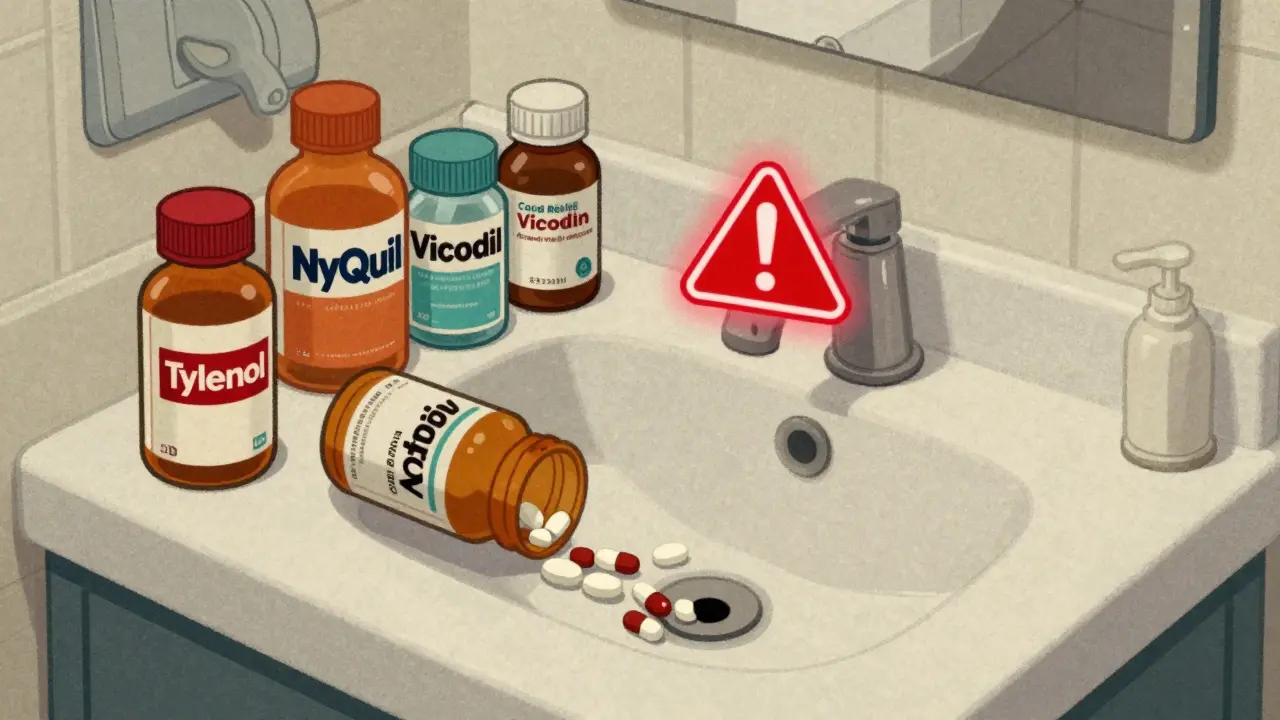
Every year, more than 56,000 people in the U.S. end up in the emergency room because of an acetaminophen overdose. Most of them didn’t mean to take too much. They just didn’t realize how easy it is to accidentally cross the line between safe and dangerous. Acetaminophen - sold as Tylenol or generic pain relievers - is in more than 600 products. Cold medicines. Sleep aids. Prescription painkillers like Vicodin. Even some migraine pills. Taking two or three of these together? You could be hitting a lethal dose without ever feeling like you’re in danger.
How Much Is Too Much?
The official safe limit for adults is 4,000 milligrams in 24 hours. That’s eight 500 mg pills. Sounds like a lot, right? But here’s the catch: many people take one pill for a headache, another for back pain, then grab a cold medicine that also has acetaminophen. That’s three doses in a few hours. No one thinks it’s a problem - until their liver starts shutting down.
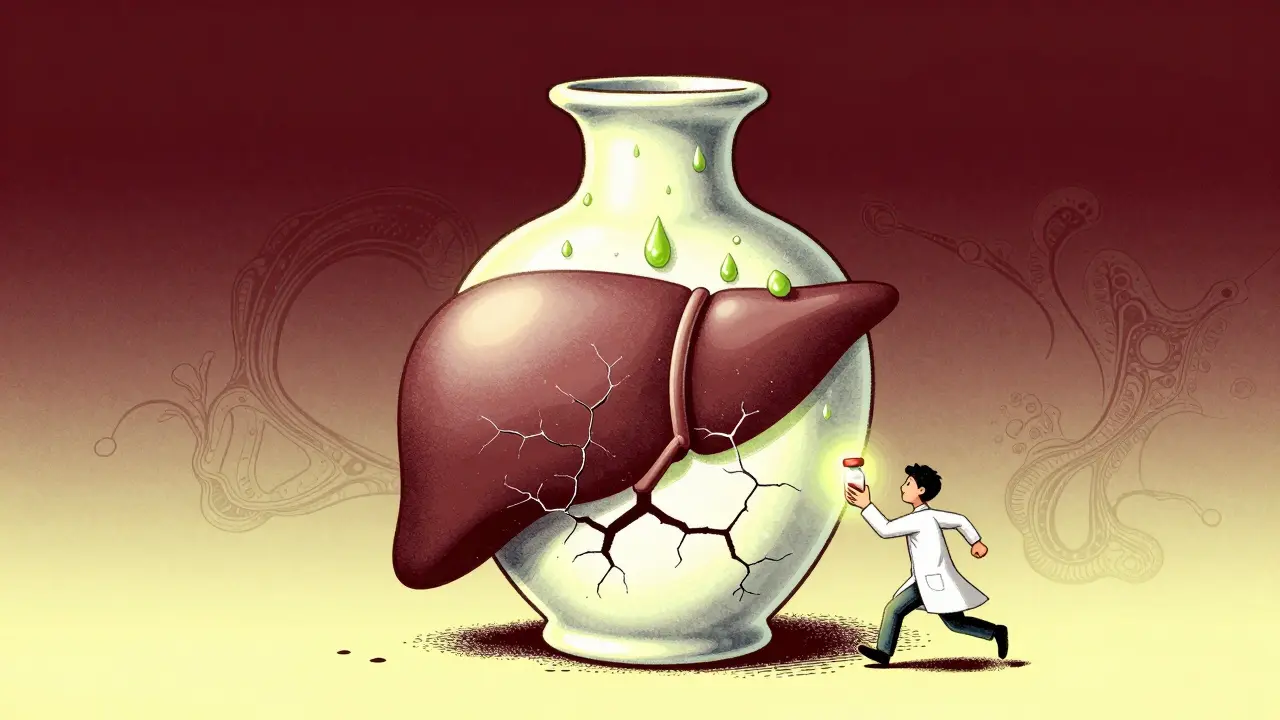
The liver breaks down acetaminophen normally, but when you overload it, a toxic byproduct called NAPQI builds up. Your liver has a natural defense - glutathione - that neutralizes it. But when you take too much, glutathione runs out. NAPQI starts eating away at liver cells. And you won’t feel it until it’s too late.
The Four Stages of Liver Damage
Acetaminophen poisoning doesn’t hit like a heart attack. It creeps up. And that’s what makes it so deadly.
Stage 1 (0-24 hours): You might feel nauseous. Maybe throw up. Or you might feel fine. About 40% of people have no symptoms at all. This is when most people think, ‘I’m okay, I’ll just sleep it off.’
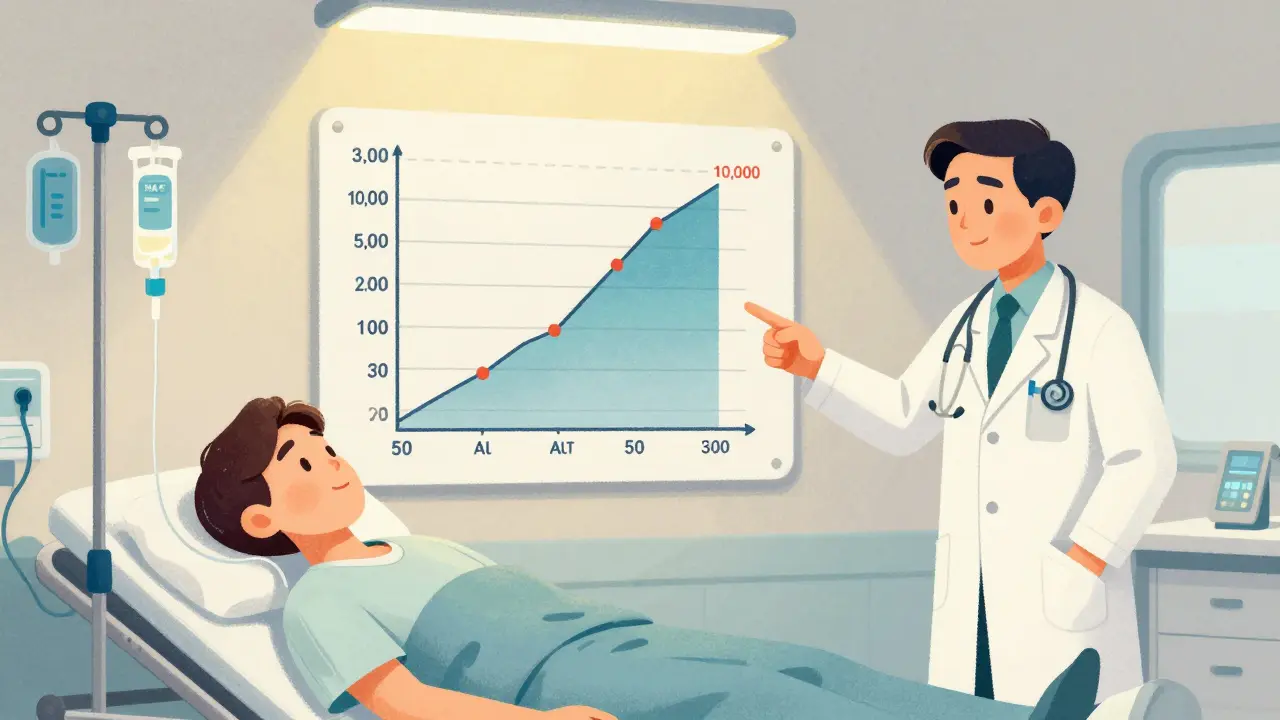
Stage 2 (24-72 hours): Now the pain starts. Right under your ribs on the right side. That’s your liver. You might still feel sick. Your blood tests will show your liver enzymes (ALT) climbing. Normal is below 56 IU/L. In overdose, it can jump past 10,000. That’s not a typo.
Stage 3 (72-96 hours): This is the crisis. Your skin and eyes turn yellow (jaundice). Your blood can’t clot - you bruise easily or bleed internally. Your kidneys start failing. You get confused. Your blood pH drops. At this point, you’re in acute liver failure. Without treatment, death is likely.
Stage 4 (5+ days): Either you recover - and most people do if they got help in time - or you don’t. About 1-2% of cases need a liver transplant. Of those, 85% survive five years or more.
The Only Antidote That Works
N-acetylcysteine, or NAC, is the only FDA-approved antidote. It doesn’t just treat symptoms - it saves your liver. It works by replacing the glutathione your body burned through and binding to the toxic NAPQI before it destroys more cells.
But timing is everything. If you get NAC within 8 hours of taking too much, your chances of survival are over 98%. After 15 hours? That drops to 55%. Every hour you wait increases your risk of death by 8.5%.
The standard IV protocol is a 21-hour drip: 150 mg/kg over the first hour, then 50 mg/kg over the next four hours, then 100 mg/kg over the next 16 hours. Oral NAC takes three days - 140 mg/kg first dose, then 70 mg/kg every four hours for 17 doses. It smells bad and makes you vomit, but it works.
Even if you show up 24 hours later with liver damage, NAC still helps. Doctors keep giving it until your liver enzymes drop and the drug is out of your system.
Who’s at Highest Risk?
Not everyone reacts the same way. Some people can take 5,000 mg and be fine. Others get hurt at 3,000 mg. Why?
- Chronic alcohol use: Heavy drinkers have 3-4 times higher risk. Alcohol makes your liver produce more of the toxic NAPQI and lowers glutathione.
- Existing liver disease: If you have hepatitis B or C, your liver is already damaged. Overdose risk jumps 65%.
- Medications that speed up liver metabolism: Drugs like phenytoin or carbamazepine (for seizures) force your liver to break down acetaminophen faster - creating more NAPQI.
- Malnutrition: People with poor diets, eating disorders, or HIV/AIDS often have 25-30% less glutathione. Their liver has no backup.
And here’s the hidden trap: many people don’t know that Vicodin, Percocet, and other prescription painkillers contain acetaminophen. One Vicodin tablet has 300 mg. Take four a day - that’s 1,200 mg. Add two Tylenol pills? You’re at 2,200 mg. Then take NyQuil for a cold? That’s another 650 mg. Suddenly you’re over 3,000 mg - and you didn’t even think you were taking extra.
What to Do If You Suspect an Overdose
Don’t wait for symptoms. Don’t assume you’re fine because you feel okay. If you think you took too much - even if it was hours ago - get to a hospital immediately.
Emergency teams will:
- Check your acetaminophen blood level - ideally at the 4-hour mark after ingestion.
- Plot it on the Rumack-Matthew nomogram. If it’s above 150 µg/mL at 4 hours, you need NAC.
- Give activated charcoal if you came in within 1-2 hours. It can trap unabsorbed pills.
- Start IV fluids, anti-nausea meds like ondansetron, and vitamin K if your blood won’t clot.
If you’re past 24 hours and your liver enzymes are sky-high, they’ll still give you NAC. It’s not too late. But you’ll need close monitoring - possibly in the ICU.
When a Transplant Is the Only Option
Some cases are too far gone. That’s when doctors use the King’s College Criteria to decide if you need a liver transplant:
- Arterial pH below 7.3
- INR (clotting time) over 6.5
- Creatinine over 3.4 mg/dL
If you meet all three, your chance of dying without a transplant is 100%. With a transplant? 85% survive five years. It’s a last resort - but it works.
Recovery and Long-Term Outlook
Most people who get treated early recover completely. About 92% have full liver function back within three months. Their ALT levels drop to normal. No scarring. No long-term issues.
But 8% have lingering mild liver enzyme elevations. They need follow-up blood tests every few months. It’s not dangerous, but it’s a reminder: your liver took a hit. Don’t test it again.
The economic cost? Over $38,500 per hospital stay. That’s not just money - it’s lost work, lost time, lost peace of mind.
How to Prevent It
Prevention is simple - but it takes awareness.
- Always check the labels. Look for “acetaminophen” or “APAP” on any medicine you take.
- Never combine painkillers unless a doctor says it’s safe.
- Stick to 325-650 mg per dose. Don’t max out at 1,000 mg unless directed.
- Never take more than 4,000 mg in 24 hours - and even that’s pushing it. 3,000 mg is safer for most people.
- If you drink alcohol regularly, cut acetaminophen out completely.
- If you have liver disease, ask your doctor what dose is safe for you - it may be 2,000 mg or less.
Since 2011, the FDA forced prescription painkillers to reduce acetaminophen from 750 mg to 500 mg per tablet. That change alone cut overdose-related liver failure by 21%. Education works.
What’s Next in Treatment?
Scientists are looking beyond NAC. Early research at Harvard shows nitric oxide might help the liver regenerate faster - even after the 8-hour window. In mice and zebrafish, it boosted healing without needing more glutathione.
Another breakthrough? Blood tests for microRNA-122. It rises within 2 hours of overdose - way before liver enzymes. A simple blood draw could tell you if your liver is already damaged, even if you feel fine. Clinical trials are underway.
These tools could turn acetaminophen overdose from a silent killer into a treatable emergency - if we act fast enough.
Can you overdose on acetaminophen by taking too many cold medicines?
Yes. Many cold, flu, and sleep medicines contain acetaminophen. Taking Tylenol for a headache while also using NyQuil, DayQuil, or Vicodin can easily push you past 4,000 mg in a day. Always read the active ingredients - look for "acetaminophen" or "APAP" on the label.
Is it safe to take acetaminophen if I drink alcohol?
No. Chronic alcohol use increases your risk of liver damage from acetaminophen by 3 to 4 times. Even moderate drinking - a few drinks a week - can make your liver more vulnerable. If you drink regularly, avoid acetaminophen entirely. Use ibuprofen or naproxen instead, unless your doctor says otherwise.
How long does it take for liver damage to show up after an overdose?
Symptoms often don’t appear for 24 to 48 hours - sometimes longer. You might feel fine the first day. By the time nausea, pain, or jaundice shows up, your liver is already severely damaged. That’s why waiting for symptoms is dangerous. If you suspect an overdose, go to the ER immediately - don’t wait.
Can NAC be taken at home?
Oral NAC is available by prescription, but it’s not something to self-administer. It requires strict timing and dosing, and it causes severe nausea and vomiting. IV NAC is the gold standard and must be given in a hospital under medical supervision. Never try to treat a suspected overdose at home.
Do children have different overdose limits?
Yes. Children’s dosing is based on weight - not age. The maximum is 90 mg per kg per day, split into 4-6 doses. Never give adult-strength acetaminophen to a child. Always use pediatric formulations and follow the label or your doctor’s instructions exactly. Accidental overdoses in kids are common and can be fatal.
Is acetaminophen safer than ibuprofen for the liver?
Acetaminophen is harder on the liver; ibuprofen is harder on the kidneys and stomach. Neither is "safe" if misused. If you have liver disease, avoid acetaminophen. If you have kidney problems or ulcers, avoid ibuprofen. Choose based on your health history - and always check with your doctor before switching pain relievers.
Teresa Marzo Lostalé
December 28, 2025 AT 06:53
Just read this and my heart dropped. I took Tylenol and NyQuil last week for a cold and didn’t even think twice. 😅 Thanks for the wake-up call. I’m deleting all my cold meds now and just drinking tea.
ANA MARIE VALENZUELA
December 29, 2025 AT 02:46
People are idiots. You don’t read labels? You don’t count pills? You take random meds like candy and then act shocked when your liver gives up? This isn’t rocket science. Stop being lazy and read the damn bottle.
Bradly Draper
December 30, 2025 AT 08:52
I had a friend go through this. He didn’t even know Vicodin had Tylenol in it. Got to the ER just in time. They said if he’d waited another 4 hours, he wouldn’t have made it. Scary stuff. I told everyone I know now.
Gran Badshah
December 31, 2025 AT 16:19
India has no idea about this. People here take 5 paracetamol at once for fever. No one checks ingredients. My cousin died last year. No one knew why. This needs to be on every medicine bottle in the world.
Ellen-Cathryn Nash
January 1, 2026 AT 07:55
Of course this happens. Society rewards ignorance. We’ve turned medicine into a snack aisle. You want to live in a world where people self-medicate like it’s a game? Then don’t be surprised when your organs turn to mush. 🤦♀️
Samantha Hobbs
January 3, 2026 AT 07:24
Wait so if I take one Tylenol and one Advil, I’m fine right? I mean, Advil doesn’t have acetaminophen? Right? Someone tell me I’m not gonna die.
Nicole Beasley
January 4, 2026 AT 14:27
🤯 I just checked my medicine cabinet. 3 bottles with APAP. I’m gonna throw them out. Also, I didn’t know NAC smelled like rotten eggs. 😷 I’ll never take it at home. Hospital only for me now.
sonam gupta
January 5, 2026 AT 17:57
USA has too many pills and too little sense. We are a nation of lazy people who want magic cures. This is why your healthcare costs are insane. Stop blaming the drug. Blame the people who don’t read.
Julius Hader
January 6, 2026 AT 17:24
My mom took 8 Tylenol once thinking it was better for her back pain. She was fine. So I don’t get the hype. People panic over nothing. I’ve been taking 2 a day for years. No issues.
Hakim Bachiri
January 7, 2026 AT 21:51
Let me just say-this is a textbook case of pharmaceutical capitalism exploiting cognitive laziness. The FDA’s 2011 cap? A PR stunt. The real villain is the OTC industry’s predatory labeling practices-‘APAP’ is a deliberate obfuscation tactic to mislead consumers. Also, NAC is a band-aid. The real solution is banning acetaminophen outright. It’s a 1950s drug with 21st-century toxicity profiles. We’re all guinea pigs.
Celia McTighe
January 8, 2026 AT 17:05
Thank you for writing this with such care. I work in ER and see this every month. People come in saying ‘I didn’t think it was a big deal.’ It’s never a big deal… until it is. Please share this. Save someone’s liver. ❤️
Ryan Touhill
January 9, 2026 AT 21:10
Did you know that the real reason NAC works is because it’s a synthetic glutathione analog designed by Big Pharma to maintain their market dominance? The liver’s natural detox pathways are far more elegant. This whole system is rigged. Also, I’ve read the Harvard study on nitric oxide. It’s been suppressed since 2018. The FDA won’t approve it because it can’t be patented. Wake up.
Payton Daily
January 11, 2026 AT 00:47
So… what if you take acetaminophen and then drink a beer? Is it like a chemical bomb? Like, does your liver explode? I’ve done it before. I’m fine. But now I’m scared. Like… what if I’m already dead and just don’t know it? 😭
Kelsey Youmans
January 12, 2026 AT 20:38
It is with profound solemnity that I acknowledge the gravity of the public health implications delineated herein. The prevalence of unintentional acetaminophen toxicity represents a systemic failure in pharmaceutical literacy, compounded by inadequate public health messaging. One must advocate for standardized, universally legible labeling and mandatory patient counseling at point-of-sale. This is not merely a medical issue-it is a societal imperative.
Sydney Lee
January 13, 2026 AT 21:32
Of course the liver fails. The human body is not a machine you can overload with chemicals like a smartphone battery. This isn’t ‘accidental’-it’s moral negligence. People treat their bodies like disposable tech. I’ve seen it. You don’t eat 10 Advils and then cry about it. You don’t drink bleach and say ‘I didn’t know.’ You’re just weak. And now you’re making the rest of us pay for your ignorance with ER bills and transplant lists.