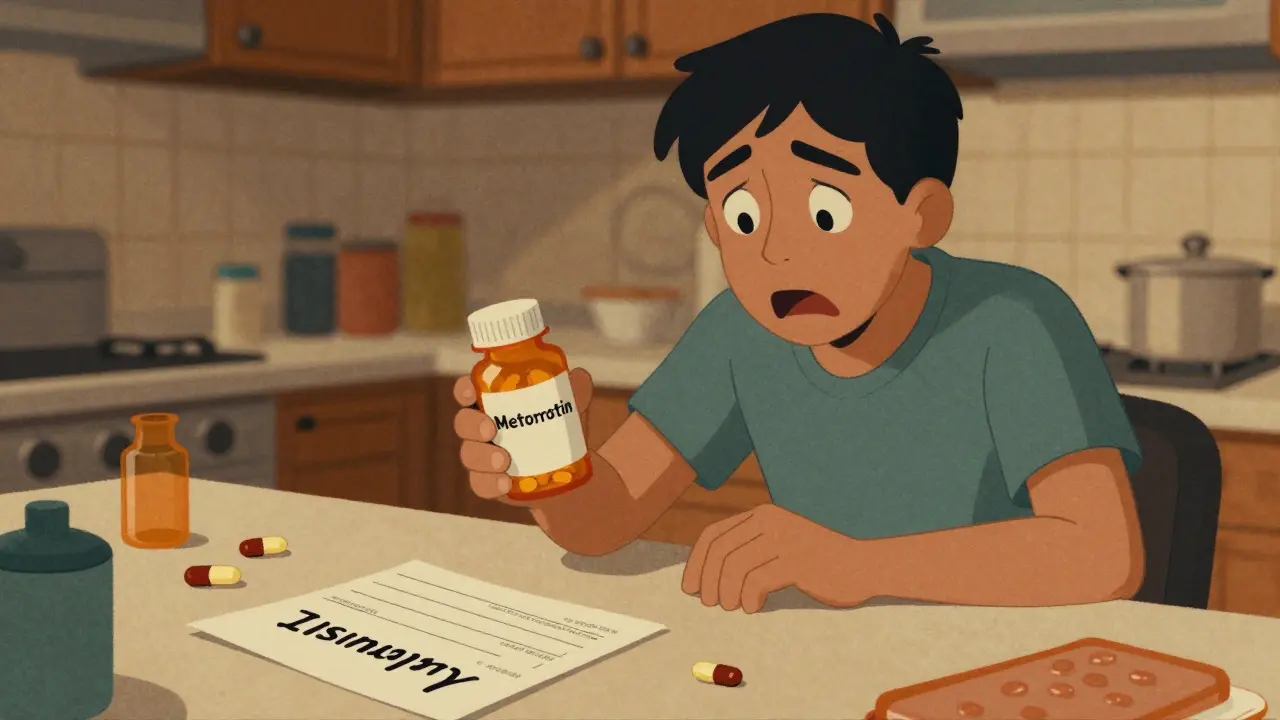
You open the pill bottle and freeze. The pills don’t look right. The label says metformin, but you’re on lisinopril for high blood pressure. Or maybe it’s the wrong dose - 500mg instead of 250mg. Or worse - it’s a completely different drug, like insulin instead of thyroid medicine. This isn’t rare. Pharmacy errors happen more often than most people think, and they can be deadly.
According to the Institute for Safe Medication Practices, about 1.5 million people in the U.S. are affected by medication errors every year. About one in five of those errors happens at the pharmacy counter. In Australia, while reporting systems aren’t as public, data from the Therapeutic Goods Administration shows similar patterns: dispensing mistakes are among the top causes of preventable harm in community pharmacies.
If you’ve just realized you got the wrong medication, don’t panic - but don’t wait either. Your next 10 minutes could prevent serious injury or even save your life.
Stop Taking It Immediately
Do not swallow another pill. Do not rinse it down the sink. Do not hide it. The moment you suspect something’s wrong, stop using it. Even one dose of the wrong drug can trigger dangerous side effects. For example, taking metformin when you’re on warfarin might cause low blood sugar and confusion. Taking a blood pressure pill when you need an antibiotic could let an infection spiral out of control.
Some medications are high-risk. Insulin, blood thinners, chemotherapy drugs, and opioids - if you get the wrong dose or type, harm can come within hours. If you’ve already taken one or more pills and feel dizzy, nauseous, short of breath, or your heart is racing, go to the emergency room now. Don’t call your doctor first. Call an ambulance or drive yourself if you’re able.
Call Your Doctor Right Away
Once you’ve stopped taking the medication, contact your prescribing doctor immediately. Don’t wait for business hours. Many clinics have after-hours lines. If you can’t reach them, go to an urgent care center or emergency department.
Your doctor needs to know what you took, when you took it, and how much. They’ll check if the wrong medication interacts with any of your other drugs. They may order blood tests, heart monitoring, or imaging to see if damage has started. In some cases, they’ll give you an antidote. In others, they’ll prescribe a replacement and tell you how to safely transition.
Keep notes. Write down the time you noticed the error, what symptoms you felt, and what your doctor said. These details matter later.
Go Back to the Pharmacy - But Don’t Just Talk, Document
Take the medication - the whole bottle, the original bag, the receipt - back to the pharmacy. Don’t throw anything away. You need proof.
Ask to speak with the head pharmacist or manager. Say clearly: “I believe I was given the wrong medication. I need to report this.” Do not apologize. Do not say, “I might be wrong.” You’re not guessing - you’re reporting a safety incident.
Ask them to check their records. Show them your prescription. Ask them to explain how this happened. Did they misread the handwriting? Mix up similar-sounding names? Skip the double-check? Record the conversation if you can - legally, you can record in Australia if you’re part of the conversation. If they refuse to let you record, say: “I’m documenting this for my records and for patient safety.”
Get their name, employee ID, and the time of the conversation. Ask for a written report or incident number. Most pharmacies have a formal process for handling dispensing errors - demand it.
Preserve Every Piece of Evidence
You’re not being paranoid. You’re being smart. Here’s what you need to save:
- The incorrect medication (whole bottle or pills)
- The original prescription label
- The pharmacy bag
- The receipt with date, time, and pharmacist name
- Your original prescription copy (from your doctor or online portal)
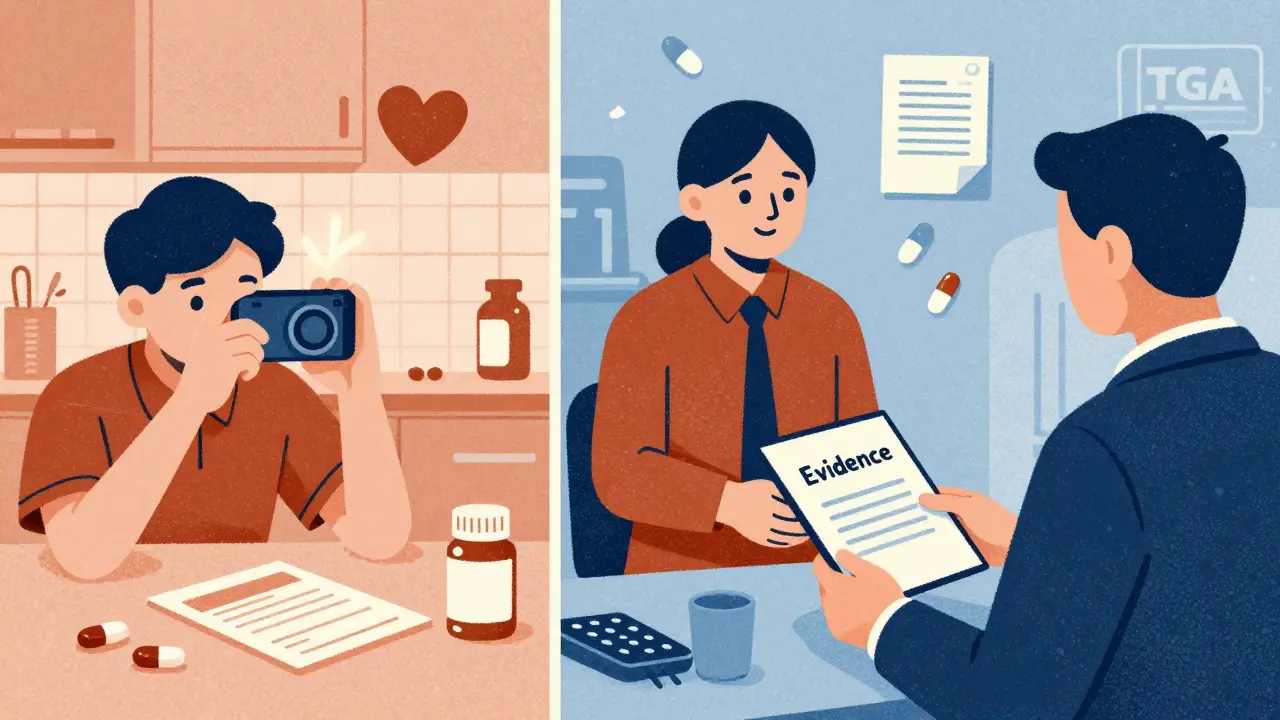
- Photos or video of the pills next to the label
Photographic evidence is critical. A 2022 study from Matt Law’s practice found that 92% of successful pharmacy error claims included clear photos showing the mismatch between the drug and the label. Video is even better - a short clip of you reading the label and holding the pills increases settlement value by up to 37%.
Do not return the medication to the pharmacy. They may try to take it back to “dispose of it.” Say no. You need it for your records - and possibly for legal action.
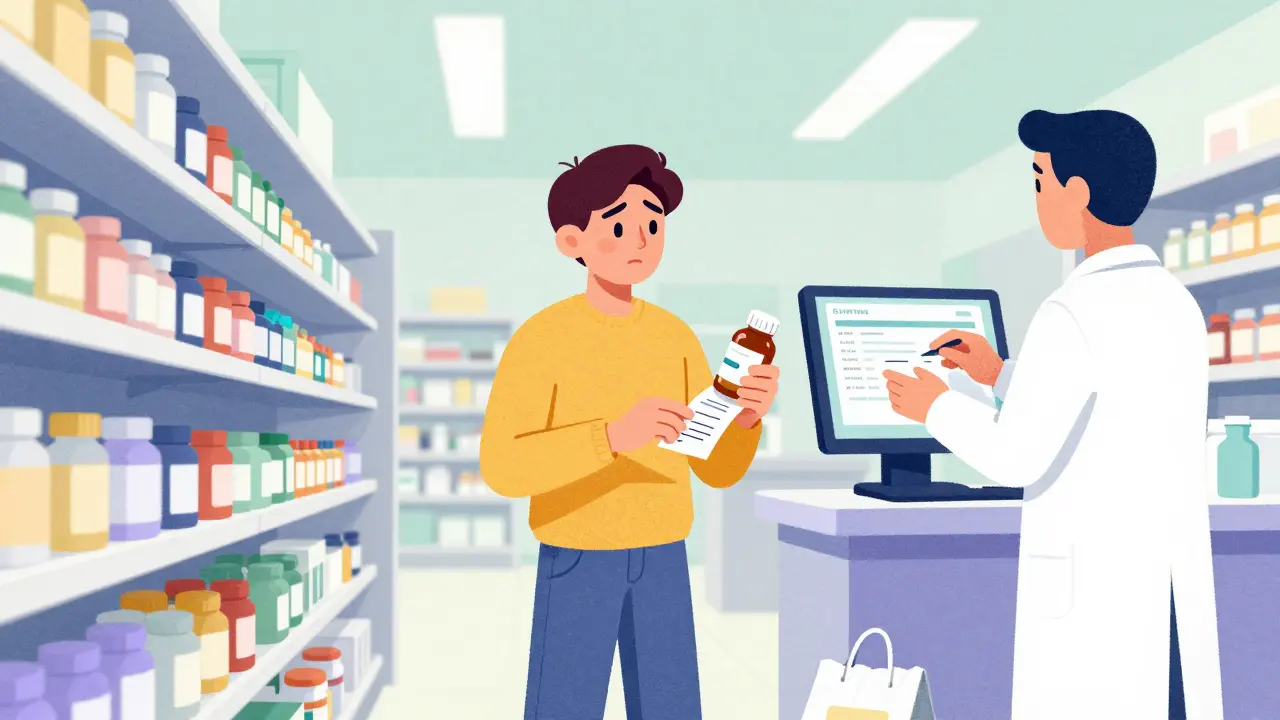
Report It - To the Right Places
Pharmacies are required to report errors, but many don’t. Only about 15% of all medication errors are officially reported, according to the FDA. That’s because pharmacists fear punishment, not because they don’t care.
You have the power to change that. Report the error to:
- The Therapeutic Goods Administration (TGA) - Australia’s drug regulator. You can file a report online at tga.gov.au/reporting-problems.
- Your state’s pharmacy board - In Western Australia, that’s the Pharmacy Board of Australia under AHPRA.
- The pharmacy’s corporate office - If it’s a chain like Chemist Warehouse, CVS, or TerryWhite Chemmart, call their national customer service line. Ask for their quality assurance department.
When you report, give exact details: date, time, pharmacy location, pharmacist name, drug names, and what happened. Include your contact info. Anonymous reports are accepted, but named reports lead to real changes.
Know Your Legal Rights
Pharmacy errors can be medical negligence. If you suffered harm - even if it was minor - you may have a claim. You don’t need to be hospitalized to qualify. Dizziness, confusion, nausea, or a trip to the ER counts.
Here’s what you should know:
- You have three years from the date you discovered the error to file a claim in Australia. That’s under the Limitation Act 1969 (WA).
- Do not give a recorded statement to the pharmacy’s insurance company without a lawyer. They will use your words against you.
- Settlements for pharmacy errors range from $10,000 for minor reactions to over $500,000 for permanent injury or hospitalization.
- Most cases (70%) settle out of court. You don’t need to sue to get paid.
If you’re unsure, contact a medical negligence lawyer. Many offer free initial consultations. Bring your evidence: photos, receipts, doctor’s notes, pharmacy records. They’ll tell you if you have a case - and if it’s worth pursuing.
How These Errors Happen - And How to Prevent Them
Why does this keep happening? Here are the top causes:
- Similar drug names - e.g., Hydralazine vs. Hydroxyzine
- Handwritten prescriptions - Still used in some clinics
- High workload - Pharmacies are understaffed, especially during flu season
- Lack of double-checks - Only 62% of pharmacies use barcode scanning systems
- Prescription miscommunication - Doctor says “Lisinopril 10mg,” but the system shows “Lisinopril 20mg”
Here’s how to protect yourself:
- Always check the label before leaving the pharmacy - compare the drug name, dose, and instructions to your prescription.
- Ask: “Is this what my doctor prescribed?” - Pharmacists expect this question.
- Use digital prescriptions - e-scripts reduce errors by 40% compared to paper.
- Keep a list of all your medications - including doses and why you take them - and bring it to every appointment.
- If you get a refill and the pills look different - stop and ask.
What Happens If You Don’t Act
Ignoring a wrong medication isn’t harmless. The Journal of the American Medical Association found that patients who took the wrong drug had a 28% higher risk of dying within five years. Cardiovascular errors - like getting the wrong blood pressure or heart rhythm drug - carried the highest risk: 42% increased mortality.
Even if you feel fine, the damage might be internal. Liver enzymes, kidney function, or electrolyte levels can be thrown off without obvious symptoms. One woman in Perth took the wrong thyroid pill for two weeks. She thought she was just tired. By the time she saw a doctor, her heart was beating irregularly. She needed a pacemaker.
Don’t wait for a crisis. Act fast. Document everything. Speak up.
Frequently Asked Questions
What should I do if I’ve already taken the wrong medication?
Stop taking it immediately. Call your doctor or go to the nearest emergency room if you feel unwell - dizziness, chest pain, vomiting, confusion, or rapid heartbeat are warning signs. Even if you feel fine, get checked. Some drugs cause delayed reactions. Bring the medication and packaging with you.
Can I get compensation if I didn’t get hurt?
Yes. You don’t need to be hospitalized to make a claim. If you had to miss work, pay for a doctor’s visit, or experience anxiety or stress because of the error, you may be entitled to compensation. Many law firms offer no-win, no-fee services for pharmacy error cases. The key is documenting the mistake - photos, receipts, and records.
How common are pharmacy errors in Australia?
While exact numbers aren’t always public, data from the Therapeutic Goods Administration and the Australian Commission on Safety and Quality in Health Care show that dispensing errors are among the top five types of medication incidents in community pharmacies. Experts estimate 1 in 200 prescriptions has a dispensing error - that’s thousands every year. Most are caught before harm happens, but not all.
Should I switch pharmacies after this happens?
You have every right to. If the pharmacy didn’t take the error seriously, refused to document it, or blamed you, leave. Your health matters more than convenience. Find a pharmacy that uses barcode scanning and has a clear error-reporting process. Chain pharmacies like Chemist Warehouse or TerryWhite Chemmart have standardized systems - independent pharmacies vary.
Can I report a pharmacy anonymously?
Yes. You can report to the TGA or your state’s pharmacy board without giving your name. But named reports lead to faster action and better investigations. If you’re worried about retaliation, ask for confidentiality. Most regulators protect your identity if you request it.
Next Steps
If you’re reading this because you got the wrong medication, your first move is clear: stop taking it. Then call your doctor. Then go back to the pharmacy with the bottle and receipt. Document everything. Report it. And if you’re unsure about your rights - talk to a lawyer. You’re not overreacting. You’re protecting your life.
Pharmacy errors aren’t accidents. They’re system failures. And the only way to fix them is by speaking up - loudly, clearly, and with proof.
Linda O'neil
January 28, 2026 AT 02:25
Just had this happen to me last month - got metformin instead of lisinopril. I caught it because I noticed the pills were white and oblong instead of blue and oval. I didn’t panic, but I didn’t hesitate either. Walked back to the pharmacy with the bottle, receipt, and my prescription printout. The pharmacist apologized, said it was a mix-up with a similar-looking script. They gave me a free refill and a $25 gift card. Moral of the story? Always check before you leave. It’s your life, not their convenience.
James Dwyer
January 29, 2026 AT 22:06
This is exactly why I only use digital prescriptions now. No more scribbled handwriting, no more misreads. My pharmacy even sends me a text with a photo of the pill before I pick it up. Took me three years to get over my fear of tech, but now I won’t go back. If your doctor still uses paper, ask them to switch. It’s safer and faster.
Mel MJPS
January 30, 2026 AT 06:54
I’m so glad someone wrote this. My mom took the wrong blood thinner for three days last year and ended up in the ER. She didn’t even realize it until her arm turned purple. She felt too embarrassed to go back to the pharmacy. Please don’t let shame stop you. That pharmacy made a mistake - not you. You’re not being dramatic, you’re being responsible. And if they brush you off? Report them. Someone needs to hold them accountable.
Rhiannon Bosse
January 31, 2026 AT 05:47
Oh, so now we’re supposed to trust pharmacies? LOL. Let me guess - the same ones that gave people Tylenol instead of Zoloft last year? The same ones that still use handwritten scripts in 2024? The same ones that have a 17-year-old bagging meds while scrolling TikTok? I’ve seen it. I’ve been there. They don’t care. They’re overworked? So what? That’s not your problem. Your problem is that they’re under-regulated, under-trained, and under-punished. And the FDA? They’re asleep at the wheel. You think reporting it changes anything? Nah. But posting it? That’s how you start a movement. #PharmacyFail #WeAreNotGuineaPigs
Lance Long
February 1, 2026 AT 08:09
Let me tell you something - I used to be the guy who just grabbed his meds and left. I thought, ‘It’s a pharmacy, how hard can it be?’ Then my sister almost died because they gave her insulin instead of thyroid meds. She was in the hospital for a week. I’ve spent the last two years fighting for pharmacy reform. I’ve spoken to state reps. I’ve filed complaints. I’ve even started a local group to teach people how to check their meds. You’re not alone. And you’re not overreacting. You’re becoming part of the solution. Keep going. Your voice matters.
Lexi Karuzis
February 1, 2026 AT 09:26
Wait - so you’re telling me that pharmacies aren’t REQUIRED to use barcode scanners? And that handwritten scripts are STILL allowed? And that the FDA lets this happen? And that people are just supposed to ‘check their pills’? This is a national scandal. You know what’s worse? That 92% of successful claims have photos? That means 8% of people just… died quietly. No one saw it. No one knew. And now we’re just supposed to be grateful for a ‘free refill’? This isn’t a mistake - it’s systemic negligence. And if you’re not screaming about this on social media? You’re part of the problem.
Brittany Fiddes
February 3, 2026 AT 08:41
How can you even trust a pharmacy system that doesn’t have mandatory double-checks? In the UK, we’ve had barcode scanning in community pharmacies since 2012. We’ve also had mandatory incident reporting. Here? You’re lucky if the pharmacist can spell your name correctly. It’s no wonder Americans are dying from simple errors. The system is broken. And frankly? It’s embarrassing. You’d think a country that spends billions on healthcare could afford a scanner. But no - profit over safety. Again. Typical.
Amber Daugs
February 5, 2026 AT 07:58
I can’t believe people still don’t know this. If you don’t check your meds, you’re asking for trouble. And if you don’t report it? You’re enabling the next person’s tragedy. I’ve worked in healthcare for 18 years - I’ve seen people die because someone ‘assumed’ the pill looked right. Don’t be that person. Don’t be that family. Don’t be that pharmacy. This isn’t just about you - it’s about everyone who walks through that door. If you’re reading this and you’ve never checked your meds? Start today. And if you’ve been wronged? Don’t be quiet. Be loud. Be angry. Be documented. Your silence kills.