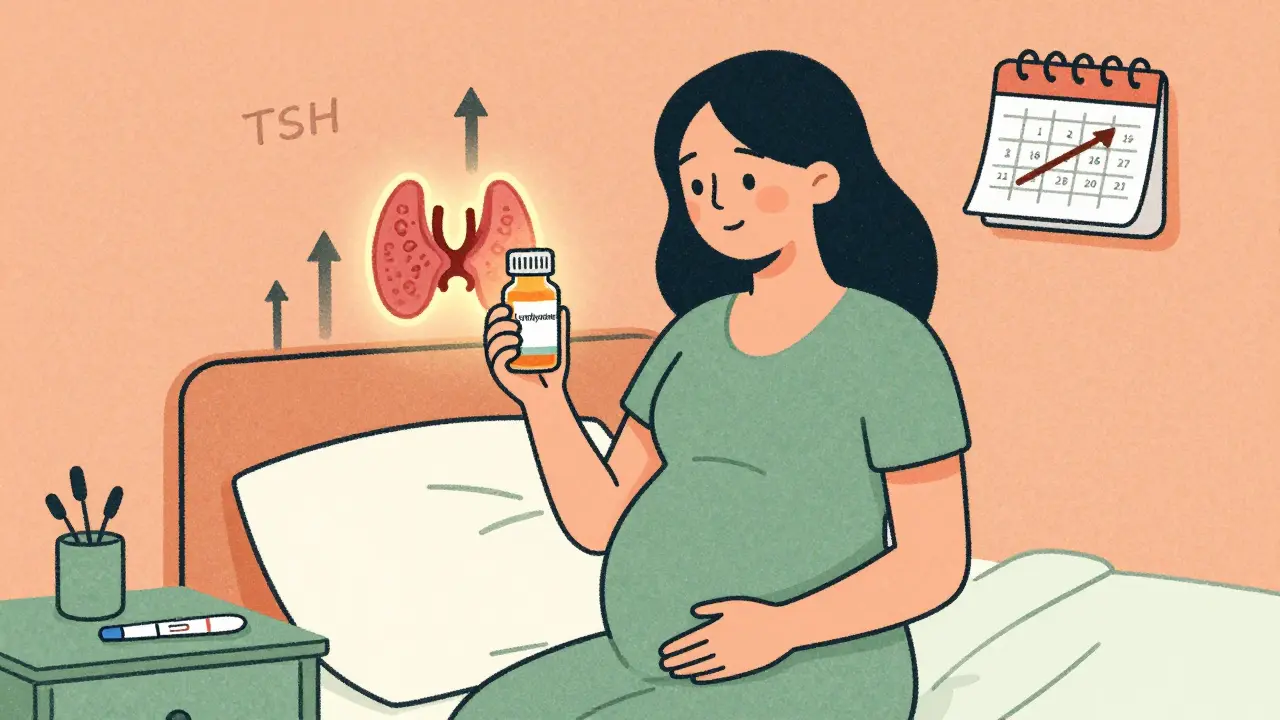
Why Thyroid Medication Matters in Pregnancy
When you're pregnant, your body doesn't just need more food or rest-it needs more thyroid hormone. That’s because your baby relies entirely on your thyroid hormones during the first 10 to 12 weeks of development. Their own thyroid doesn’t start working until then. If your thyroid levels are too low, it can affect your baby’s brain development, increase the risk of miscarriage, or lead to preterm birth. The good news? This is one of the most manageable conditions in pregnancy-if you know what to do.
Levothyroxine (LT4), the synthetic form of thyroid hormone, is the only medication recommended for hypothyroidism during pregnancy. Brands like Synthroid® are commonly used, but the generic version works just as well if taken consistently. What matters isn’t the brand-it’s the dose and how often you get checked.
How Much More Medication Do You Need?
If you were already on levothyroxine before getting pregnant, you’ll likely need more. On average, women increase their dose by 20% to 30% as soon as they find out they’re pregnant. That’s not a suggestion-it’s a medical necessity. The thyroid hormone demand starts rising the moment conception happens, often before a woman even knows she’s pregnant.
A study of 280 women showed their average dose jumped from 85.7 mcg before pregnancy to 100.0 mcg in the first trimester. That’s a 14.3 mcg increase in just a few weeks. For some, that means adding an extra 12.5 to 25 mcg daily. Others may need to increase by 50 mcg right away, especially if their TSH was already high before conception.
Here’s what experts recommend based on your starting TSH level:
- If your TSH is over 10 mIU/L, start at 1.6 mcg per kg of body weight per day.
- If your TSH is between 5 and 10 mIU/L, increase your current dose by 25 to 50 mcg per day.
- If your TSH is over 20 mIU/L, you may need a jump of 75 to 100 mcg per day.
Some doctors suggest taking two extra doses per week instead of increasing daily. For example, if you normally take 100 mcg Monday through Sunday, you’d take 125 mcg on Tuesday and Friday. But this can cause spikes and dips in hormone levels. A better approach is to spread the extra dose evenly across the week-like adding 5 mcg to your daily dose.
When to Adjust Your Dose
Don’t wait for your first prenatal visit. If you’re trying to conceive or think you might be pregnant, talk to your doctor about increasing your dose immediately. Delaying adjustment by even a few weeks can hurt fetal brain development. One study found that women who got their dose adjusted within four weeks of confirmation had 23% fewer preterm births than those who waited.
Many OB/GYNs don’t check thyroid levels at the first appointment. A survey of 150 OB/GYNs found that 68% didn’t routinely test TSH in pregnant women with known hypothyroidism. That means you might need to speak up. Bring your pre-pregnancy dose with you. Ask for a TSH test right away. Don’t let anyone tell you to “wait and see.”
What TSH Levels Are Safe During Pregnancy?
Target TSH levels change with each trimester. The American Thyroid Association (ATA) recommends keeping TSH below 2.5 mIU/L throughout pregnancy. The Endocrine Society allows up to 3.0 mIU/L in the second and third trimesters. But here’s the key point: the stricter the target, the better the outcomes.
Women with TSH above 2.5 mIU/L in the first trimester have a 69% higher risk of miscarriage. That’s not a small number. Even if you feel fine, your baby isn’t. Studies show that children born to mothers with untreated or poorly controlled hypothyroidism score 7 to 10 points lower on IQ tests than those whose mothers had well-managed thyroid levels.
There’s debate among experts. Some argue that TSH up to 4.0 mIU/L is fine in later pregnancy, citing data from Denmark. But most major guidelines, including ACOG and ATA, still push for the tighter target. Why? Because the brain is developing fast in the first trimester-and that’s when you need the most hormone.

How Often Should You Get Tested?
Testing isn’t optional-it’s non-negotiable. You need a TSH blood test every 4 weeks until your dose is stable. That usually means checking at:
- 4 to 6 weeks gestation
- 8 to 10 weeks
- 16 weeks
- 20 to 24 weeks
- 28 to 32 weeks
After that, you can space tests out to every 6 weeks unless your levels start to drift. But if you’re on a new dose, test again in 4 weeks. Don’t assume your dose is right just because you felt fine last time.
Some clinics now use electronic health records that automatically flag pregnant patients and remind doctors to check thyroid levels. But if yours doesn’t, you’ll have to be the one to ask.
How to Take Levothyroxine Correctly
It’s not just about the dose-it’s about how you take it. Levothyroxine is absorbed poorly if you eat too soon after taking it. Take it on an empty stomach, at least 30 to 60 minutes before breakfast. Coffee, calcium, iron, and even soy can block absorption by up to 50%.
If you take prenatal vitamins with iron or calcium, take them at least 4 hours apart from your thyroid pill. Same with antacids, fiber supplements, or multivitamins. Many women don’t realize this and wonder why their TSH keeps creeping up.
Consistency matters too. Take it at the same time every day. If you forget, take it as soon as you remember-unless it’s close to your next dose. Don’t double up.
What About Breastfeeding?
Good news: levothyroxine is safe while breastfeeding. Only tiny amounts pass into breast milk-far less than what a newborn naturally produces. You don’t need to adjust your dose after delivery. In fact, many women go back to their pre-pregnancy dose after giving birth. But wait until your TSH is checked 6 to 8 weeks postpartum before making any changes.
Some women feel exhausted after delivery and assume it’s “baby fatigue.” But if your TSH is high, it could be your thyroid. Don’t ignore it. Postpartum thyroiditis is common, and untreated, it can lead to long-term hypothyroidism.
Real Stories, Real Challenges
One patient on Reddit shared how her OB told her to “wait and see” when she asked for a dose increase at 6 weeks. Her TSH hit 4.2 by 8 weeks. She had to push hard for another increase. She said the anxiety over her baby’s development was worse than the pregnancy itself.
Another woman, who increased her dose the day she got a positive test, kept her TSH perfectly in range. Her daughter scored in the 90th percentile for development at 18 months. That’s not luck-it’s science.
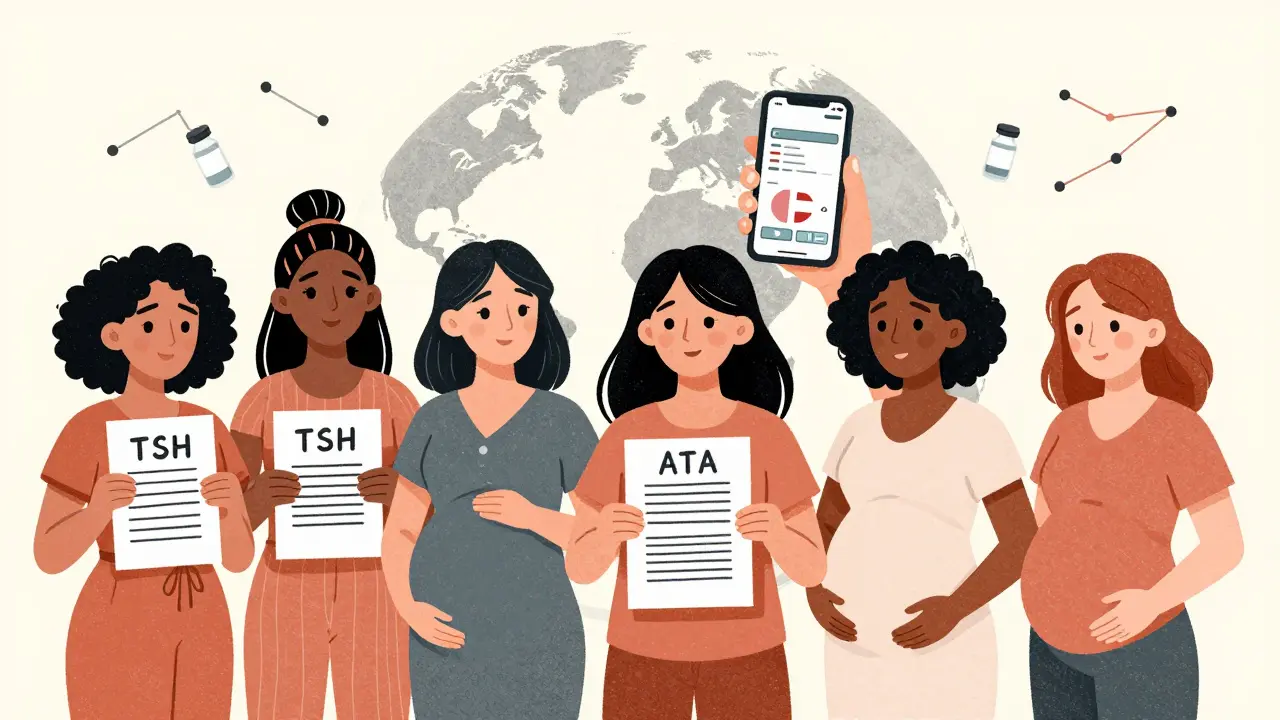
Doctors aren’t always up to date. Only 78% of OB/GYNs follow current thyroid guidelines. That means you might be your own best advocate. Bring printouts from the American Thyroid Association. Ask for specific tests. Don’t settle for vague answers.
What’s New in 2026?
AI is starting to help. A 2022 trial showed that an algorithm using pre-pregnancy TSH, weight, and antibody status predicted the right dose 28% more accurately than standard methods. By 2026, tools like this are becoming more common in clinics.
Also, the WHO now lists levothyroxine as a priority medicine for maternal health. That means more countries are making it available in low-income areas. But globally, 15% of preventable developmental delays still happen because women can’t get consistent access to this simple, life-changing drug.
Universal screening for TSH in early pregnancy is now recommended by the ATA-something they didn’t suggest just a few years ago. That’s a big shift. It means more women will be caught early, before damage is done.
Bottom Line: Do This Now
If you’re pregnant and on thyroid medication:
- Call your doctor today-don’t wait for your next appointment.
- Ask for a TSH test immediately.
- Increase your dose by 20-30% if you haven’t already.
- Take your pill correctly: empty stomach, 30-60 minutes before food, 4 hours away from iron or calcium.
- Test every 4 weeks until your levels are stable.
- Don’t stop-even if you feel fine.
Thyroid disease in pregnancy is not a crisis. It’s a manageable condition-with the right steps. The difference between a healthy baby and a child with developmental delays often comes down to one simple thing: timely dose adjustment. Don’t let a delay cost your child their potential.
franklin hillary
January 31, 2026 AT 15:34
This is the kind of info every pregnant woman needs to hear. If your doc doesn't know this, find a new one. Thyroid isn't optional. Your baby's brain is building itself right now, and it's running on YOUR hormones. No excuses. Get tested. Adjust. Do it now. 🚨
June Richards
February 1, 2026 AT 17:49
Ugh I hate when doctors say 'wait and see.' My OB told me that at 7 weeks. My TSH was 5.8 by 10 weeks. Baby's fine now but I cried for three days. Why is this still not standard care?
Bryan Coleman
February 3, 2026 AT 14:57
I'm a nurse and I've seen this too many times. Women come in with TSH over 10 and no idea they needed to up their dose. It's not that hard. Take the pill on an empty stomach. Don't take iron with it. Test every 4 weeks. Done. Why is this so hard to get across?
Rachel Liew
February 5, 2026 AT 11:30
i just found out im preggo and was on synthroid. i had no clue i needed to up the dose. i called my dr today and they said 'oh yeah, that's normal' and gave me a script for +25mcg. thank you for this post. i feel less alone now. 💛
Sami Sahil
February 6, 2026 AT 20:35
bro this is life changing. i was taking my thyroid med with my morning coffee like a dummy. turned out my TSH was creeping up because of it. now i take it before breakfast with water only. my levels dropped in 2 weeks. dumb move on my part but hey-now i know!
Deep Rank
February 8, 2026 AT 17:30
i mean sure, the science says this, but have you ever considered that maybe the body knows what it's doing? maybe the thyroid slows down because it's conserving energy for the baby? maybe forcing more hormone in is actually disrupting natural balance? i’ve read studies where high-dose LT4 was linked to fetal tachycardia. why aren't we talking about the risks? just saying.
Angel Fitzpatrick
February 9, 2026 AT 21:26
Let me guess-Big Pharma paid the ATA to push this. Levothyroxine is a billion-dollar drug. They don't want you to know that selenium, iodine, and ancestral diets can regulate thyroid naturally. They want you dependent. And now they're pushing 'universal screening' so they can monetize every pregnant woman. Wake up. This isn't medicine-it's a business model.
Naresh L
February 9, 2026 AT 22:49
There's a quiet truth here: medicine moves slowly. But biology doesn't wait. The fact that a fetus relies on maternal T4 for neurodevelopment is not a suggestion-it's a law of physiology. The real tragedy isn't the dose adjustment-it's the women who never find out until it's too late. We need to stop treating this like a footnote and start treating it like the critical lifeline it is.
Ishmael brown
February 11, 2026 AT 06:57
I’m just here for the drama 😂 my OB told me to ‘eat more seaweed’ instead of increasing my dose. I did. My TSH went to 11. I had to beg for a referral. Now I’m on 150mcg and my baby’s kicking like a soccer champ. 🍍
Lu Gao
February 11, 2026 AT 13:10
The claim that 'generic levothyroxine works just as well' is misleading. Bioequivalence doesn't mean bio-identical. I switched brands three times during pregnancy and each time my TSH drifted. Consistency > cost. If you're going to risk your child's neurodevelopment, at least do it with the brand your body tolerates.
vivian papadatu
February 12, 2026 AT 03:15
I'm from a country where thyroid meds aren't always available. I had to get mine shipped from the US. I didn't know about the 20-30% increase until I found this post. I wish I'd known sooner. My daughter is 2 now and hitting every milestone. I'm so grateful for people sharing this. Thank you.
Melissa Melville
February 13, 2026 AT 21:13
So let me get this straight-we're telling women to take a synthetic hormone, adjust it based on arbitrary numbers, and then blame them if their kid has a learning disability? What about all the women who can't afford tests? Or who live in places with no endocrinologists? This feels like blaming the victim while the system stays broken.
Chris & Kara Cutler
February 14, 2026 AT 12:35
DO IT. DO IT NOW. 💪 Your baby's brain is counting on you. No excuses. No waiting. Test. Adjust. Take it right. You got this.
Lilliana Lowe
February 16, 2026 AT 01:02
The Endocrine Society’s allowance of 3.0 mIU/L in later trimesters is a scientifically indefensible compromise. The ATA’s 2.5 threshold is grounded in neurodevelopmental outcomes, not convenience. To suggest otherwise is to prioritize administrative ease over fetal neurology. This is not a debate-it is a clinical imperative.