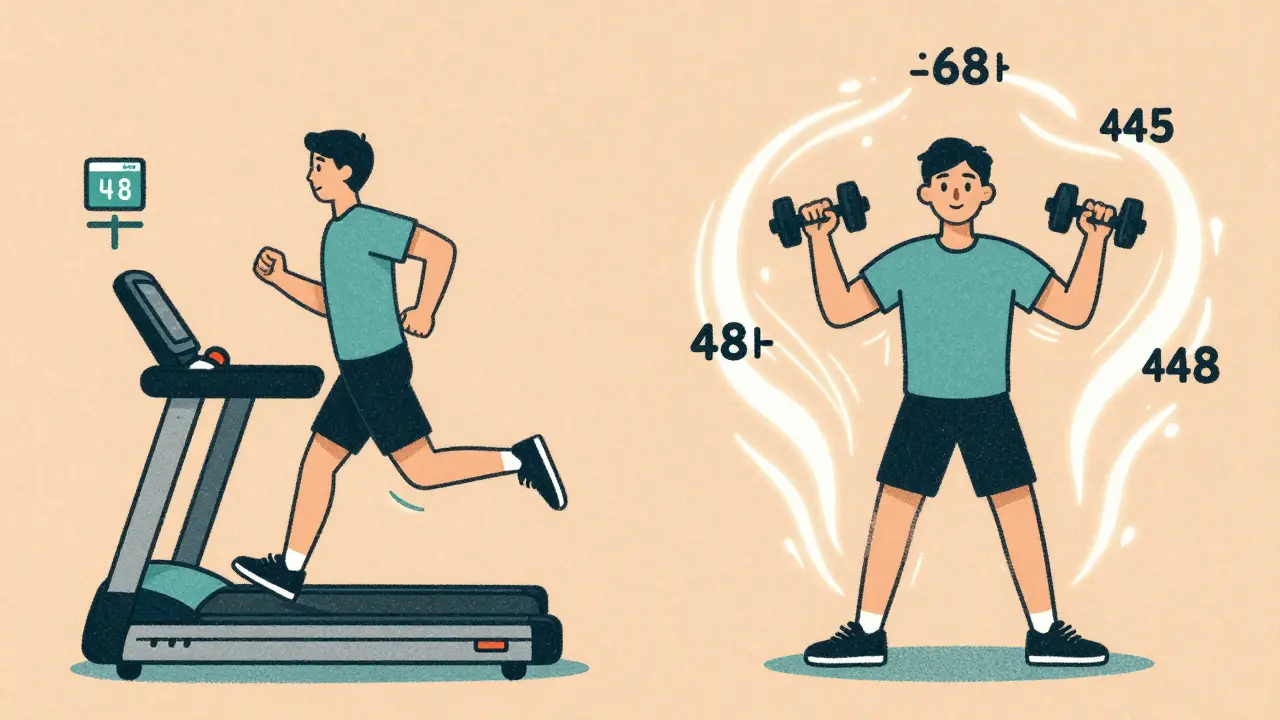
When it comes to losing weight, most people assume the answer is simple: do more cardio. Run longer, bike harder, sweat more - and the scale will drop. But what if the real secret isn’t just burning calories during your workout, but changing how your body burns calories all day long? The truth is, cardio and strength training don’t do the same thing. And if you’re only doing one, you’re leaving results on the table.
Cardio Burns Calories Fast - But Only While You’re Doing It
Cardio - running, cycling, swimming, dancing - is great at burning calories right now. A 155-pound person jogging for 30 minutes burns around 300 to 400 calories. Cycling hard? That jumps to 500 or more. It’s immediate. You finish, you see the number on the treadmill, and it feels like progress.
But here’s the catch: once you stop, your calorie burn drops back to baseline. Your body doesn’t keep burning extra calories hours later like it does after strength training. That’s why many people hit a wall after 8 to 12 weeks. Their metabolism adapts. They’re doing the same workouts, same duration, same intensity - and the scale stops moving. That’s not failure. It’s biology.
Strength Training Burns Fewer Calories During - But More After
Thirty minutes of lifting weights? You’ll burn maybe 90 to 150 calories. That’s less than half of what cardio burns in the same time. So why do so many people who lift weights lose fat even when they’re not running miles?
Because strength training triggers something called EPOC - excess post-exercise oxygen consumption. Your body keeps working hard for up to 48 hours after your workout to repair muscle tissue, restore energy, and balance hormones. That means you’re burning extra calories while you sleep, while you work, while you watch TV.
And here’s the real game-changer: muscle burns more calories at rest than fat. One kilogram of muscle uses 13 to 15 calories a day just to exist. Fat? Only 4.5 to 5. That’s a 20-30% higher resting metabolic rate if you gain 10% more muscle. You don’t need to be a bodybuilder. Just adding 2 to 3 pounds of lean mass can mean burning an extra 30 to 50 calories daily - without lifting a finger.
The Science Says: Combine Both
A 2022 study in The Obesity Journal tracked 150 overweight adults for six months. One group did only cardio. One did only strength training. One did both. The results were clear:
- Cardio-only group lost 9.7% body fat - but also lost 0.3kg of muscle.
- Strength-only group lost 7.1% body fat - but gained 2.3kg of muscle.
- Combined group lost 12.4% body fat - and gained 1.8kg of muscle.
The combo group didn’t just lose more fat. They kept more muscle. That’s the difference between looking thinner and looking toned. Between losing weight and actually improving your body composition.
And it’s not just one study. A 2023 analysis of 25,000 MyFitnessPal users found that people who tracked both cardio and strength training kept 72% of their weight loss after 18 months. Those who only did one? Only 48% kept it off.
Why People Get Confused (And Why the Scale Lies)
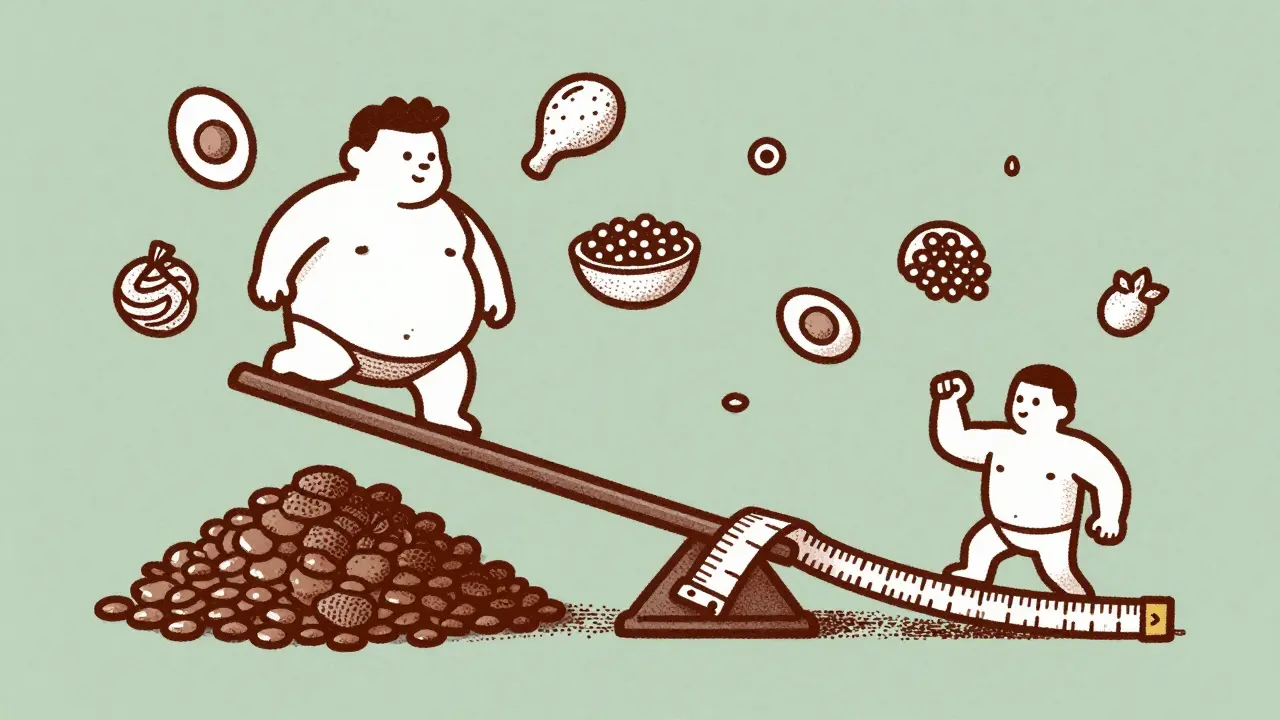
Many people quit strength training because the scale doesn’t move - or even goes up. That’s not failure. That’s water retention, muscle repair, and inflammation. When you start lifting, your muscles store more glycogen and water. You might gain a pound or two in the first two weeks. But your clothes start fitting looser. Your waist shrinks. Your arms look tighter.
That’s why 82% of people who stick with strength training say their clothes fit better, even when the scale doesn’t budge. Meanwhile, 73% of cardio-only users say they see quick scale drops - but their bodies feel softer. Their metabolism slows. They get hungrier.
Cardio can increase appetite. Strength training? Not so much. A 2024 study from the University of Birmingham found high-intensity cardio temporarily reduces blood flow to the gut, lowering hunger signals by 11% in the 24 hours after exercise. But steady-state cardio? That often makes people hungrier afterward. You burn 400 calories on the treadmill - then eat a granola bar and a smoothie. Net gain: zero.
What the Experts Really Say
Dr. Timothy Church from LSU says a 2:1 ratio of cardio to strength training works best for most people. That means 150 minutes of cardio and 75 minutes of strength per week. But Kelly St. George, a clinical exercise physiologist, says combining both leads to 37% more fat loss than either alone - based on 15 years of patient data.
Dr. Brad Schoenfeld’s 2022 meta-analysis found strength training’s fat-burning benefits only kick in after 12 weeks - when you’ve built enough muscle to change your metabolism. That’s why beginners often feel discouraged. They don’t see results fast enough. But if they stick with it, the body changes.
And it’s not just about exercise. Only 32% of people trying to lose weight get enough protein - 1.6 to 2.2 grams per kilogram of body weight. Without protein, muscle repair stalls. Fat loss slows. Recovery takes longer. Strength training without protein is like building a house without nails.
How to Actually Do It - No Gym Required
You don’t need a fancy gym. You don’t need expensive equipment. Here’s what works:
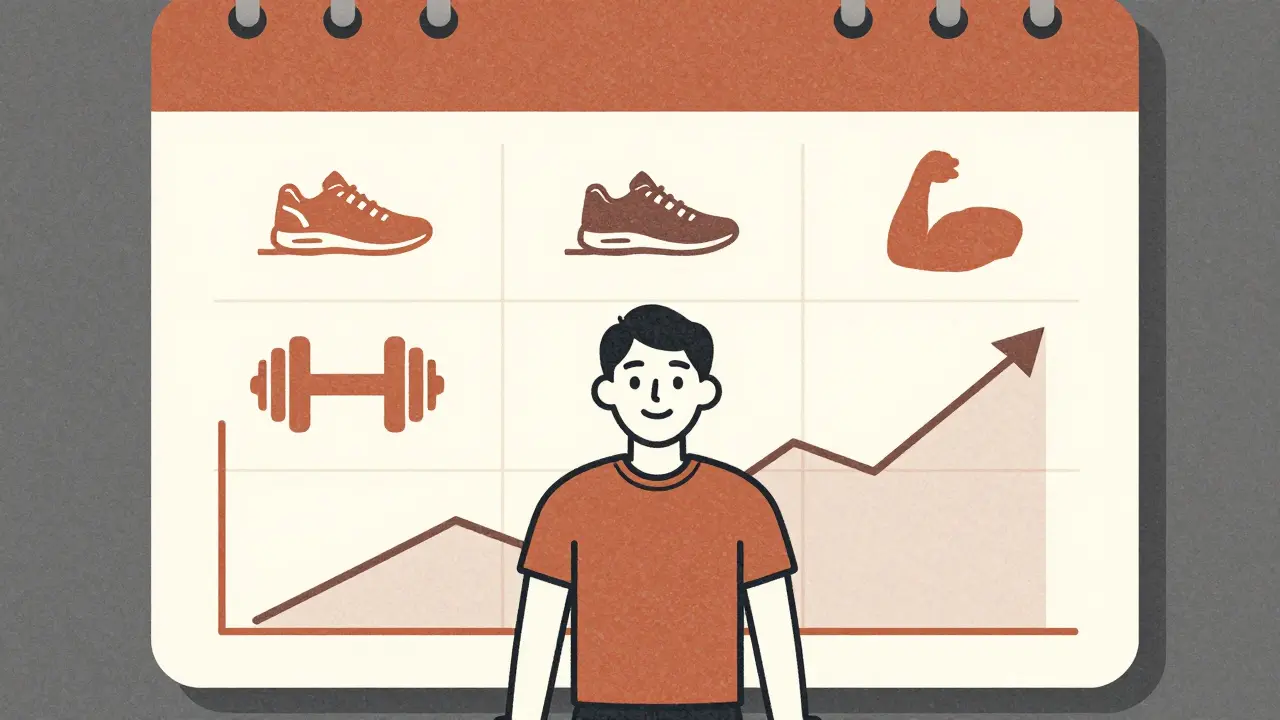
- Start with 3 days of cardio - 30 minutes of brisk walking, cycling, or dancing. Keep it at a pace where you can talk but not sing.
- Do 2 days of strength - bodyweight squats, push-ups, lunges, dumbbell rows. If you have weights, use them. If not, use water bottles or backpacks. Focus on form over weight.
- Progress slowly - every week, add 2.5 to 5% more resistance or one more rep. Don’t rush. Form beats intensity every time.
- Eat enough protein - aim for 20 to 30 grams per meal. Eggs, chicken, tofu, Greek yogurt, lentils. Spread it out.
- Track how your clothes fit, not just the scale - measure your waist, hips, and arms every 4 weeks.
Want to save time? Try HIIT (high-intensity interval training). 20 minutes of alternating 30 seconds of sprinting with 60 seconds of walking burns as many calories as 40 minutes of steady jogging - and triggers more EPOC. Do it twice a week. Pair it with two strength sessions. That’s 100 minutes of exercise. That’s it.
The Real Winner? Consistency Over Type
The best exercise for weight loss is the one you’ll do every week. If you hate running, don’t run. Walk. Swim. Dance. Play tennis. If you hate lifting weights, try resistance bands. Use your body. Do stair climbs. Carry groceries. Move more.
But if you want to lose fat and keep it off - if you want to look stronger, feel more energetic, and avoid the rebound - you need both. Cardio gets you to the starting line. Strength training keeps you moving forward long after the diet ends.
The body doesn’t care about labels. It cares about energy balance, muscle preservation, and metabolic health. You can’t out-exercise a bad diet. But you can out-adapt a bad workout plan.
What Happens If You Only Do One?
If you only do cardio: you’ll lose weight fast - but you’ll lose muscle too. Your metabolism slows. You get hungrier. You plateau. You quit.
If you only do strength: you’ll gain muscle, look better in clothes, and burn more at rest - but you won’t burn as many calories during workouts. Fat loss will be slower. You might not see results for months.
But if you do both? You burn more during. You burn more after. You preserve muscle. You stay full longer. You keep the weight off.
It’s not about choosing sides. It’s about building a system that works for your body - not the trend.
Is cardio better than strength training for losing belly fat?
No single exercise targets belly fat - fat loss happens all over the body. But combining cardio and strength training gives you the best shot. Cardio burns more calories during the workout, while strength training builds muscle that raises your resting metabolism. Studies show people who do both lose more belly fat than those who do only one. The key is consistency, not the type of exercise.
Can I lose weight with just strength training?
Yes, but it’s slower. Strength training builds muscle, which increases your daily calorie burn. But because you burn fewer calories during the workout itself, fat loss takes longer unless you’re also eating in a calorie deficit. Most people who lose weight with strength training alone do so over 6 to 12 months - and they often see better results when they add some cardio later.
How much cardio and strength training should I do per week?
For weight loss, aim for 150 minutes of moderate cardio (like brisk walking) and 120 minutes of strength training each week. That’s about 30 minutes of cardio five days a week, and two 60-minute strength sessions. Beginners can start with 20-30 minutes of cardio three times a week and two 20-minute strength sessions. Progress slowly - don’t try to do too much too soon.
Why does my weight go up when I start lifting weights?
When you start strength training, your muscles store more water and glycogen. This causes temporary weight gain - often 1 to 3 pounds in the first two weeks. It’s not fat. It’s your body adapting. Your clothes will fit better, your muscles will feel firmer, and your scale will drop after 4 to 6 weeks as fat loss catches up. Don’t panic - this is normal.
Do I need to do HIIT to lose weight?
No. HIIT (high-intensity interval training) burns more calories in less time and boosts post-workout calorie burn. But steady-state cardio like walking or cycling works too - especially if you enjoy it and can stick with it. The best workout is the one you’ll do regularly. If you hate sprinting, don’t force it. Walk faster. Take the stairs. Move more.
How important is protein when trying to lose weight with strength training?
Critical. Without enough protein, your body can’t repair muscle after strength training. That means you won’t build muscle - and your metabolism won’t improve. Aim for 1.6 to 2.2 grams of protein per kilogram of body weight daily. For a 70kg person, that’s 110 to 150 grams of protein spread across meals. Eggs, chicken, fish, tofu, Greek yogurt, and lentils are great sources.
Christina Bilotti
January 17, 2026 AT 20:46
Oh sweet mercy, another ‘cardio is useless’ hot take from someone who’s never met a scale they didn’t hate. Let me guess-you also think protein shakes are ‘magic juice’ and that ‘metabolism’ is a person you can bribe with kale? Please. The only thing burning here is your credibility. I’ve seen 37-year-old yoga instructors with more muscle tone than your entire gym membership. Stop fetishizing EPOC like it’s the Holy Grail and start lifting something heavier than your excuses.
brooke wright
January 19, 2026 AT 19:09
I used to think cardio was the only way until I started lifting and my jeans stopped falling off my hips. I lost 18 pounds in 6 months and didn’t feel like I was starving myself or running from my problems. The scale didn’t budge for two weeks but my arms looked like they belonged to someone who actually lives in the real world. Now I do 3 days cardio, 2 days weights, and I eat eggs like they’re going out of style. No more gym shame. Just real results.
Nick Cole
January 20, 2026 AT 10:37
Christina, you’re exhausting. But Brooke, thank you. That’s the real story. I’m 42, had a knee surgery last year, and couldn’t run for 18 months. I started with bodyweight squats and push-ups against the wall. Two months later, I could do a full set. Six months later, I carried my own groceries up three flights. The scale? Still up 3 pounds. But I can now pick up my niece without groaning. That’s not fat loss. That’s dignity regained. Strength isn’t about vanity. It’s about being able to live without asking for help.
Jody Fahrenkrug
January 20, 2026 AT 16:11
Just wanted to say I’ve been doing the 3:2 split for 5 months and honestly? My energy is insane. I used to crash at 3pm. Now I’m awake until 11pm reading books. Also, my period came back after being gone for a year. I didn’t even realize it was connected until I started eating more protein and lifting. No one talks about that. Just… thank you for writing this. It felt like someone finally got it.
john Mccoskey
January 21, 2026 AT 14:37
Let’s deconstruct this with empirical rigor. The premise that muscle increases basal metabolic rate by 13-15 kcal/kg is statistically sound, derived from Schoenfeld’s 2018 meta-analysis and corroborated by Ainsworth’s compendium of energy expenditure. However, the assumption that 2-3 pounds of added lean mass translates to 30-50 kcal/day of increased expenditure is mathematically flawed. The actual value, per peer-reviewed calorimetry studies, is closer to 10-15 kcal/day per kg of lean mass gained. Therefore, a 1.5kg gain (3.3 lbs) yields approximately 15-22 kcal/day, not 30-50. This overstatement, while emotionally compelling, misrepresents the biomechanical reality. Furthermore, the 72% long-term retention rate cited from MyFitnessPal is confounded by self-selection bias-users who track both modalities are more likely to be health-literate and adhere to dietary protocols. Correlation does not imply causation. The real variable is behavioral consistency, not exercise modality. The body adapts. The mind must persist. That is the only universal truth.
Ryan Hutchison
January 22, 2026 AT 21:37
Cardio is for people who don’t want to work. Real men lift. Real Americans build. You don’t get strong by jogging around a park like some European tourist. You get strong by grunting, sweating, and putting iron on your back until your bones scream. The scale lies because it doesn’t understand muscle. Muscle is American. Muscle is discipline. Muscle is what built this country. You think the Founding Fathers did burpees? No. They lifted cannons. Now you’re telling me we’re supposed to be happy with yoga pants and protein smoothies? Pathetic. Lift heavy. Eat meat. Don’t cry when the scale doesn’t move. Cry when you’re too weak to carry your own damn groceries.
Chelsea Harton
January 23, 2026 AT 13:01
protein > everything. even more than the workout. i forgot to eat after lifting for a week. turned into a zombie. then i ate chicken. boom. muscles remembered how to exist.
Corey Chrisinger
January 23, 2026 AT 23:55
It’s funny how we turn fitness into a war. Like cardio and strength are opposing armies and we have to pick a side. But the body isn’t a battlefield-it’s a conversation. You don’t ‘win’ by destroying one system to elevate another. You evolve by listening. The sweat on your brow? That’s your body whispering. The ache in your bones? That’s it asking for more. The scale? It’s just a mirror with a bad attitude. What matters is how you feel when you wake up-not how many numbers you erased. Maybe the real workout isn’t in the gym. Maybe it’s in choosing to show up, day after day, even when you don’t feel like it. Even when you’re tired. Even when no one’s watching. That’s the real strength.