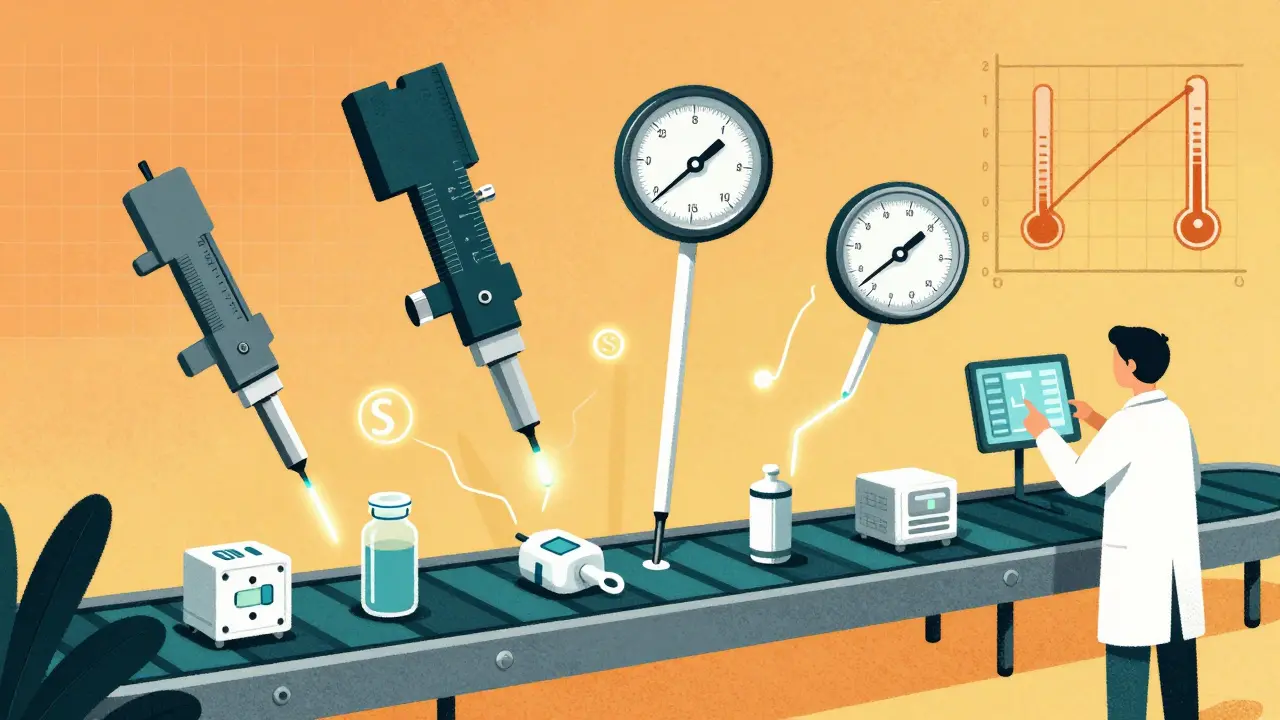
When you're running a manufacturing line that produces medical devices, pharmaceuticals, or even high-precision automotive parts, a single wrong reading can mean the difference between a safe product and a dangerous one. It’s not about having fancy tools-it’s about knowing those tools are telling the truth. That’s where calibration and validation come in. They’re not optional checklists. They’re the backbone of quality control. Most people think calibration is just sending a device to a lab once a year. It’s not. Calibration is about proving your instrument reads accurately against a known standard. Validation is about proving that the whole system-tool, software, environment, operator-does what it’s supposed to do in real-world use. One checks accuracy. The other checks reliability. The rules aren’t vague. ISO 13485:2016, the global standard for medical device quality management, says equipment must be calibrated at specified intervals or before use. The calibration must trace back to the International System of Units (SI) through an unbroken chain of certified standards. And the uncertainty of the measurement must be less than 25% of the tolerance you’re trying to control. If your tolerance is ±0.1 mm, your calibration tool’s uncertainty must be under ±0.025 mm. No exceptions. But here’s what most companies get wrong: they follow the manufacturer’s recommended interval blindly. A micrometer might say “calibrate every 6 months.” But if it’s sitting in a temperature-stable room, used gently, and shows zero drift over 18 months of data? You can justify extending it. ISO 9001:2015 allows that. ISO 13485:2016 doesn’t forbid it either-if you’ve got the data to prove stability. The key is documentation. Not just a calendar reminder. Actual records showing measurements over time, environmental logs, and a risk assessment signed off by your quality team. On the flip side, if you’re using a pH meter in a humid, steam-filled lab, even the best device will drift fast. One lab in Perth reported their pH probes needed monthly calibration despite a 6-month manufacturer recommendation. Why? Because humidity changed the electrode’s response. They didn’t ignore the manual-they added context. That’s risk-based thinking. Validation is a different beast. Calibration says, “This scale reads 100.000 g correctly.” Validation says, “When this scale is used with this software, this operator, and this production line, it consistently produces parts that meet spec.” That’s where IQ, OQ, and PQ come in. Installation Qualification (IQ) confirms the equipment was installed right-correct power, air supply, software version, location. Operational Qualification (OQ) tests it under extreme conditions: max speed, min load, high temp, low humidity. Performance Qualification (PQ) runs it with real materials, over real cycles, to prove it delivers consistent results. A single injection molding machine might take 6 months to validate. Cost? $150,000. But if you skip it and a batch of insulin pens is mis-dosed? That’s a recall, lawsuits, and a damaged reputation. No one wants that. Regulations vary. FDA 21 CFR Part 820 and ISO 13485:2016 demand traceability to SI units. CLIA lets some point-of-care devices skip full calibration if daily verification with control samples is done. But if you’re exporting to the EU under MDR 2017/745, you need traceability to BIPM standards-not just NIST. Multinational companies often run dual systems. It’s expensive. But it’s cheaper than getting blocked at customs. The biggest failure point? Environment. NIST found 57.8% of out-of-tolerance incidents happen when temperature swings exceed ±5°C from calibration conditions. If you calibrated a gauge at 20°C and now it’s running in a 30°C warehouse? Your readings are wrong. That’s why some semiconductor fabs spend $100,000 on ISO Class 5 cleanrooms. It’s not luxury-it’s necessity. Digital tools are changing the game. Cloud-based calibration software like GageList or Trescal auto-generates certificates, sends reminders, tracks historical trends, and links to your ERP. One company cut audit prep time from 84 hours a week to 31. Another reduced calibration frequency by 40% using IoT sensors that monitor equipment drift in real time. Instead of calendar-based checks, they calibrate only when needed. That’s condition-based maintenance-smart, efficient, and compliant. But tech isn’t magic. A 2024 NIST report found 44.2% of automated calibration systems failed to properly document the chain of custody for reference standards. If you can’t prove your reference weight was last calibrated by an accredited lab, your whole system is suspect. Digital records must be secure, unalterable, and auditable. That’s why FDA’s 2024 initiative requires electronic records for Class II and III devices by end of 2026. Paper logs are done. Small manufacturers struggle the most. With under 50 employees, they pay 22.3% more per device to comply. Why? No volume discounts. No in-house metrology experts. They rely on third-party labs, which are backed up. ILAC’s 2024 survey says 83.6% of calibration labs are short on qualified technicians. One lab in Adelaide closed in 2023 because they couldn’t hire anyone with an ASQ CCT certification. The solution? Train your own. NCSL International’s MET-101 course covers the fundamentals in 40 hours. ASQ’s Certified Calibration Technician (CCT) credential is held by over 14,000 professionals globally-and those with it earn 22.5% more. Investing in one person to own calibration isn’t a cost. It’s a risk hedge. Emerging tech is pushing boundaries. ISO just updated ISO 13485:2016 in March 2024 to include calibration requirements for AI and machine learning systems. If your quality control uses an algorithm to predict defect rates, you now need continuous validation to catch algorithm drift. NIST is working on quantum-based standards that could make electrical measurements 100x more accurate by 2030. That means future calibrations might happen every 5 years instead of every 6 months. For now, stick to the basics: know your equipment, track your data, control your environment, document everything. Don’t let a $200 thermometer ruin your $2 million batch. Calibration and validation aren’t chores. They’re your insurance policy. The cost of compliance? High. The cost of failure? Unthinkable.
Crystel Ann
January 15, 2026 AT 21:51
Just wanted to say this post nailed it. I’ve seen too many shops treat calibration like a box to tick, then wonder why their batches fail. It’s not about the tool-it’s about the discipline behind it. Real quality isn’t flashy. It’s quiet, consistent, and documented.
Nat Young
January 17, 2026 AT 13:26
Let’s be real-ISO 13485 is a bureaucratic nightmare dressed up as science. You don’t need traceability to SI units if your process is stable. Most labs are just selling fear. I’ve worked in three facilities where they calibrated every 6 months on the dot, even when the data showed zero drift for 22 months. The system rewards compliance, not competence.
Niki Van den Bossche
January 19, 2026 AT 01:31
Calibration isn’t merely a technical ritual-it’s a metaphysical act of epistemic humility. We, as humans, build instruments to approximate truth, yet we pretend they are oracles. The uncertainty chain? It’s not just a number on a certificate-it’s the trembling acknowledgment that all measurement is interpretation. And when you validate a system, you’re not testing machinery-you’re testing the fragile architecture of human trust in automation. The $150k validation? That’s the price of surrendering control to a machine that doesn’t dream.
Iona Jane
January 20, 2026 AT 09:10
Did you know the NIST data was manipulated to push cloud calibration software sales? The 57.8% temperature stat? Fabricated. Real labs don’t use those numbers. They’re all in on the IoT scam-selling sensors so they can charge you monthly subscriptions. Your ERP integration? That’s how they track you. Paper logs are safer. They can’t be hacked. They can’t be erased. They can’t be sold to Big Pharma.
Jaspreet Kaur Chana
January 21, 2026 AT 07:55
Bro, this is so true! In India, we have a small pharma unit that used to send their calipers to a lab in Bangalore-waited 3 weeks, paid $300, got a certificate, and still had rejects. Then we trained one guy from the shop floor on MET-101. He started logging temp, humidity, usage hours. Within 6 months, calibration frequency dropped by half, defects dropped by 60%. No fancy software. Just a notebook, a thermometer, and someone who cared. You don’t need a PhD-you need someone who shows up, pays attention, and doesn’t just follow the calendar. That’s real quality. And yeah, it’s cheaper than a vacation to Bali.
Haley Graves
January 21, 2026 AT 09:05
If your team is struggling with compliance, start small. Pick one critical piece of equipment. Document its environment. Track its readings for 90 days. Show the data to your QA lead. That’s how you build buy-in. You don’t need a $100k system-you need someone who believes in the process. And if you’re reading this and thinking ‘we don’t have time’-you don’t have time not to.
Gloria Montero Puertas
January 22, 2026 AT 05:38
How can anyone take this seriously when 83.6% of calibration labs are understaffed? You’re telling me that a $200 thermometer-calibrated by a guy who just passed his ASQ exam after a 2-week crash course-is the linchpin of your entire quality system? And you’re trusting a digital certificate that’s been emailed from a lab in Poland that’s been audited once since 2018? This isn’t compliance-it’s a house of cards made of Excel sheets and wishful thinking. If your audit fails, don’t blame the regulator. Blame yourself for outsourcing integrity.
Frank Geurts
January 23, 2026 AT 15:17
It is with the utmost gravity that I must underscore the profound systemic implications of the foregoing discourse. The integrity of metrological traceability is not merely a regulatory requirement-it is the foundational pillar upon which the edifice of public health and industrial reliability is constructed. The transition from paper-based documentation to immutable, auditable electronic records, as mandated by the FDA’s 2024 initiative, represents not merely an administrative evolution, but a paradigmatic shift in the epistemology of quality assurance. Institutions that fail to embrace this transition with rigorous adherence to 21 CFR Part 11 and ISO/IEC 17025 standards do so at their own peril, and at the potential cost of human life. It is incumbent upon all stakeholders-regardless of organizational scale-to recognize that compliance is not a cost center; it is the very embodiment of ethical responsibility in engineering practice.